.jpg)
Padise Abbey
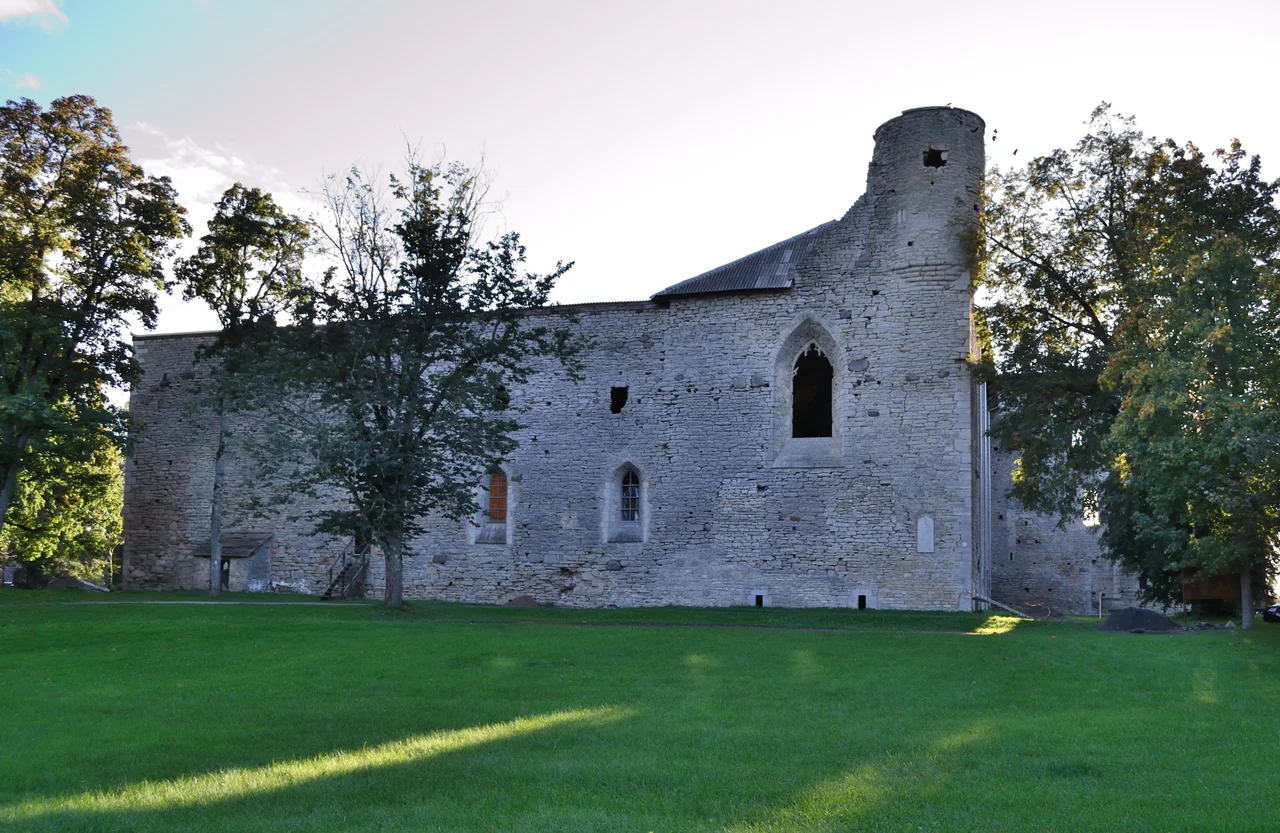
The monks arrived in 1310 with nowhere else to go. Five years earlier, the Teutonic Knights had seized their home at Dünamünde Abbey near Riga and turned them out into the world. King Eric VI of Denmark, who still ruled this corner of Estonia, gave them permission to build again — this time on the marshy, forested land at Padise. They took thirty-five years to finish the church, paused only by a peasant uprising that killed twenty-eight of them. The walls they raised still stand, even after fortresses and country houses came and went on top of them.
Refugees in Stone
Cistercian monks had a knack for choosing difficult sites. Their order specialized in turning useless land into productive estates — draining swamps, clearing forest, building mills. The brothers who arrived at Padise from Latvia had already proven this once. Now, dispossessed and starting from nothing, they were doing it again. Stone construction did not begin until 1317. By 1343, when the St. George's Night Uprising swept across Estonia, the abbey was still only half-built. Estonian peasants, rising against their German overlords, attacked the monastery and killed the twenty-eight monks, lay brothers, and German vassals living inside. Rebuilding had to wait nearly three more decades. The vaulted church the monks finally consecrated in 1448 represented the patient work of seven generations.
A Century of Quiet Wealth
By 1400 Padise was rich. The abbey owned estates throughout Harju County and across the Gulf of Finland in southern Finland — vast holdings worked by tenant farmers and managed from this remote scriptorium. For roughly a hundred years, Padise was one of the most influential spiritual centers in Estonia. The monks rang Estonia's oldest church bell, cast in the 14th century and still surviving today at the Lutheran Church of the Holy Cross in nearby Risti. They survived the upheavals of the 1520s Reformation, when so many Catholic houses across Europe were dissolved. From around 1500 they had begun selling off lands; the great age was already passing. But Padise continued, smaller and quieter, into the middle of the next century.
From Abbey to Fortress
The Livonian War ended Padise as a place of prayer. In 1558, fearing that invading Russian forces or rival Swedish troops would seize the abbey, the last Master of the Livonian Order, Gotthard Kettler, occupied it himself. A year later he simply dissolved it — ejecting the remaining monks, confiscating the buildings, and converting the consecrated complex into a fortress. The Swedes took it from him in 1561. The Russians besieged and captured it in 1576, strengthening the fortifications during their occupation. Then in 1580 the Swedes returned and bombarded their way back inside after a long siege. In twenty-two years the abbey changed hands four times, and the prayer of monks gave way permanently to the noise of cannon.
What the Forest Kept
After the wars Padise served quieter purposes — a country house until 1766, then slow abandonment to the elements. The roof fell. The forest crept in. For two centuries the abbey was a romantic ruin in the Estonian countryside, the kind that Baltic German poets liked to visit and sketch. Today partial restoration has stabilized the walls, and a small museum tells the story to visitors who find their way down the country road from Tallinn. Renovation work in 2020 turned up new findings, archaeologists still pulling fragments of the medieval life out of the rubble. The bell-tower is gone. The church bell sits in another building. But the gatehouse, the moat, the convent walls — these survived everything that history threw at them.
From the Air
Padise Abbey lies at 59.23°N, 24.14°E, roughly 50 km southwest of Tallinn near the Gulf of Finland coast. From cruising altitude the ruins appear as pale stonework against forest, surrounded by a moat. Best viewed from 3,000 to 6,000 ft on approach to or from EETN (Tallinn Airport, 40 km east). Other useful airports: EFHK (Helsinki Vantaa, 90 km north across the Gulf of Finland) and EVRA (Riga, 320 km south). The site is photogenic in low winter sun when shadows pick out the wall lines.
Nearby Stories
- Estonian Open Air Museum 2.5 km away
- Spithami 7.8 km away
- Peter the Great's Naval Fortress 18 km away
- Russian Battleship Slava 26 km away
- Battle of Lyndanisse 33 km away
- German submarine U-745 33 km away
- Battle of Moon Sound 48 km away
- Siege of Fellin (1560) 82 km away