
Battle of Lyndanisse
Right after supper, on the long evening of 15 June 1219, the Estonians attacked from five directions at once. They had spent days sending negotiators to the Danish camp at Lindanise, a low headland on the northern coast of Estonia where King Valdemar II had landed two weeks earlier with an army of crusaders. The negotiators had come, the Danes assumed, to discuss the terms of their submission to the Pope and his northern holy war. The Estonians were buying time. While their ambassadors talked, an Estonian army was assembling in the forests behind the new Danish castle. When it came down on the crusaders at suppertime, it nearly threw them into the Baltic.
The crusade against the last pagans
By the early thirteenth century the Estonians were one of the last European peoples who had not converted to Christianity. They lived in a network of self-governing parishes along the eastern Baltic, fishing, farming, and trading amber and furs through the merchant towns of the German Hansa. Their religion was older than written history — sky gods, sacred groves, the spirits of place. To the Catholic powers of Europe, this made them targets. In a series of papal bulls beginning in 1199, Rome had declared open season on the pagans of the Baltic, granting the same indulgences for killing Estonians, Livonians, and Prussians as for fighting Saracens in the Holy Land. German crusader orders moved up from Riga. The Swedes pushed in from the west. King Valdemar II of Denmark, one of the most powerful monarchs in northern Europe, took up the call from Pope Honorius III and sailed for Revalia in early June 1219 with an army that included Archbishop Anders Sunesen of Lund, Bishop Theoderich von Treyden, and the Slavic Wendish vassals of Vitslav I of Rügen.
Castrum Danorum
The Danes landed at Lindanise on a low limestone bluff overlooking what is now Tallinn Bay. They built a wooden castle, which they called Castrum Danorum — the Danish Castle. According to a much later legend, the local Estonians began to call the place Taani linna, Danish town, the name that supposedly contracted over the centuries into Tallinn. (The historical evidence for this is thin; Tallinn probably derives from Estonian words meaning Danish-town independently, or possibly from an older local name. But the story sticks because the bones of it are true: the Danes built here, and the Estonian name remembers them.) The Estonians did not intend to let the castle stand. Their parishes had a long tradition of acting collectively in defense, and they assembled an army from across the surrounding regions. They sent embassies to the Danish camp to discuss terms. The Danes, secure behind their new walls, took the negotiations at face value.
Five attacks at suppertime
The assault came in the long Baltic twilight of midsummer, when the sun barely sets at 59 degrees north. Five Estonian columns came out of the woods at once, in different directions, into a Danish camp that was eating its evening meal. The crusaders broke. They ran in scattered groups for the ships and the castle gates. Bishop Theoderich von Treyden, identified by the Estonians from his rich vestments, was killed in the first rush — they thought, evidently, that they had cut down the king himself. The Danish line was on the verge of collapse. What saved the crusaders was the cool nerve of one of Valdemar's vassals: Vitslav I of Rügen, prince of the Wends — a Slavic people from the southern Baltic islands whose loyalties were as transactional as everyone else's in this war — led a quick counterattack with his own troops that stopped the Estonian advance long enough for the Danes to regroup. Once the lines stabilized, the better-equipped crusaders pushed back. The Estonians, who had committed everything to the surprise, were eventually routed.
The flag from heaven
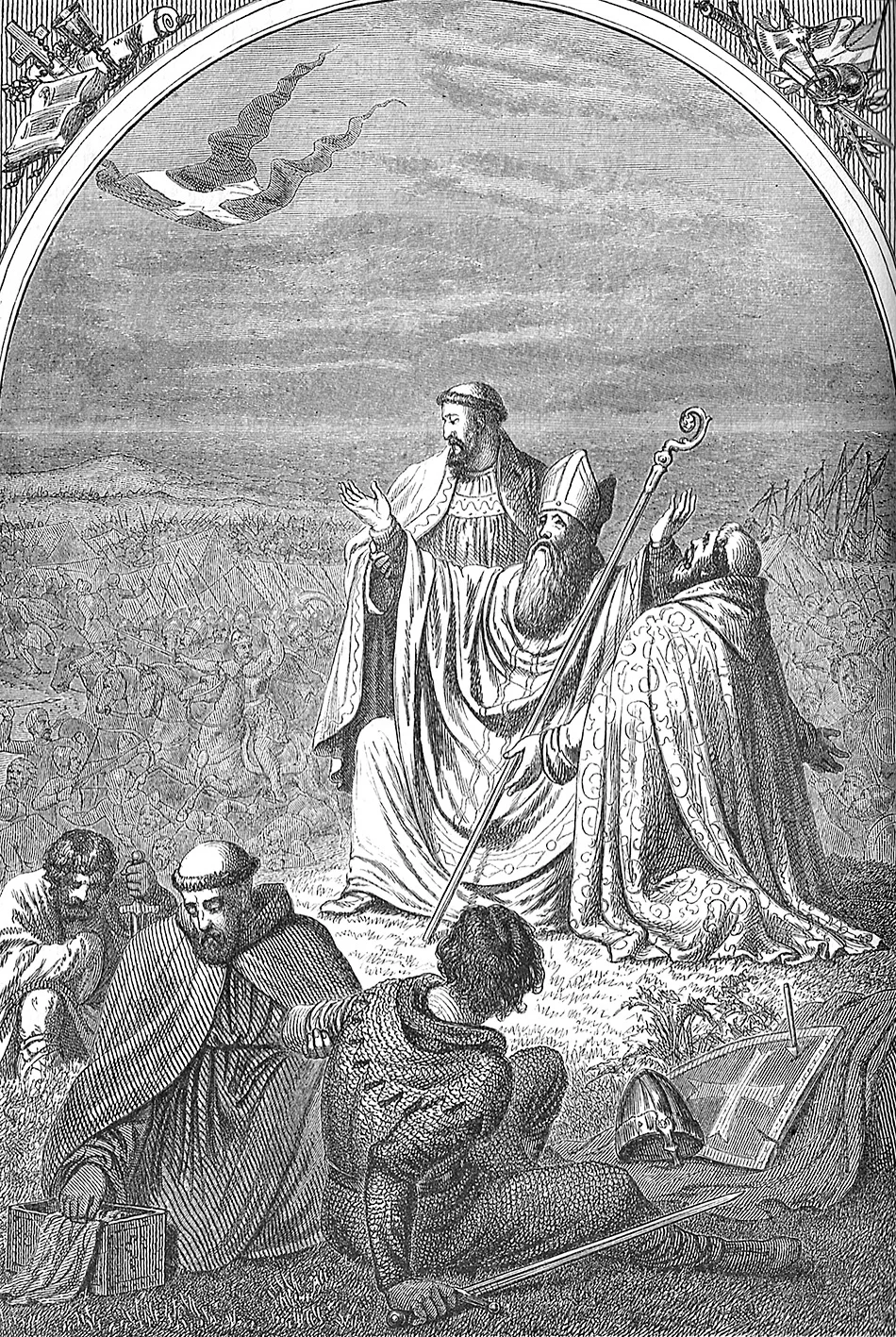
And then, according to the legend that every Danish schoolchild learns, something happened. As the Danes were being pressed hardest, Archbishop Anders Sunesen raised his hands toward heaven in prayer; as long as he kept his arms up, the line held; when he grew tired and lowered them, the Estonians surged forward again. At the very moment the Danes seemed about to lose, a red flag with a white cross fell from the sky into the camp. The defenders took it as a sign of divine favor, rallied, and won the battle. The flag became the Dannebrog — the oldest continuously used national flag in the world, still the flag of Denmark today. The legend appears in two early sixteenth-century sources, possibly drawing on an older one that originally placed the miracle in 1208 in Livonia; the Franciscan friar Peder Olsen rewrote it in the year 1219 and attached it to Lyndanisse. Historians have known for centuries that the heavenly origin is myth — the red-cross banner was a generic crusader symbol used across Europe — but the connection between the battle and the Dannebrog remains one of the founding stories of the Danish nation.
What followed for the Estonians
The Danish victory secured the conquest of northern Estonia, which became the province of Danish Estonia and remained under Danish rule for more than a century until Valdemar IV sold the territory to the Teutonic Order in 1346. Christianity was imposed by force across the country, sometimes through preaching, more often through the sword and the burned village. The Estonian language and the deep substrate of folk religion survived underground, kept alive in song and proverb, and would re-emerge in the nineteenth-century national awakening as the foundation of modern Estonian identity. Tallinn — which keeps the name Danes gave it — has stood at the spot where the crusaders built their castle for 800 years. Both Danes and Estonians visit the cliff every June to remember 15 June 1219, although they remember somewhat different things on the same day. For Denmark, it is Valdemarsdag, the day the flag fell from heaven. For Estonia, it is the day a foreign army planted itself on home soil, and a long road of dispossession began.
From the Air
The battle was fought near modern Tallinn, Estonia, at 59.44°N, 24.74°E, on the limestone bluff now occupied by the city's old town and Toompea hill. From cruising altitude in clear weather Tallinn Bay, the western tip of Estonia, and across the Gulf of Finland to Helsinki are all visible — the entire geography of the medieval Danish crossing. Nearest major airport is Tallinn (EETN), about 4 kilometers from the historic battlefield. Helsinki-Vantaa (EFHK) lies about 50 nautical miles to the north across the Gulf of Finland. Aircraft on Baltic transit routes pass directly overhead.
Nearby Stories
- Padise Abbey 6.8 km away
- SuperShe Island 34 km away
- Battle of Weissenstein 42 km away
- Military Museum of Finland 44 km away
- SMS Schleswig-Holstein 45 km away
- Koluvere Castle 54 km away
- Battle of Wesenberg (1268) 61 km away
- Svartholm fortress 88 km away