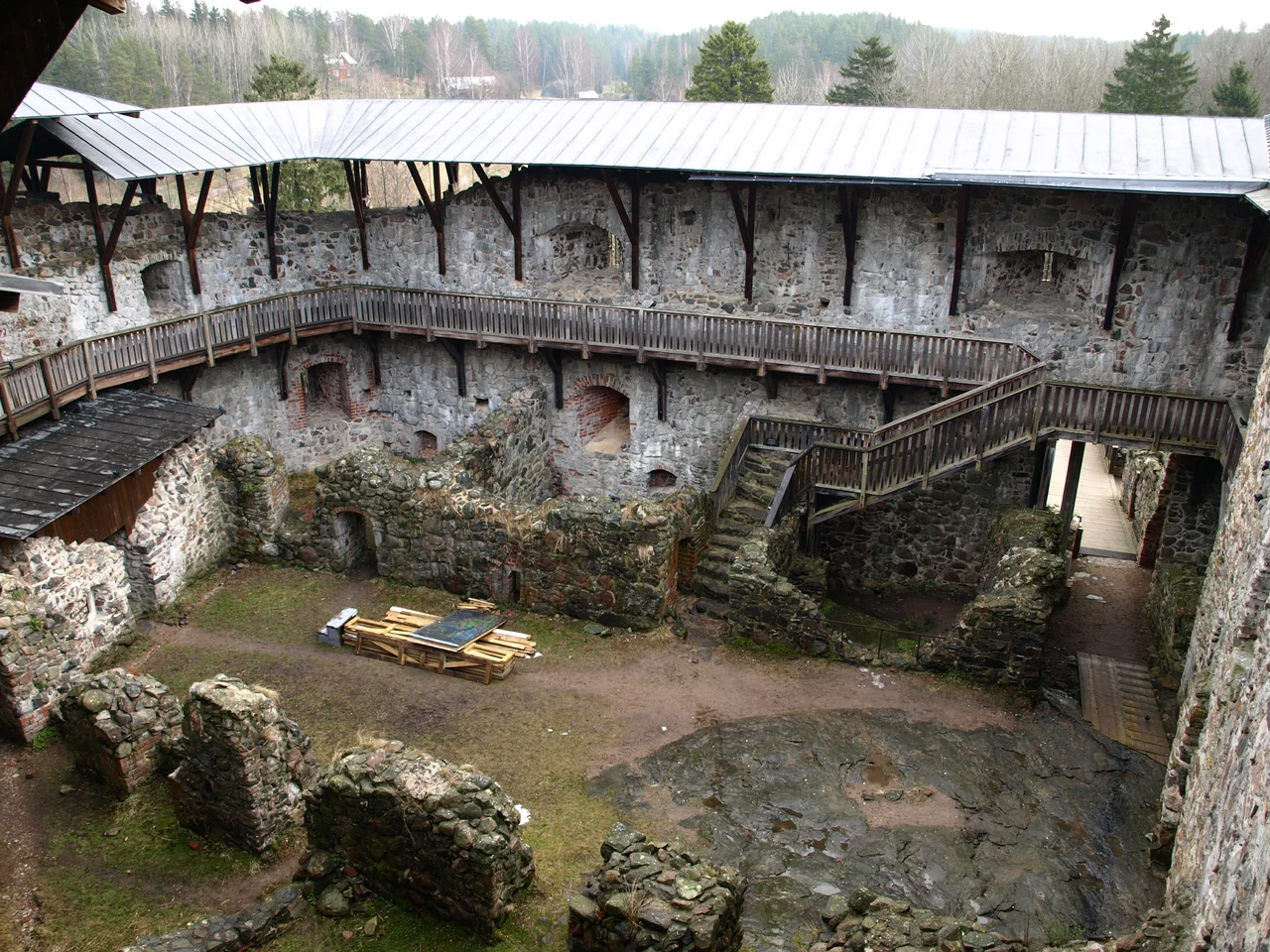

Raseborg Castle
Raseborg Castle was abandoned by its enemies. Not the Danes, not the pirates, not the Hanseatic merchants from Tallinn that it was built to watch. The thing that finally defeated Raseborg was geological. The land here is rising — slowly, steadily, inexorably — at about 4 mm per year, lifted by postglacial rebound after the great ice sheet retreated ten thousand years ago. The castle was built on an island in a sea bay in the 1370s. By 1553 the bay was shallow, the sea was retreating, and ships could no longer reach the harbor. Helsinki had been founded three years earlier and offered better access. Raseborg's position no longer made sense. The Swedish crown simply stopped using it.
Watching Tallinn
The first written mention of Raseborg dates to 1378, but the castle was probably begun a few years earlier — perhaps by Bo Jonsson Grip, the powerful Swedish nobleman who controlled vast estates across the kingdom in the late 14th century. Some historians have suggested an earlier origin involving Hermann of Dorpat and the Livonian Brothers of the Sword, with the name derived from Ratzeburg in northern Germany, but the evidence for that is thinner. What is certain is the purpose. Across the Gulf of Finland to the south sat Tallinn — wealthy, fortified, and a member of the Hanseatic League, which dominated Baltic trade. Sweden controlled southern Finland but needed a strongpoint on the Finnish coast to assert its interests against Hanseatic ambition. Raseborg was that strongpoint. From its rocks the Swedish administration could watch the gulf, control the local trade routes, and project Swedish power into the area.
The D-Shaped Castle
The layout was unusual. The castle plan resembles a capital letter D — a round, thick-walled donjon at one corner, with the straight side forming the keep wall, and an inner bailey in the center. The outer walls enclosed two outer baileys, with one square tower and a barbican gate. Construction proceeded in three distinct phases between the 14th and 16th centuries, with each generation strengthening what the last had built. The outer walls were added later, when artillery began to threaten older fortifications. Beyond the walls a wooden barrier surrounded the harbor approaches, preventing hostile ships from getting close. Pieces of that barrier still survive today — though now on dry land, as the seabed they once lay on has risen above water level. Battles were fought here in the medieval period between Swedish and Danish forces, and even pirates contested control of the castle. The walls held through every contest.
Stranded by the Sea
Postglacial rebound is invisible on any human timescale, but its effects accumulate. The Fennoscandian land mass had been compressed under kilometers of ice during the last glaciation, and after the ice melted it began to spring back upward. Around Raseborg the rate of uplift is about 4 mm per year — roughly a meter every 250 years. The bay that once let merchant ships and warships approach the castle directly was steadily becoming shallower. The harbor silted. The approaches grew unreliable. By 1550, when Sweden's King Gustav Vasa founded Helsinki to the east as a new trading post, Raseborg's strategic logic was fading. The new town offered access to deeper water and a better strategic position. In 1553 the Swedish crown simply abandoned Raseborg. No siege, no surrender, no destruction. The castle stood empty, and the forest crept in.
Theatre Ruins
For nearly 350 years the castle was a romantic ruin in the Finnish countryside, gradually losing stones to local builders and weather. Restoration work began in the 1890s, around the time the Swedish-speaking elite of southern Finland was rediscovering the medieval past as part of its cultural identity. Today the ruins are open to the public throughout the summer. The thick walls of the donjon still stand. The keep, the inner bailey, and parts of the outer walls survive in recognizable form. Just beside the castle is one of Finland's largest open-air theatre stages — the Raseborg Summer Theatre, founded in 1966, which gives performances in Swedish every July. The plays often draw on the castle's own history, so visitors who come on the right evening can watch medieval drama unfolding against the actual medieval walls. The sea has continued its long retreat. The castle that once watched the gulf now stands two kilometers from open water, with the green Finnish forest rising where ships used to ride at anchor.
From the Air
Raseborg Castle stands at 59.99°N, 23.65°E, in southwestern Finland in the Raseborg municipality of Uusimaa region, about 90 km west of Helsinki. The ruins sit on a low rise that was once an island, now surrounded by green meadow and forest. From altitude the D-shaped layout is identifiable as pale stonework against the surrounding vegetation. EFHK (Helsinki Vantaa) is 90 km east. EETN (Tallinn) lies 100 km south across the Gulf of Finland. EVRA (Riga) is 460 km southwest. The local airfield at Hanko (EFHN) is small and grass-only. Best viewed at 3,000 to 5,000 ft on Helsinki area transits. The historic geological context — sea where there is now land — is the key visual story for this site.
Nearby Stories
- Paikkari Croft 7.8 km away
- Salo 11 km away
- Finnish minelayer Louhi 13 km away
- Hanko Peninsula 23 km away
- Peter the Great's Naval Fortress 35 km away
- National Museum of Finland 41 km away
- SMS Schleswig-Holstein 49 km away
- Hakoinen Castle 68 km away