
Russian Battleship Slava
Glory - that is what Slava means in Russian. The word looks bitter in hindsight. The battleship was the youngest of the five Borodino-class pre-dreadnoughts the Imperial Russian Navy built in the 1900s, and the only one that did not steam east to be slaughtered at Tsushima in 1905. She missed that catastrophe because she was finished too late to make the voyage. For twelve more years she carried the name of an outcome her four sisters had been denied. Then, in October 1917, sinking in the Moon Sound channel between Estonia and the small island of Muhu, she became one more of the war's mechanical casualties - except that her dying was not done by the Germans alone. Her own sailors helped.
Late to Tsushima, Late to Everything
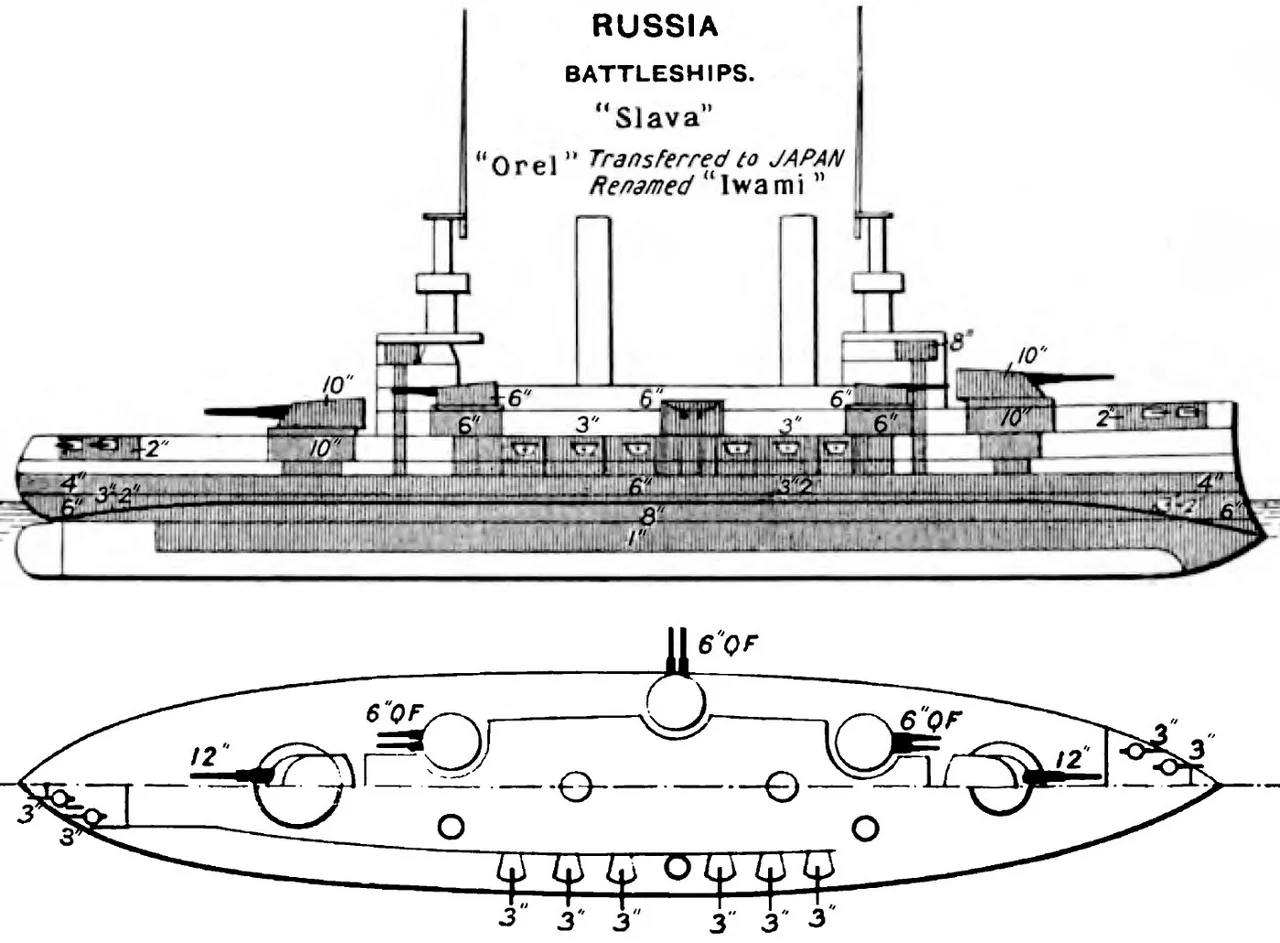
Laid down at the Baltic Works in Saint Petersburg in 1902, launched in August 1903, completed only in October 1905, Slava was 389 feet at the waterline, displaced about 14,400 tons, and carried four 12-inch guns in twin turrets fore and aft, with twelve 6-inch guns in side casemates. She was already obsolete by the time she went to sea: HMS Dreadnought launched in 1906 and instantly made every pre-dreadnought in the world a second-rate ship. But Slava had her uses. She helped suppress the 1906 Sveaborg Rebellion of mutinying sailors at the Helsinki naval fortress. She trained generations of new officers. In December 1908 her crew rescued survivors of the Messina earthquake on the Italian coast and ferried them to Naples. She had a serious boiler accident in 1910 that took her to Toulon for nearly a year of repairs. By the time the World War began in August 1914, she was the largest fighting ship the Russians could spare for the Gulf of Riga.
Holding the Gulf
Through the summer of 1915 and most of 1916, Slava was the spine of the small Russian squadron defending the Gulf of Riga against the German High Seas Fleet. She held off the first German push through the Irbe Strait in August 1915, took three 283mm shells from German dreadnoughts, and stayed in position. A month later, anchored off Tukums and bombarding German Army positions ashore, a shell hit her conning tower and killed her captain along with five others. She kept firing. In April 1916 a seaplane dropped three light bombs on her - little material damage, but seven sailors dead. In September that year the Germans tried to ambush her with a submarine and torpedo bombers - the first time torpedo bombers had ever attacked a moving battleship. All the torpedoes missed. The crew, by then, knew the channel and the ship and the war intimately. They were also, by 1917, getting tired.
The February Revolution at Sea
When the Tsar abdicated in March 1917, the Russian Baltic Fleet did not abdicate quietly. Sailors at the great naval bases of Kronstadt and Helsinki murdered some of their officers, refused to follow orders, formed soviets, and turned themselves into a political force. Slava, smaller and far from the fleet's main concentration, was less violent - but the Sailors' Committee that organized aboard her was no less real. Officers commanded only when the committee allowed it. Petrograd was 600 kilometers east, and the war the Provisional Government wanted to keep fighting felt increasingly absurd to men who had been at sea for three years for an empire that no longer existed.
Moon Sound, October 1917
On October 17, 1917 - by then a week before the Bolshevik Revolution would seize Petrograd - the Germans pushed into Moon Sound with battleships, dreadnoughts, and minesweepers, the next step in Operation Albion. Slava sortied south at dawn, fired at maximum elevation on the German line, and put shells within 50 meters of the dreadnought König. König returned the fire and hit her with seven shells in twenty-five minutes. The first shell, below the waterline at the bow, flooded the forward 12-inch magazine. A list of 8 degrees, then 4. The forward draft increased to about 32 feet. The dredged escape channel north was only 30. She was ordered to scuttle herself at the channel mouth so she would not block the passage. The Sailors' Committee, fearing she would sink before they could get off, ordered the engine room abandoned. With no one at the throttle to obey the captain's stop order, Slava drifted past the channel and grounded on a shoal. Destroyers took off the crew. The rear 12-inch magazine was rigged to explode, and at 11:58 it did.
After the Glory
Three torpedoes were fired into the wreck for good measure - only one worked. Slava settled on the shallow bottom in October 1917, broken-backed, with a hole in her starboard hull near the funnel. The Soviets struck her from the navy list on May 29, 1918. Through the 1920s and into the 1930s, the new independent Republic of Estonia owned the wreck, and Estonian salvors gradually scrapped her for steel - a wartime battleship dismantled into pots and railings and structural beams during a peace that would not last. Many of her former crew, having joined the Bolshevik cause after Petrograd fell, became founding members of the Soviet Baltic Fleet. The Moon Sound seabed where she went down still holds debris. The water is shallow and clear on summer days. Divers occasionally bring up rivets and shell fragments - the metal residue of a battleship that bore the name Glory and ended in confusion, scuttled and unscuttled and finally cut up for scrap.
From the Air
The Slava wreck site lies at 58.68 degrees north, 23.36 east, in the Moon Sound (Suur Strait) channel between mainland Estonia and the island of Muhu, just south of the Hiiumaa-Vormsi gap. From the air the strait shows as a narrow band of shallow Baltic water dotted with low wooded islands; the wreck location is unmarked. Tallinn (EETN) is the nearest international airport, 130 km east-northeast. Best photographed from low altitude on a calm summer morning when the Baltic is glassy and the shoals show as pale shadows under the surface. Winter brings sea ice to the strait and limits any aerial inspection.
Nearby Stories
- Haapsalu Castle 11 km away
- Koluvere Castle 12 km away
- Kuressaare Castle 25 km away
- Saaremaa 31 km away
- Battle of the Gulf of Riga 68 km away
- Padise Abbey 69 km away
- Battle of Salis 72 km away
- Russian cruiser Pallada (1906) 80 km away