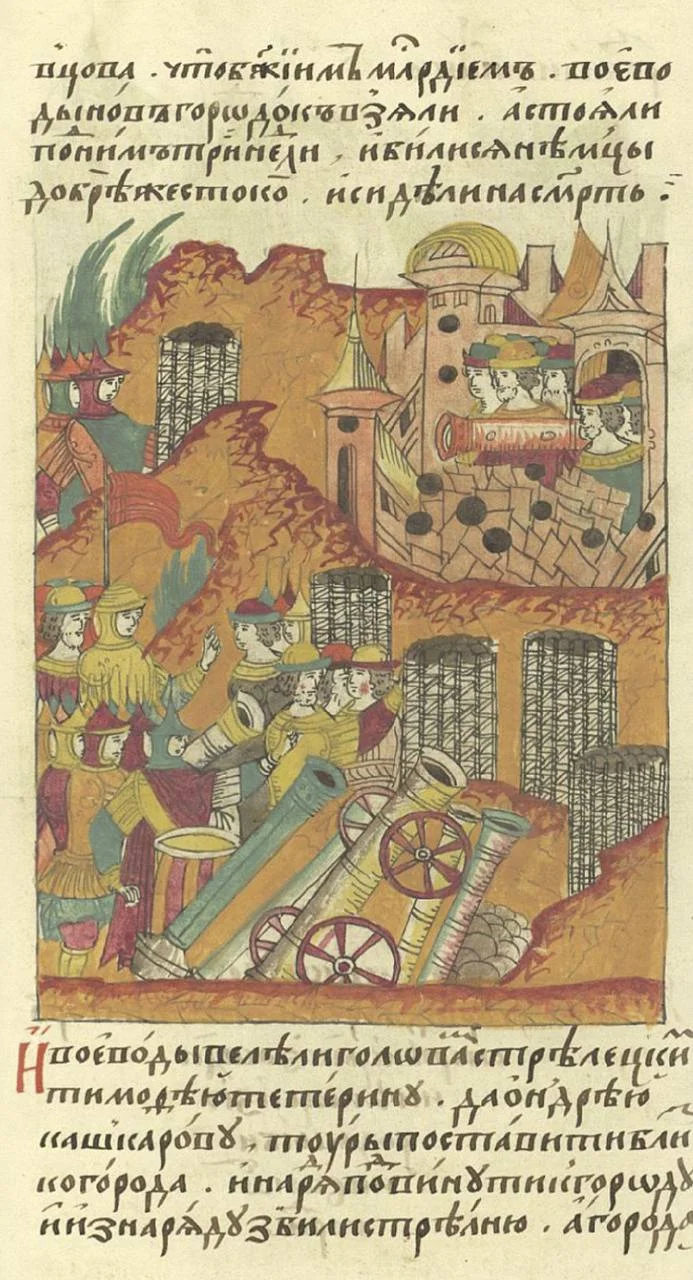

Siege of Fellin (1560)
The Livonian Order had ruled the lands that would become Estonia and Latvia for more than three hundred years when, on the morning of August 17, 1560, Russian artillery opened fire on the walls of Fellin Castle. Three days later, the walls were down. Five days later, the garrison mutinied and the city surrendered. Within months, the Order itself had ceased to exist - its lands carved up among Sweden, Poland-Lithuania, and Russia in the scramble that followed. The last Master of the Order, Wilhelm von Furstenberg, was put on a wagon and taken to Moscow as Ivan the Terrible's prisoner. Crusader states do not usually end this quickly. This one did.
An Order Out of Time
The Livonian Order was the northern Baltic branch of the Teutonic Knights - a German military-religious order originally founded to convert and conquer the pagan Baltic peoples in the 13th century. By 1560 the conversion was long since complete, the crusader rationale was four hundred years stale, and the Order had become a peculiar Germanic ruling caste presiding over a population of Estonian, Latvian, and Liv peasants who had little reason to love them. The Order's fighting strength had also withered. At its peak it could field thousands of armored knights backed by feudal levies; by 1560 it could field only hundreds, supplemented by mercenaries who often left when payment ran short. Ivan the Terrible, watching the Order's weakness, had begun the Livonian War in 1558. By summer 1560 his armies had taken city after city and were closing on what everyone understood to be the Order's spine: the great fortress at Fellin (the modern Estonian city of Viljandi).
The Disaster at Ergeme
Knowing what would happen if Fellin fell, the Order tried to stop the Russian advance in the field. The Master, Wilhelm von Furstenberg, sent out his available forces under the Landmarschall Philipp Schall von Bell. The Russian vanguard was commanded by Prince Vasily Barbashev. They met near the village of Ergeme, just south of the modern Latvian-Estonian border, in early August 1560. The battle was brief and one-sided. The Livonian heavy cavalry, fighting in the medieval style with lance and armor, was outflanked and broken by Russian light cavalry maneuvering with the discipline of a much more modern army. Von Bell himself was captured (and later executed in Moscow by Ivan's order). At least 261 knights died on the field, and Livonian losses including auxiliaries may have reached 500 - a catastrophic blow to an already small force. The road to Fellin lay open.
Three Days of Hellish Shelling
The Russian main army arrived under Prince Ivan Mstislavsky and the rising young commander Andrei Kurbsky - a man who would, three years later, defect to the Lithuanians and begin the famous correspondence with Ivan the Terrible that ranks among the greatest documents of the 16th century. Their cavalry vanguard reached Fellin first and waited for the heavy guns. When the artillery arrived on August 17, it began work immediately. Livonian chronicles described what followed as 'hellish' shelling - the German garrison defending Fellin had been told the fortress was impregnable, but they had been told that before, and the walls had already once been breached by Russian guns in 1481. By August 18 sections of wall were down. By August 19 a fire broke out inside the fortress and destroyed most of the supplies. The garrison, by then a mix of demoralized German mercenaries and frightened townspeople, mutinied against the commanders. On August 20 the white flag went up and the city surrendered.
The Master Carted to Moscow
Among those captured was Wilhelm von Furstenberg himself - the last functioning Master of the Livonian Order, who had taken refuge inside Fellin's walls. He was an old man by then, in his late sixties or early seventies, and had ruled a state that was in the process of disappearing under his hands. The Russians put him on a wagon and took him east. He spent the rest of his life in honorable Russian custody at the small town of Lyubim, where he died around 1568, far from the Baltic he had ruled. The Order he had led formally dissolved on March 5, 1562, when the surviving knights and the new Master, Gotthard Kettler, accepted vassalage to the Polish-Lithuanian Crown and converted what remained of the territory into the secular Duchy of Courland and Semigallia. The crusader state was over. Three hundred and fifty years of German rule in the eastern Baltic ended in three days of artillery.
The Long Aftermath
The collapse triggered the partition that defined the next two centuries of Baltic history. Sweden took Estonia. Poland-Lithuania took most of what is now Latvia and the Polish-Lithuanian zone of southern Latvia. Russia held what it could. Denmark briefly held the island of Saaremaa. The wars to redraw these lines went on, with intermissions, until the Great Northern War of 1700-1721 finally settled the region under Russian control. Fellin itself - now Viljandi - was rebuilt and rebuilt and rebuilt, changing hands repeatedly, eventually slipping into provincial obscurity by the 19th century. The medieval castle was never restored to its 1560 form; it stands today as picturesque ruins on a hill above Lake Viljandi, a popular weekend destination for Estonians who come to walk the Bailey and look across the water. The folk-music festival held there each summer is one of the largest in Estonia. The artillery that ended an empire is long since gone. The hill remembers.
From the Air
Viljandi (medieval Fellin) sits at 58.36 degrees north, 25.60 east, on the north shore of Lake Viljandi in southern central Estonia, about 160 km southeast of Tallinn and 95 km north of the Latvian border. From the air the castle ruins are visible as exposed stonework on a defensible hilltop above the lake, with the modern small town wrapping around them. Tallinn (EETN) is the nearest major airport, 160 km north-northwest; Tartu (EETU) is 80 km east. The countryside is gently rolling Estonian farmland and forest dotted with small lakes - best viewed from low altitude in summer when the lakes show clear blue against the green, or in autumn when the broadleaf forests turn yellow and red around the medieval ruins.
Nearby Stories
- Battle of Weissenstein 20 km away
- Otepää Castle 32 km away
- Tartu Cathedral 41 km away
- Battle of Ērģeme 46 km away
- Koluvere Castle 54 km away
- Battle of Salis 60 km away
- Battle of Wesenberg (1268) 74 km away
- Battle of Moon Sound 89 km away