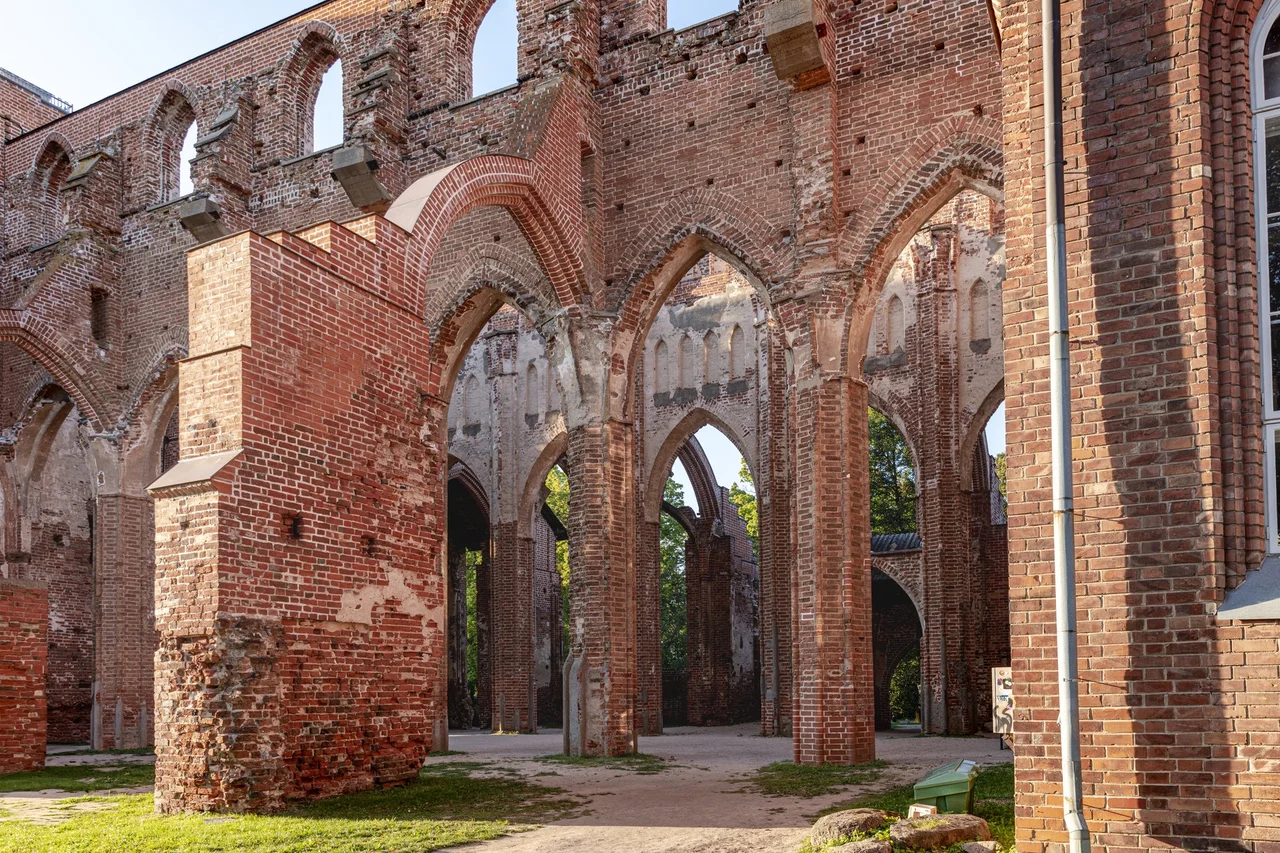

Tartu Cathedral
Two truncated towers, both 22 meters tall, rise out of the trees on Toomemagi hill above Tartu. They were once 66 meters high, the spires reportedly as tall as Notre-Dame de Paris when a French traveler measured them by eye in 1726. By the 1760s they had been chopped flat to make a platform for a cannon, and the great cathedral they crowned, one of the largest religious buildings in medieval Eastern Europe, had been a barn for over a century. The Reformation broke this church. Wars and neglect finished the job. Today the renovated middle section houses the museum of the University of Tartu, and the open ribs of brick Gothic vaulting frame the sky behind it.
From Pagan Stronghold to Bishop's Fortress
Toomemagi means cathedral hill, but for centuries before any cathedral stood on it, the hill above the Emajogi River held one of the largest fortified settlements of the pagan Estonians. In 1224 the Christian crusaders of Livonia stormed and destroyed it. The Northern Crusades had reached the eastern Baltic, and as in Tallinn and Riga, the new conquerors built immediately on the captured high ground. Their first construction was the Castrum Tarbatae, a bishop's fortress, parts of whose old walls have since been revealed by archaeologists working among the cathedral ruins. The Gothic cathedral itself probably began rising in the second half of the 13th century, dedicated to Saints Peter and Paul, who became the patron saints of the town as well. It was the seat of the Bishopric of Dorpat, the German name for Tartu, one of the major medieval bishoprics of the eastern Baltic. The choir and nave were already in use by 1299. Around 1470 the high choir was completed in Brick Gothic style with its pillars and arches. By the end of the 15th century the cathedral was finished off with two massive fortress-like towers on either side of the west front.
Iconoclasts and Russian Troops
The Reformation reached Tartu in the mid-1520s. On 10 January 1525 Protestant iconoclasts smashed up the cathedral, breaking statuary and altars, after which the building entered a long decline. The last Roman Catholic bishop of Dorpat, Hermann Wesel, was deported to Russia after the Russian invasion of 1558 and died in captivity in 1563; the cathedral was abandoned with him. The Livonian War (1558-1583) saw Russian troops devastate Tartu repeatedly. In 1582 the Polish-Lithuanian Commonwealth took the city and the new Catholic rulers planned to rebuild the cathedral, but the Polish-Swedish War (1600-1611) killed the project before it began. A fire in 1624 added more damage. Tartu became Swedish in 1629, and the Swedish administration showed no interest in restoring the building. Burials in the surrounding graveyard continued well into the 18th century, and the main body of the church served as a barn. In the 1760s, with no use left for the towers, they were cut down to nave roof level (66 meters down to 22) and turned into a platform for a defensive cannon. The main portal was bricked up at the same time.
A Library Among the Ruins
Tsar Alexander I refounded the German-speaking Imperial University of Dorpat in 1802, and the Baltic German architect Johann Wilhelm Krause was commissioned to build the new university library inside the cathedral ruins. The three-storey library went up between 1804 and 1807, fitted carefully into the surviving choir of the medieval cathedral. Krause also planned to convert one of the old towers into an observatory; that idea was dropped and a separate observatory was built nearby on the hill. At the end of the 19th century the northern tower was repurposed as a water tower. In 1981 the new university library opened elsewhere and the old Krause building became the Historical Museum of the University of Tartu. A thorough restoration in 1985 brought back the 19th-century interior. The museum displays scientific instruments, rare books, and artifacts from two centuries of one of northern Europe's most influential universities. The rest of the cathedral, the long nave and the high western towers, remains roofless ruin, the brickwork structurally consolidated but deliberately left as ruin, the blue Estonian sky filling the spaces where the vaults used to be.
Toomemagi Park
The hill around the cathedral was landscaped into a park in the 19th century, and today it is one of the loveliest urban parks in the Baltic, a wooded crown to the small university city below. Monuments dot the paths. Karl Ernst von Baer (1792-1876), the great natural scientist and embryologist born in Estonia and educated at Dorpat, sits in bronze. Kristjan Jaak Peterson (1801-1822), regarded as the first Estonian poet, who died of tuberculosis at twenty-one, is here. The Russian surgeon Nikolay Pirogov (1810-1881), a pioneer of field surgery and ether anesthesia. The folklorist Friedrich Robert Faehlmann (1798-1850), who began collecting the source material that became Estonia's national epic Kalevipoeg. The Inglisild, the Angel Bridge spanning the path down to the lower town, was built between 1814 and 1816; the name probably comes from a corruption of Englische Brucke, English bridge, and the relief in the middle commemorates the first rector of the refounded university, Georg Friedrich Parrot, with the Latin inscription Otium reficit vires, leisure renews the powers.
From Above
From the air, Toomemagi is the green tree-covered crown over the small dense Old Town of Tartu, the Emajogi River curving past to the south. The cathedral ruins sit on the highest part of the hill, the truncated towers visible against the canopy. Below them the Town Hall Square fans out toward the river. Tartu is small enough that in a single overflight at 3,000 feet you can see the cathedral, the university buildings, the Stone Bridge sites, and the river bend that the city has occupied since the Estonians first fortified this hill, more than a thousand years ago.
From the Air
Tartu Cathedral ruins sit at 58.38 N, 26.72 E on Toomemagi hill above the Emajogi River. View from 3,000-5,000 feet to see the wooded park, the truncated towers, and the Tartu Old Town below. Tartu Airport (EETU) is 8 km south. Tallinn (EETN) is 187 km northwest. Best visibility April through October.
Nearby Stories
- Otepää Castle 14 km away
- Põltsamaa Castle 23 km away
- Battle of Weissenstein 32 km away
- Battle on the Ice 35 km away
- Battle of Ērģeme 44 km away
- Pskov-Caves Monastery 53 km away
- Battle of Wesenberg (1268) 72 km away
- Ivangorod Fortress 98 km away