.jpg)
Battle of Pälkäne
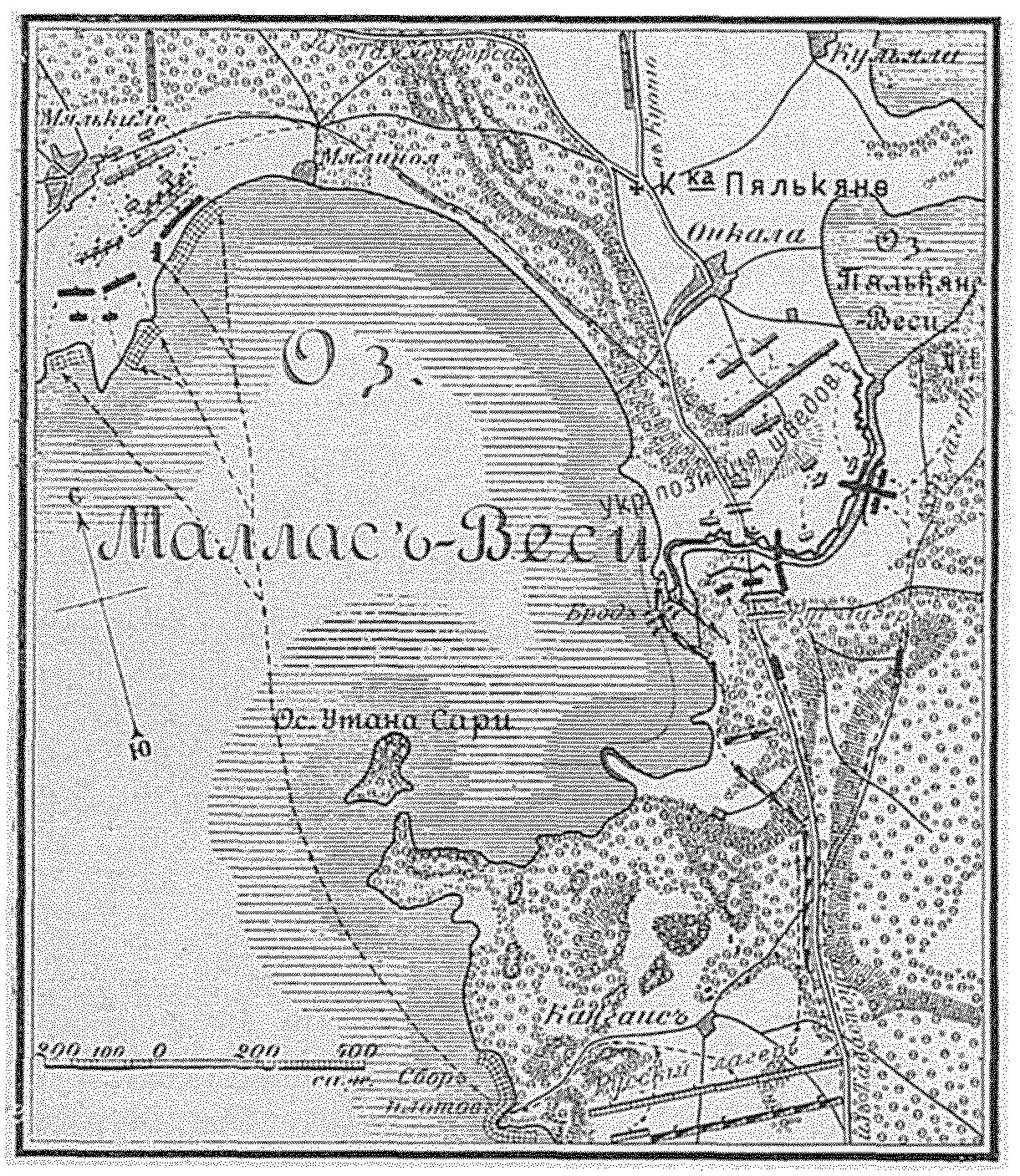
Carl Gustaf Armfeldt thought he had picked the perfect ground. Between the lakes Pälkänevesi and Mallasvesi, in the parish of Pälkäne, the land narrows to an isthmus less than a kilometer wide, with the two lakes joined by the swift channel of the river Kostianvirta. He had pulled his Finnish infantry back behind the river, his weak cavalry on the wings, and waited. Any frontal attack would have to cross the channel under fire. Behind him lay Tampere, the next defensible town. He had inherited a desperate situation only weeks earlier from a discredited predecessor; this position was the strongest geography available to him. On the morning of 6 October 1713, in the dark before dawn, the Russian Major General Mikhail Galitzine put his troops into boats and crossed the lake.
After Poltava
The Battle of Pälkäne was a small battle in a vast catastrophe. Four years earlier, in July 1709, Charles XII of Sweden had marched his veteran army deep into Ukraine and lost it utterly at Poltava. The Swedish empire that had dominated the Baltic for a century never recovered. Charles himself spent years exiled in the Ottoman Empire, refusing to negotiate peace, while Russia, Denmark, and Saxony slowly dismantled his territories. The fighting until 1712 had taken place mostly outside Sweden's core lands. By 1713 the anti-Swedish coalition decided to invade the Swedish heartland from two directions — Denmark from the south, Russia through Finland from the east. The Danish prong collapsed at the Battle of Helsingborg in 1710. The Russian prong did not.
The general who lost his cavalry
The Swedish army defending Finland was composed almost entirely of Finnish soldiers — Finland had been a Swedish province for five centuries — and was commanded by an unpopular and unsuccessful general named Georg Henrik Lybecker. His earlier campaign against Saint Petersburg in 1708 had ended in disaster: in his retreat through the wilderness he had been forced to abandon his cavalry horses, a loss that no Finnish unit had been able to make good in the years since. When Tsar Peter I and Admiral Fyodor Apraksin landed in Finland in April 1713 with a Russian army, Lybecker simply fell back. Helsinki and Porvoo fell in May. By August the Russians had reached Turku. In September, Stockholm finally replaced Lybecker with Carl Gustaf Armfeldt, an experienced Finnish-born officer who took over an army that had lost most of southern Finland and had no functional cavalry.
The amphibious flank
Apraksin understood the position at Pälkäne perfectly. A frontal attack across the Kostianvirta channel against entrenched Finnish infantry would be expensive and might fail. So he applied the same formula that had worked through the Finnish campaign: pin the defenders in front, land troops in their rear. Galitzine's first wave came ashore in the early morning west of Apraksin's main front, on the Mallasvesi shore. The Finnish cavalry, which should have driven the Russians off the beach before they could organize, was still in quarters at the village of Mälkilä. Armfeldt got it moving as fast as he could, but the delay was fatal. By the time the cavalry arrived the Russians had a secure beachhead and were pushing infantry across in waves. Armfeldt's plan to dismount and pin the Russians, then strike with mounted reserves, fell apart against the absence of trained mounts and the steady Russian buildup.
The eastern infantry refused to leave
Meanwhile, in the east, Apraksin's frontal assault was failing. The Russians tried to cross the Kostianvirta on improvised rafts in three groups, with artillery support. The Finnish infantry along the bank fought them off in attack after attack. At one point Russian cavalry actually tried to wade through the lake itself to flank the position; they failed. As long as the infantry held the river line, the position was unbreakable. But on the western beach, Galitzine's reinforced troops were rolling up the Finnish reserves. Armfeldt's counterattack was initially successful, then collapsed when the cavalry was routed, leaving the western infantry exposed. The eastern Finns — who had been winning their part of the battle all day — were reluctant to leave their positions. They had to be ordered out as Galitzine's troops closed in behind them. Harassed by Russian cavalry on the retreat, the Finnish army abandoned most of its artillery and pulled back in disorder, but in good order enough to survive.
The next winter, in the snow
The Russians took Tampere. They wintered in southern Finland. In February 1714, in deep snow at Storkyro, Armfeldt and Galitzine met again — and this time the Finnish army was destroyed, with thousands killed in a battle so brutal it broke organized Swedish resistance in Finland for the rest of the war. The period that followed, from 1713 until the Treaty of Nystad in 1721, is known in Finnish historical memory as Isoviha, the Great Wrath. Russian troops occupied the country, requisitioned what they wanted, deported thousands of Finns to Russia, and burned what they did not need. The civilian population fled or hid in the forests. By the end of the war, the population of Finland had dropped sharply from prewar levels — a combination of military deaths, deportations, famine, and refugees who never came back. The peace treaty of 1721 returned most of Finland to Sweden but transferred large parts of the Karelian Isthmus, including the city of Vyborg, to the new Russian Empire of Peter the Great. The narrow isthmus at Pälkäne, where Armfeldt had hoped to stop the tide, is now a quiet stretch of lake country thirty kilometers east of Tampere — a Finnish landscape of birch and pine that looks as it did three centuries ago, except for the silence.
From the Air
The battlefield is at 61.34°N, 24.27°E, on the narrow isthmus between lakes Pälkänevesi and Mallasvesi in Pirkanmaa region, about 30 kilometers east of Tampere. From cruising altitude in clear weather the patchwork of central Finnish lakes — particularly Pälkänevesi to the north and the larger Mallasvesi (part of the Vanajavesi system) to the south — is the dominant feature, with the narrow land bridge between them clearly visible. Nearest major airport is Tampere-Pirkkala (EFTP), about 35 kilometers west. Helsinki-Vantaa (EFHK) lies about 75 nautical miles to the south.
Nearby Stories
- Näsijärvi 8.8 km away
- Akaa 11 km away
- Koijärvi 15 km away
- Hakoinen Castle 16 km away
- Battle of Lahti 37 km away
- Helvetinjärvi National Park 65 km away
- Saynatsalo Town Hall 81 km away
- Petajavesi Old Church 111 km away