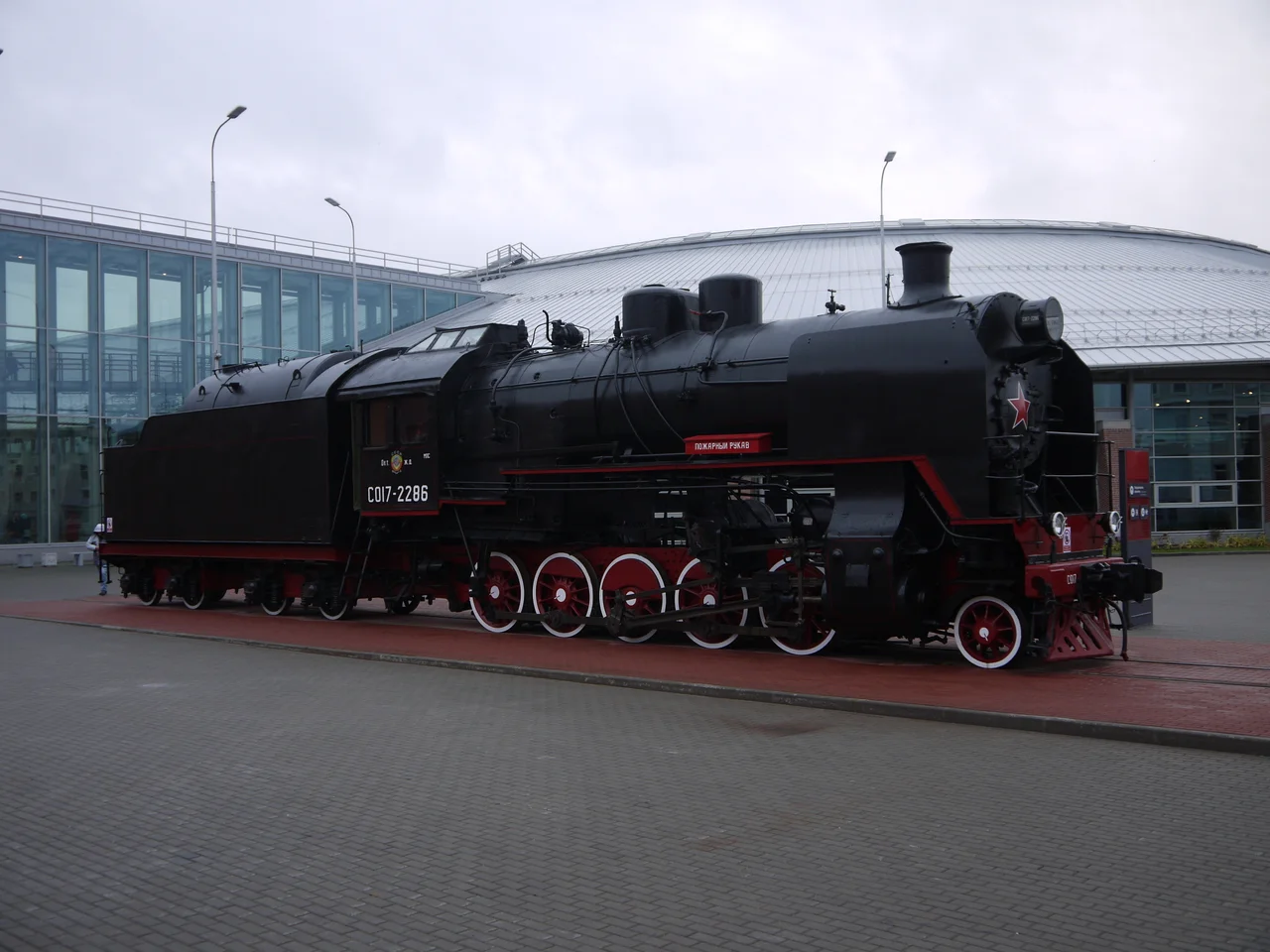

Russian Railway Museum
There is a railcar in the Russian Railway Museum that was built to launch nuclear missiles. It looks like an ordinary refrigerated freight wagon - because that was the point. The Soviet RT-23 Molodets system disguised intercontinental ballistic missiles inside what appeared to be standard rolling stock, then drove them around the country's vast rail network so American satellites could not pin down where they were. The wagon at the museum is one of the few surviving examples. It sits in the same hall as a beautifully preserved 1860s steam locomotive built in Manchester for service on the Tsarskoye Selo Railway. Russian railway history, presented under one roof, is wider than most national histories of anything.
From a Trade Union Project to a National Museum
It started small. In 1974, the trade union of the Oktyabrskaya Railway - the line connecting Moscow to Leningrad - decided to set up a small employee museum. The first exhibition opened in 1978 on Liteyny Avenue in central Leningrad. Then a group of railway workers began rescuing historic locomotives the system was about to scrap, and in 1991 a larger open-air museum opened in Shushary in the southern suburbs, with 18 locomotives and 7,500 square meters of display. The commuter rail station that served it was renamed Parovozny Muzei - Steam Engine Museum. In 2001 the most valuable rolling stock was moved to the central Varshavsky station, recently closed for passenger service. By the late 2000s, with that station slated for redevelopment, planners began designing what would become the museum's permanent home: the great former locomotive depot of Baltiysky Railway Station, built between 1857 and 1858 to service the Peterhof Railway.
The Locomotive Shed
The original 19th-century roundhouse and adjoining workshops form the museum's core. Brick arches, cast-iron columns, the smell of old steel - the building itself is a piece of the collection. A new exhibition hall designed by the architectural firm Studio 44 opened alongside the historic structures on October 30, 2017, more than tripling the display area. Total now: about 50,000 square meters of indoor and outdoor space, around 35,000 historical artifacts, 118 items of rolling stock. In 2019 the museum was nominated for the European Museum of the Year Award - rare recognition for a transport museum in Russia, and a measure of how seriously the redesign treated both the historic building and the curatorial story.
Two Centuries Under One Roof
The chronology runs from Richard Trevithick's first 1804 steam locomotive prototypes (represented by scale models) through the Cherepanov brothers' 1834 Russian-built engine, the imported British and German 19th-century giants that hauled freight and passengers across the empire, the great Soviet-era electric and diesel power, the high-speed ER-200 of the late Soviet years, and the contemporary RZD fleet. There is an interactive simulator of the TEP-70 diesel-electric locomotive where visitors can attempt to drive a 121-ton machine. There is the armored train of the Civil War era. There is a luxurious Imperial saloon car. There is a wartime hospital train from 1942, fitted with surgical theaters and patient wards. Most exhibits can be viewed from the outside; some can be boarded. The descriptions are fully bilingual in Russian and English.
The Country That Lived by Rail
Russia, more than perhaps any country in the world, was made by its railways. The Trans-Siberian (1891-1916) stitched a continent-sized empire together. The Soviet rail network, expanded for industrialization and again for the war, was the circulatory system of the planned economy - moving steel, grain, soldiers, prisoners, refugees, missiles. The cosmonauts went to Baikonur by train. The deportation of entire ethnic groups under Stalin happened by train. The siege of Leningrad was lifted, in part, by a single emergency rail line laid across the frozen Lake Ladoga. The museum tells none of this politically; it shows the hardware. But the hardware carries the history. Standing next to a wartime locomotive black with old soot and seeing the dates of its service, you can do the math yourself.
Visiting
The museum sits next to the Baltiysky railway station, two metro stops from central Saint Petersburg, easy to combine with a visit to nearby Baltiyskaya station's Stalinist marble halls. The display is unusually accessible - wide ramps, English signage, working children's exhibits, a cafe in a converted dining car. Most visitors stay 2 to 3 hours; rail enthusiasts stay all day. Outside, a row of locomotives stretches alongside the active rail tracks, where modern Sapsan trains slide past in their blue livery on the way to Moscow. Two centuries of Russian railroading on one line of sight, the present blurring past the preserved past at 200 kilometers an hour.
From the Air
The museum sits at 59.91 degrees north, 30.30 east, in southern central Saint Petersburg, immediately adjacent to Baltiysky railway station and the still-active rail yards. From the air the long parallel sheds of the historic locomotive depot and the angular new exhibition hall are easily picked out from the surrounding industrial blocks; the Obvodny Canal runs east-west just north of the site. Pulkovo airport (ULLI) is 12 km south, with the museum almost directly on the standard approach path to runway 28. The Gulf of Finland lies 5 km west. Best photographed in winter when fresh snow contrasts with the dark rolling stock parked outside, or in summer when the active rail tracks alongside show the layered history of the rail yard.
Nearby Stories
- English Palace 3 km away
- Yam Fortress 77 km away
- Khutyn Monastery 115 km away
- Siege of Novgorod (1170) 126 km away
- Antoniev Monastery 147 km away
- Battle of Fredrikshamn 155 km away
- Battle of Svensksund (1789) 192 km away
- Battle of Kollaa 224 km away