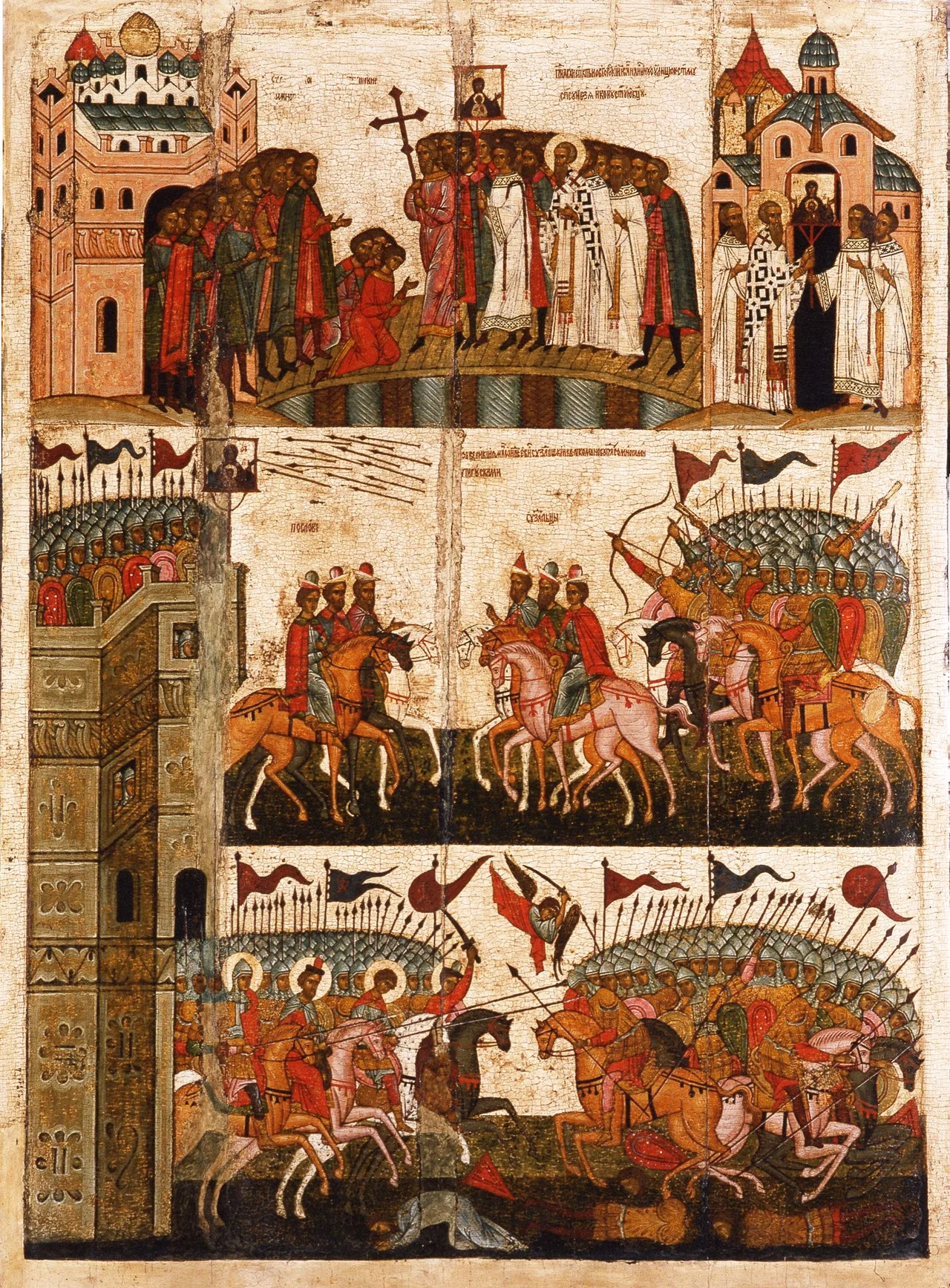

Siege of Novgorod (1170)
An icon called the Sign of the Theotokos hangs today in the Cathedral of Saint Sophia in Veliky Novgorod, and the legend attached to it dates from the winter of 1170. As the Suzdalian army of Prince Andrei Bogolyubsky pressed against the wooden walls of the city, an arrow from the besiegers is said to have struck the icon as a priest carried it along the ramparts. Tears flowed from the painted eyes. The Suzdalians, blinded and confused, turned on each other in the snow, and Novgorod was delivered. Whether or not anything like that happened, the Novgorodian republic did defeat a far larger army that February, on a frozen plain north of the lake. What the people of the city could not see was that they had won the smaller fight and lost the larger one already.
A Republic in a Princely World
Veliky Novgorod sat 58 degrees north on the Volkhov River, where it carried the trade of Scandinavia and the Hanseatic ports south to Kievan Rus and on to Constantinople. Its veche, a public assembly that met in the marketplace, hired and fired its princes by acclaim. In a Russia of hereditary princely thrones, this was already strange. By the 1160s, the most powerful prince in Rus was Andrei Bogolyubsky of Vladimir-Suzdal, who in March 1169 had sacked Kiev itself with a coalition of Smolensk, Suzdalian, and Chernigovian forces. The grand prince he deposed there, Mstislav II of Kiev, had a son named Roman ruling in Novgorod. To pacify the north, Andrei needed Roman gone. He sent an army to take him out and to reinstall his own preferred candidate.
The Battle in the Snow
The Suzdalian army that approached Novgorod through the winter of 1169–1170 was, by every account, the larger force. The Novgorodians, fighting at home and on familiar ground, met them outside the walls and broke them. The Suzdalian losses were severe enough that the chronicles speak of the city as having been miraculously delivered, and within decades the legend of the icon weeping above the rampart had taken hold. By the late fifteenth century, two large icons of the Sign of the Theotokos had been painted to commemorate the event; both survive, one in the Novgorod Museum, the other in the State Russian Museum in Saint Petersburg. The painters added crowds, towers, descending angels. They left out, as legend tends to do, the one detail that defined what came next.
Winning and Losing
Andrei Bogolyubsky did not need to take Novgorod by storm. He needed only to cut off the grain that came up from the south. The Suzdalian principalities controlled the river routes, and within a year of their tactical defeat in the snow, they applied an economic blockade that the Novgorodians could not break. Hungry and isolated, in 1170 the city expelled Roman Mstislavich, who had been the cause of the war, and accepted a prince approved by Andrei. The following year they accepted Andrei's own son Yury Bogolyubsky on the throne. The republic survived as an institution. Its independence in foreign policy did not. Andrei Bogolyubsky remained the dominant prince in Rus until his assassination in 1174, by which time the lesson had been absorbed: a free city upstream from grain country is only as free as its winter pantry.
The City Today
Veliky Novgorod is one of the oldest cities in Russia, a UNESCO World Heritage Site whose Detinets, the kremlin on the Volkhov's left bank, still encloses the eleventh-century Saint Sophia Cathedral. Inside, the icon at the center of the legend has been venerated for more than eight hundred years. Across the river, the Yaroslav's Court trading quarter preserves the layout of the medieval merchant town that the siege failed to subdue militarily and crippled economically. In the surrounding earth, archaeologists have recovered more than a thousand birch-bark letters written by the literate citizens of the republic, mundane scraps about debts and grain prices and absent husbands, the everyday voice of the people behind the walls in 1170.
From the Air
Veliky Novgorod lies at 58.55°N, 31.28°E on the banks of the Volkhov River, about 180 km southeast of Saint Petersburg. The nearest airport is ULLN (Yuryevo) outside Veliky Novgorod itself; Saint Petersburg's ULLI is the major international gateway. From altitude, look for the Volkhov flowing north into the broad expanse of Lake Ilmen, with the kremlin's white walls and gold-domed Saint Sophia Cathedral on the river's western bank. Recommended viewing altitude FL200–FL300 in clear weather; the surrounding Novgorodian plain is largely unforested and the river ribbon is unmistakable.
Nearby Stories
- Battle of Shelon 27 km away
- Novgorod Oblast 48 km away
- 1981 Pushkin Tu-104 Crash 89 km away
- Battle of Krasny Bor 92 km away
- Valday Iversky Monastery 106 km away
- Catherine Palace 122 km away
- Pskov Oblast 140 km away
- Lonin Museum of Veps Ethnography 344 km away