.jpg)
Catherine Palace
Almost a hundred kilograms of gold went into the stucco. The walls were painted sky-blue, the columns snow-white, and along the roofline a long row of gilded sculptures and chapel cupolas caught the slanting light of the Russian summer. When Bartolomeo Rastrelli finished his rebuild of the Catherine Palace in 1756, it stretched 300 meters across a hilltop south of Saint Petersburg, by far the most theatrical rococo facade in the empire. Catherine the Great, who eventually ordered the gilding replaced with olive-drab paint because she found it gaudy, would still describe the place as her summer refuge. Hitler's army would burn most of it to the ground.
The Tsar's Village
Before there was a palace, there was a Finnish farm called Saari Mojs, perched on a 65-meter hill that the locals had cleared after the Great Northern War. Peter the Great gave the farm to his wife Catherine I in 1710. The village's name shifted across two languages: from Saari Mojs to Sarskoye Selo to, finally, Tsarskoye Selo, the Tsar's Village. Catherine I built a modest two-story stone house there in 1723, sixteen rooms with alabaster and Gobelin tapestries. Her daughter, Empress Elizabeth, decided this was not nearly enough. Construction on a much grander palace began in 1744 under Mikhail Zemtsov, expanded under Andrei Kvasov and Savva Chevakinsky, and reached its operatic peak when Rastrelli took over in 1751. By 1756 the palace had forty state apartments and over a hundred private and service rooms. It was conceived not as a residence but as a stage.
The Light Gallery
The Great Hall, which Rastrelli's contemporaries called the Light Gallery, runs the full width of the palace at roughly a thousand square meters. The eastern windows look onto the park; the western ones look onto the parade plaza. After dark, six hundred and ninety-six lamps were lit on a dozen chandeliers placed near the mirrors, doubling the light. Tall pier glasses on the inner walls reflected each other so that a guest moving through the room saw versions of themselves recede into infinity. Sculptural and gilded carvings, drawn from Rastrelli's own sketches and modeled by Johann Franz Dunker, ran around every door and window. The hall was meant for masquerades, formal dinners, and balls. Catherine the Great's grandson Alexander I would later host receptions here for the diplomats who had helped break Napoleon. The room survived all of that. It did not survive 1941.
The Amber Room
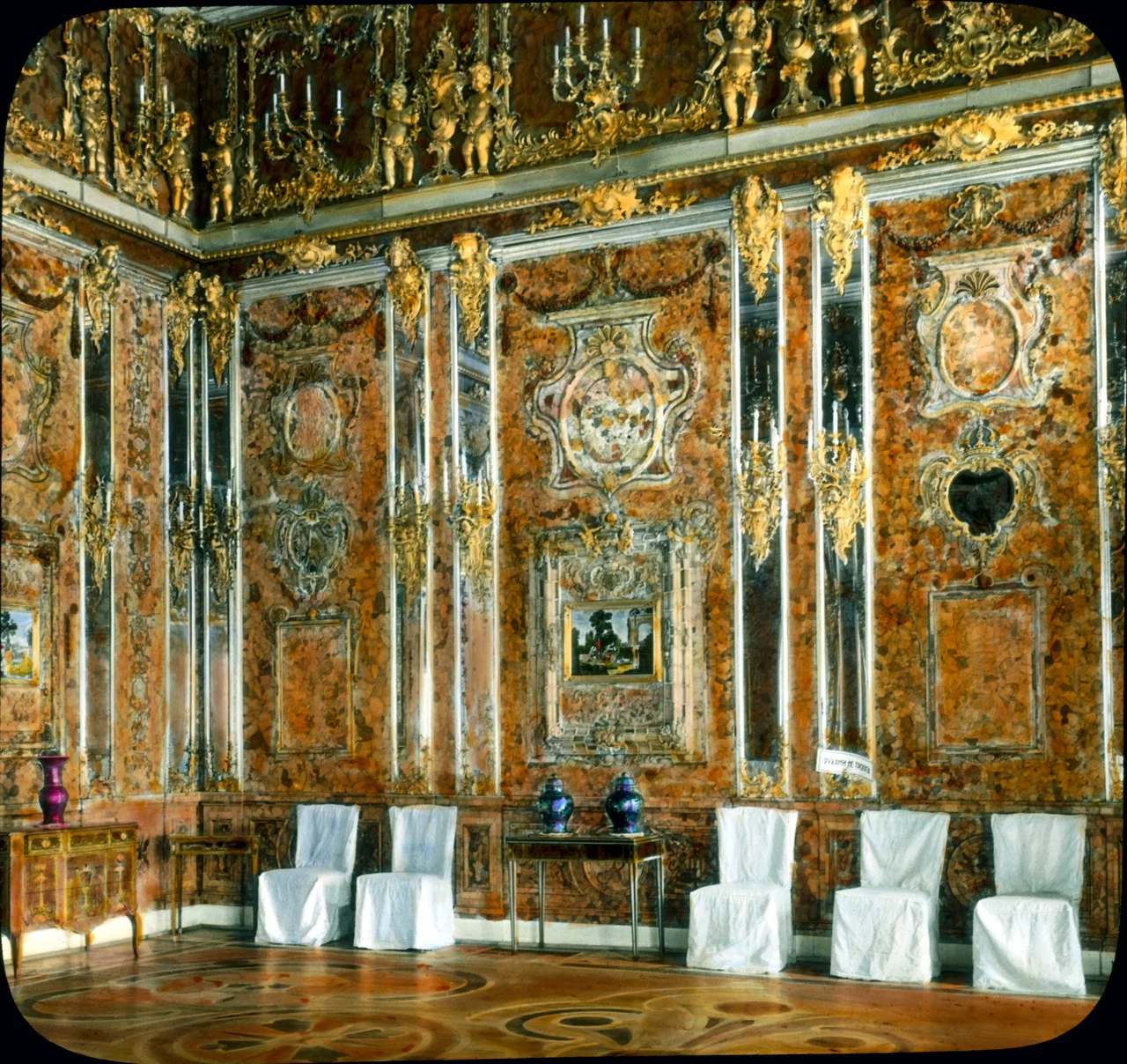
Of all the rooms Rastrelli built, the most famous is the one that no longer exists in its original form. The Amber Room was a chamber lined entirely with carved amber panels, originally crafted in Prussia by Andreas Schluter and given to Peter the Great by King Frederick William I in 1716. Rastrelli reinstalled it at Catherine Palace and added gold leaf and mirrors. Six tons of amber, glowing in candlelight, drew comparisons to a sunlit honey jar. In September 1941, German army units occupied Tsarskoye Selo. Soviet curators tried to hide the room behind wallpaper. The Germans found it within hours, dismantled the panels in thirty-six hours, and shipped them to Konigsberg. The panels were last documented in Konigsberg Castle in early 1945. Then they vanished. They have never been recovered. From 1979 to 2003, Russian craftsmen rebuilt the room from black-and-white photographs, archival drawings, and a single surviving color slide. The reconstruction opened on the tercentenary of Saint Petersburg, mostly faithful, completely beautiful, and still marked by what was lost.
Rooms in Sequence
The interior is organized as an enfilade, a long line of rooms whose doors align so that opening them all yields a single perspective stretching the entire wing. Beyond the Great Hall sits the small Courtiers-in-Attendance Dining Room, lit by four real windows and four false ones with mirrors behind them, a Rastrelli trick to multiply space. Across the Main Staircase is the White Formal Dining Room, where The Triumph of Apollo, a copy of Guido Reni, fills the ceiling. The Portrait Hall holds full-length canvases of the Romanov women: Catherine I, Elizabeth Petrovna, and Catherine the Great herself. Further north, the Green Dining Room marks the start of an entirely different sensibility. Charles Cameron, the Scottish neoclassicist Catherine commissioned in the 1770s, replaced Rastrelli's Hanging Garden with pistachio walls lined in stucco figures by Ivan Martos. The contrast is intentional. Catherine wanted Rastrelli's exuberance to give way to reason. The fire of 1820 destroyed the Cameron interiors, which were restored under Stasov.
Hollow Shell
When the Wehrmacht retreated from Tsarskoye Selo in January 1944, they left the palace gutted. Photographs from that winter show the rococo facade still standing in long stretches, but the roof was open to the sky and the interiors were ash. Soviet archivists, fortunately, had documented enough of the palace before the war that reconstruction became possible. In 1957, under Alexander Kedrinsky and the State Control Commission for the Preservation of Monuments, the work began. It is still going on. The Great Hall was restored by 1981. The Amber Room reopened in 2003. Smaller rooms continue to be returned to their pre-war state, panel by panel, gilt by gilt. The palace today is a national museum and one of the most visited sites in Russia. Walking its enfilade now, you are walking through both Rastrelli's vision and the patient labor of restorers who decided that what war takes can sometimes be made again.
From the Air
Catherine Palace sits at 59.716°N, 30.396°E in the town of Pushkin, about 30 km south of central Saint Petersburg. The 300-meter-long sky-blue and white facade with its gilded chapel cupolas is one of the easiest landmarks in the area to identify from the air. Pulkovo (ULLI) lies about 16 km northwest and routes inbound to RWY 28L pass close enough on clear days to see the parade plaza. Recommended viewing altitude 2,000 to 3,500 ft AGL. The roofline gilding catches morning light from the east; afternoon flights see better contrast on the western parade facade.
Nearby Stories
- Memorial to the Victims of Political Repression (Saint Petersburg) 2.8 km away
- English Palace 23 km away
- Battle of Kronstadt 38 km away
- Yam Fortress 73 km away
- Khutyn Monastery 96 km away
- Siege of Novgorod (1170) 108 km away
- Antoniev Monastery 128 km away
- Battle of Kollaa 243 km away