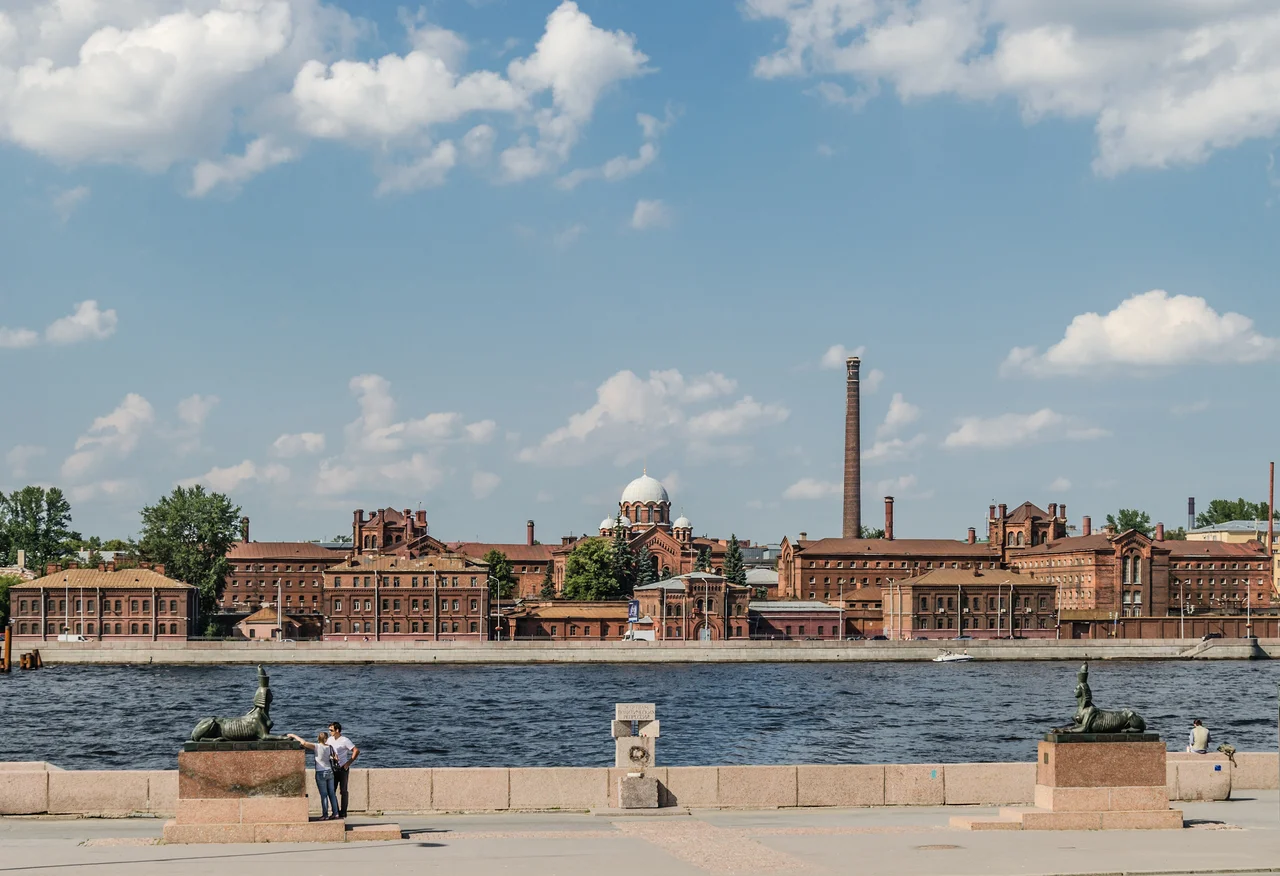

Memorial to the Victims of Political Repression (Saint Petersburg)
Stand on the Voskresenskaya Embankment and look at the sphinxes from the river side. You see skulls. Walk around to the side facing the apartment buildings and you see the profiles of young women. The sculptures by Mikhail Shemyakin, unveiled here on April 28, 1995, have two faces because the Soviet century had two faces: the official face it showed itself, and the face of the dead it would not name. Across the Neva looms Kresty Prison, the brick fortress where Anna Akhmatova spent seventeen months waiting in line to deliver parcels to her son Lev. She wrote Requiem for that line. The sphinxes face Kresty. They have not looked away.
The Women in the Line
Akhmatova stood outside Kresty in the winter of 1938. Behind her in the line, a woman with bluish lips whispered, Can you describe this? Akhmatova answered, I can. She wrote Requiem in fragments she dared not put on paper, memorizing each line and burning the drafts, the cycle finally published in full only after the Soviet Union fell. Her son Lev Gumilyov, the historian, was inside the prison. Her first husband Nikolai had been shot in 1921. Her second husband Nikolai Punin would die in a labor camp. The monument to Akhmatova herself, unveiled across the road in 2006, was placed according to her literary will from Requiem: she asked to be remembered facing the prison. The sphinxes and the poet now keep watch together over the same stretch of cold water.
Names Shemyakin Refused to Forget
The sculptures were created by Shemyakin in 1992, originally dedicated to the enslavement of the Jews in Egypt, with stars of David on their pedestals. When the work became the basis of the political-repression memorial, the stars were covered by anthology plaques bearing texts by writers and dissidents who knew Soviet terror from inside it: Akhmatova, Osip Mandelstam who died in a transit camp near Vladivostok in 1938, Andrei Sakharov, Joseph Brodsky, Vladimir Vysotsky, and others. The plaques name the literature that the regime tried to silence. Shemyakin himself was forced into exile by the KGB in 1971 for his nonconformist art. The architect Vyacheslav Bukhaev, who designed the surroundings with Anatoly Vasilyev, lost relatives in the camps. The monument was made by people who had reason to know what they were memorializing.
The Stones and the Cross
Between the sphinxes, fifteen meters apart, stands a structure of granite blocks arranged as an early Christian cross with a small lattice window at its center. Look through the window and your gaze lands on Kresty Prison across the river. A wreath of barbed wire crowns the cross like a crown of thorns. A granite book lies at the base, either the Soviet Penal Code or a list of victims, the meaning deliberately ambiguous. A pavement cross is laid out in stones between sphinxes and embankment, and according to the artists, each stone represents ten thousand victims of Soviet repression. The estimates of how many people died in Stalin's terror alone range from hundreds of thousands shot to millions worked to death in the Gulag. The stones do not pretend to count them all. They acknowledge that a count is owed.
Vandalism and Vigil
The monument has been attacked repeatedly. Plaques were stolen early on. A wreath disappeared. A bronze rose was pried off. On Hitler's birthday in April 2001 vandals knocked the central structure off the parapet. The granite book has been stolen at least twice. Each time the city, eventually, has restored it. Across the road at 4 Liteyny Avenue stands the Bolshoy Dom, the Big House, built in the early 1930s as the headquarters of the NKVD and now occupied by its successor the FSB; political prisoners were interrogated and killed inside. Since 1988, on the first Saturday of June, citizens have floated flowers on the Neva from the embankment between the Big House and Kresty, in memory of those whose graves are unknown. After Alexei Navalny died in an Arctic prison colony in February 2024, people came again to the sphinxes and laid more flowers.
From the Air
The memorial sits at 59.950 N, 30.364 E on the Voskresenskaya Embankment of the Neva River in central Saint Petersburg, directly across from the brick fortress of Kresty Prison. From the air the wide Neva and its embankments are the dominant landmark; the FSB building (Bolshoy Dom) is the prominent constructivist block at 4 Liteyny just inland. Nearest airport is Pulkovo (ULLI), 20 km south. Recommended low-altitude viewing 1,500-3,000 ft; the historic city center is restricted airspace, observe Russian regulations.
Nearby Stories
- Tsarskoye Selo 4.7 km away
- English Palace 17 km away
- Ingrian War 36 km away
- Khutyn Monastery 134 km away
- Battle of Fredrikshamn 151 km away
- Siege of Novgorod (1170) 166 km away
- Battle of Svensksund (1789) 189 km away
- Battle of Kollaa 205 km away