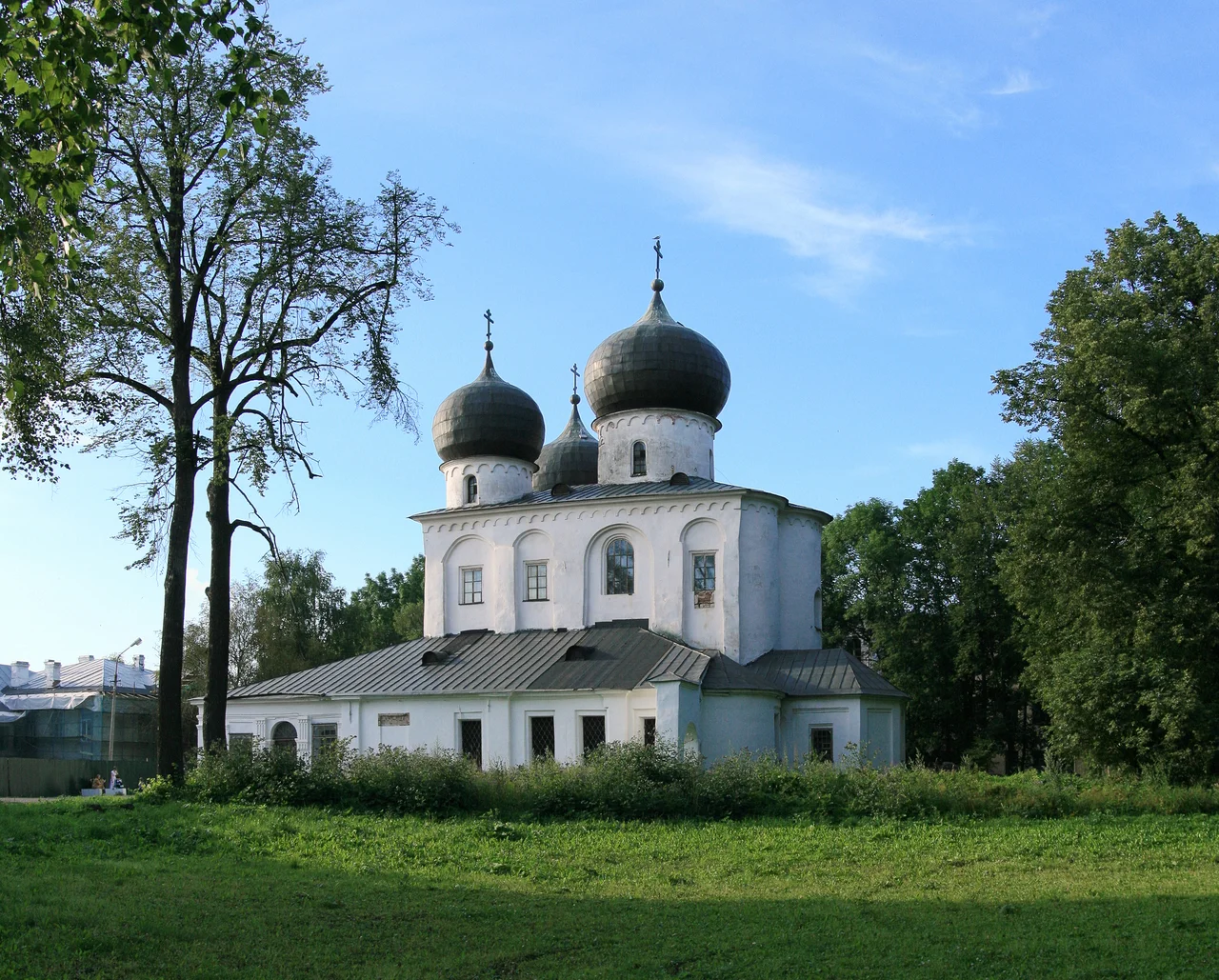

Antoniev Monastery
The legend is so strange that it has survived nine centuries of telling and retelling. An Italian monk named Anthony, fleeing persecution in Rome around the year 1106, climbed onto a rock by the sea to pray. Storms swept him away. After two days adrift, he washed up on the bank of the Volkhov River near Novgorod, more than two thousand miles from home. The rock is still there, in the vestibule of the church he built, sitting beneath a fresco of Bishop Nikita. Whether you believe the story or not, the monastery Anthony founded in 1117 is one of the few buildings in Russia that has survived from the twelfth century, and the man who supposedly drifted there from Rome on a stone is buried beneath a slab to the right of its altar.
An Improbable Founder
Anthony was born in Rome in 1067, in a Christian world that had only recently split between Latin West and Greek East. His family kept the Orthodox faith in a city that was turning sharply Catholic, and according to the tradition, the pressure on Eastern believers grew unbearable. Anthony took refuge with monks on a rocky shore. When the rock he prayed on was carried out to sea, he interpreted the journey as God's hand. Whatever actually happened on that voyage, by 1117 he was building a stone church on the Volkhov, and by 1131 the Archbishop of Novgorod had consecrated him hegumen, the abbot, of his own monastery. He was buried there in 1147.
Three Domes on the Volkhov
The Church of the Nativity of the Mother of God, completed in 1119, is one of only a handful of three-domed churches in all of Russia. Stand on the right bank of the Volkhov north of the old Kremlin and you can pick it out by that triple silhouette, white walls rising above the river meadows. Inside, fragments of medieval frescoes still cling to the apse, layered over by sixteenth and seventeenth century painting that has aged less gracefully. Most of what visitors see is patchwork, but the building itself is the rarity: nine hundred years of weather, war, and political upheaval, and it still stands.
A Monk Who Counted the Years
One of the monastery's most remarkable residents was Kirik the Novgorodian, a twelfth-century monk who wrote what scholars consider the first mathematical treatise in the Eastern Slavic world. His Teaching on Numbers worked out calendar calculations and the durations of small fractions of time. He also kept entries in the Novgorodian First Chronicle, the running record that gives historians most of what they know about medieval Novgorod. A monk in a riverside cloister, calculating eclipses and counting the seconds in a day, is not the image most people carry of medieval Russia. Antoniev is where that image gets corrected.
Ivan's Reach
The monastery grew wealthy, becoming the fourth-largest landowner among Novgorod's many religious houses. Then Moscow came. After Ivan III conquered Novgorod in the 1470s, much of Antoniev's land was confiscated. Worse arrived a century later: in 1570, during what historians call the Massacre of Novgorod, the troops of Ivan IV — Ivan the Terrible — descended on the city in a frenzy of suspicion. The hegumen and the monks of Antoniev were among the dead. The monastery slowly recovered through gifts and royal favor, especially after the relics of Anthony himself were rediscovered in 1597 and his cult expanded. By 1740 a seminary was attached, training generations of Russian Orthodox clergy.
Museum, Not Monastery
After the Bolshevik Revolution the monastery was closed, and unlike many Orthodox sites it has not been returned to the Russian Orthodox Church. It now belongs to the Novgorod United Museum-Preserve, part of the Historic Monuments of Novgorod and Surroundings UNESCO site. Visitors can walk the grounds, look up at the three white domes, and step into a vestibule where a worn rock sits under glass. The stone has no scientific provenance, but it has carried a story for nine hundred years. Whether Anthony rode it from Rome or simply chose it as a relic of his own legend, the rock is the monastery in miniature: improbable, persistent, half history and half faith.
From the Air
Antoniev Monastery sits at 58.54°N, 31.29°E on the right bank of the Volkhov River, about 3 kilometers north of the Novgorod Kremlin. The three white domes of the Church of the Nativity are unmistakable from low altitude in clear weather. Veliky Novgorod's airport (ULLN, Krechevitsy) lies 6 kilometers northeast; St. Petersburg Pulkovo (ULLI) is roughly 160 kilometers north. The Volkhov River and Lake Ilmen to the south are the dominant landmarks. Best viewed at 1,500 to 3,000 feet AGL with the river leading the eye through the city.
Nearby Stories
- Battle of Shelon 27 km away
- Novgorod Oblast 48 km away
- 1981 Pushkin Tu-104 Crash 89 km away
- Battle of Krasny Bor 92 km away
- Valday Iversky Monastery 106 km away
- Catherine Palace 122 km away
- Pskov Oblast 140 km away
- Lonin Museum of Veps Ethnography 344 km away