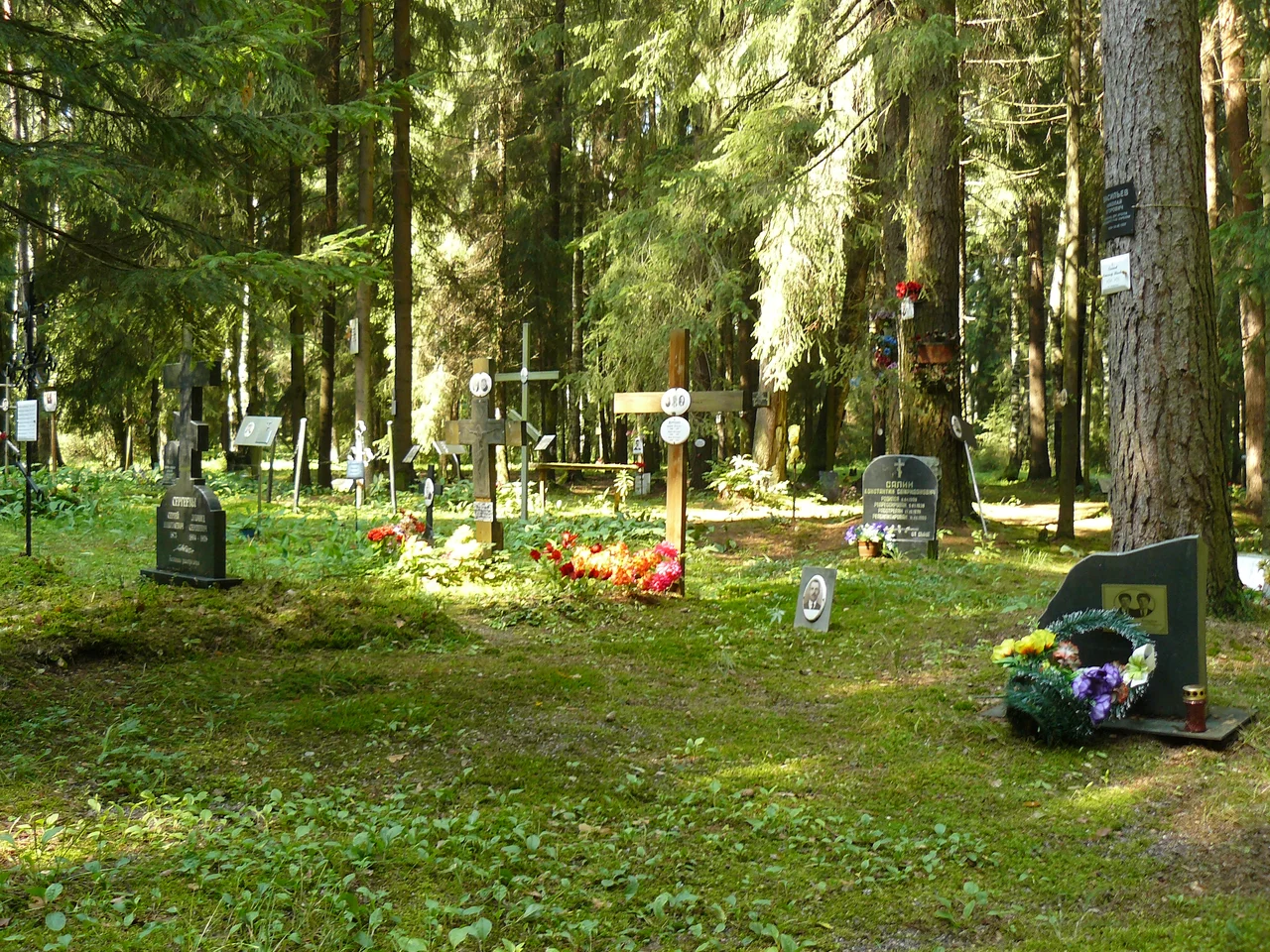

Levashovo Memorial Cemetery
In the spring of 1989, a small group of Russians went looking through a fenced patch of forest north of Leningrad. They were members of Memorial, a new human-rights organization founded the year before to document Soviet political repression. Their guide was V. T. Muravsky. The fence belonged to the KGB, and behind it lay 6.5 hectares of pine and birch that the security services had used since 1937 as a secret burial ground. Muravsky's group found the bodies the regime had hidden for fifty years. The FSB, successor to the KGB and NKVD, finally handed the area over to the city in 1990. Archival evidence suggests that 19,540 people are buried at Levashovo, 8,000 of whom were shot during Stalin's Great Terror of 1937 and 1938. None of them lies in a marked grave.
Who They Were
The lists at Levashovo are a portrait of who Stalin's purges actually killed. Not generals and politburo members, though some of those are here too. Mostly ordinary Leningraders: factory workers, teachers, engineers, a tram driver arrested for telling a joke, a librarian denounced by a neighbor, energy workers shot by the NKVD because their power station had a production shortfall. They were Russians, but they were also Latvians, Estonians, Lithuanians, Poles, Finns, Germans, Jews, Italians, Norwegians, Assyrians, Belarusians, Ukrainians. Some were Russian Orthodox priests; some were Catholics; some were Seventh-day Adventists; some were deaf workers from a Leningrad factory who couldn't even hear the accusations. They were arrested at night, processed at Leningrad's NKVD prisons, often tortured into signing confessions, sentenced in proceedings that lasted minutes, shot in basements, and trucked here in the dark.
The Names Being Restored
Among those known to have been buried at Levashovo: Boris Kornilov, the poet whose lyrics for the song Morning Greets Us with Coolness were sung across the Soviet Union, executed in 1938. Benedikt Livshits, a poet of the Russian Futurist circle, executed in 1938. Nikolay Oleynikov, an absurdist children's writer, executed in 1937. Anna and Rudolf Tieke, German communists who had fled Hitler to find safety in Stalin's Russia, instead found the same death. Igor Akulov, a senior party official. Nikolai Voznesensky, sentenced in 1950 as the alleged leader of the Leningrad Affair, the postwar purge of Leningrad's wartime leadership. Project Their Names Restored, run from the Russian National Library, has spent decades returning names to faces, building books of remembrance from the NKVD archives so that families can know what happened to their grandparents.
The Memorials Came Later
When Levashovo was opened in 1990, there was nothing there. Just the woods, and the knowledge of what lay beneath them. The first collective memorial, the Moloch of Totalitarianism, sculpted by Nina Galitskaia and Vitaly Gambarov, was placed at the entrance in 1996. After that came memorials added one ethno-confessional group at a time: Latvians, Lithuanians, Poles, Finns, Estonians, Italians, Russian Germans, Soviet and Russian Jews, Belarusians, Ukrainians, Norwegians, Assyrians. The Italian memorial in 2007 commemorates Italian victims of the Soviet Gulag. By 2017, more than 1,300 personal plaques and memorials had been added by the families of victims, scattered across the 6.5 hectares. Each plaque marks a remembered person, but not their grave: nobody knows which body lies where. The acts of memorial are symbolic, the location of any specific person impossible to determine.
Three Days of Remembrance
Three annual gatherings mark the cemetery. On 25 January, or the nearest Sunday, the Saint Petersburg Metropolitan of the Russian Orthodox Church celebrates the Feast of Russia's New Martyrs and Confessors, honoring the Orthodox clergy and laity executed by the Soviet state. In June, solemn ceremonies are held in remembrance of the victims of political repression. On 30 October each year, the Day of Remembrance of the Victims of Political Repressions, the Memorial Society and other NGOs gather at Levashovo with city officials, diplomats, foreign delegations, and the families and descendants of the dead. In 2016 the gathering drew representatives of every ethno-confessional group with a memorial in the woods. They came to read names, light candles, and stand on ground that for half a century the state pretended did not exist.
Memorial Was Outlawed
The Memorial Society that found Levashovo and helped open it to the public was forcibly liquidated by Russian courts in late 2021, on technical pretexts that observers around the world recognized as a political decision. For thirty years Memorial had been one of the most important historical organizations in Russia, building databases of victims, recovering archives, organizing the recovery of execution sites like Levashovo, Butovo near Moscow, Sandarmokh in Karelia, the Kommunarka shooting ground. The work continues despite the liquidation, scattered across smaller groups and individual researchers, but the institutional infrastructure for telling the truth about Soviet repression in Russia has been largely dismantled. Levashovo remains. The memorials remain. The 19,540 people in the soil remain. The annual gatherings still happen, smaller now, more difficult, more important.
What the Wasteland Means
Russians call this place the Levashovskaya Pustosh, the Levashovo Wasteland. Pustosh suggests something abandoned, empty, fallow. It is also, in this context, a refusal: a refusal to call this a normal cemetery, a refusal to pretend the dead were buried with dignity, a refusal to forget that the wasteland was made on purpose. Levashovo is the largest mass burial site of Stalin's terror in the Saint Petersburg region. It is one of hundreds across Russia, in forests outside Moscow, Karelia, the Urals, Siberia. Most of those sites were never identified. The fact that Levashovo was identified, opened, and turned into a place of public mourning was a small triumph of the late Soviet years, when truth-telling briefly seemed possible. The plaques in the woods are quiet evidence that the truth, once told, doesn't easily go back into the ground.
From the Air
Levashovo Memorial Cemetery sits at 60.094 degrees north, 30.191 degrees east, near the village of Levashovo about 25 km northwest of central Saint Petersburg. From altitude, look for a 6.5-hectare patch of pine and birch forest just east of the Vyborg highway and rail line, with no obvious built structures, the cemetery deliberately preserved as woodland. Levashovo Air Base lies a few kilometers to the south. Pulkovo Airport (ULLI) is approximately 35 km south-southeast. The site reads as forest from above, distinguishable mainly by the small entry path and the surrounding fenced perimeter.
Nearby Stories
- Battle of Krasny Bor 11 km away
- Battle of Kronstadt 16 km away
- 1981 Pushkin Tu-104 Crash 18 km away
- Ingrian War 20 km away
- Battle of Fredrikshamn 132 km away
- Khutyn Monastery 167 km away
- Battle of Svensksund (1789) 170 km away
- Battle of Kollaa 213 km away