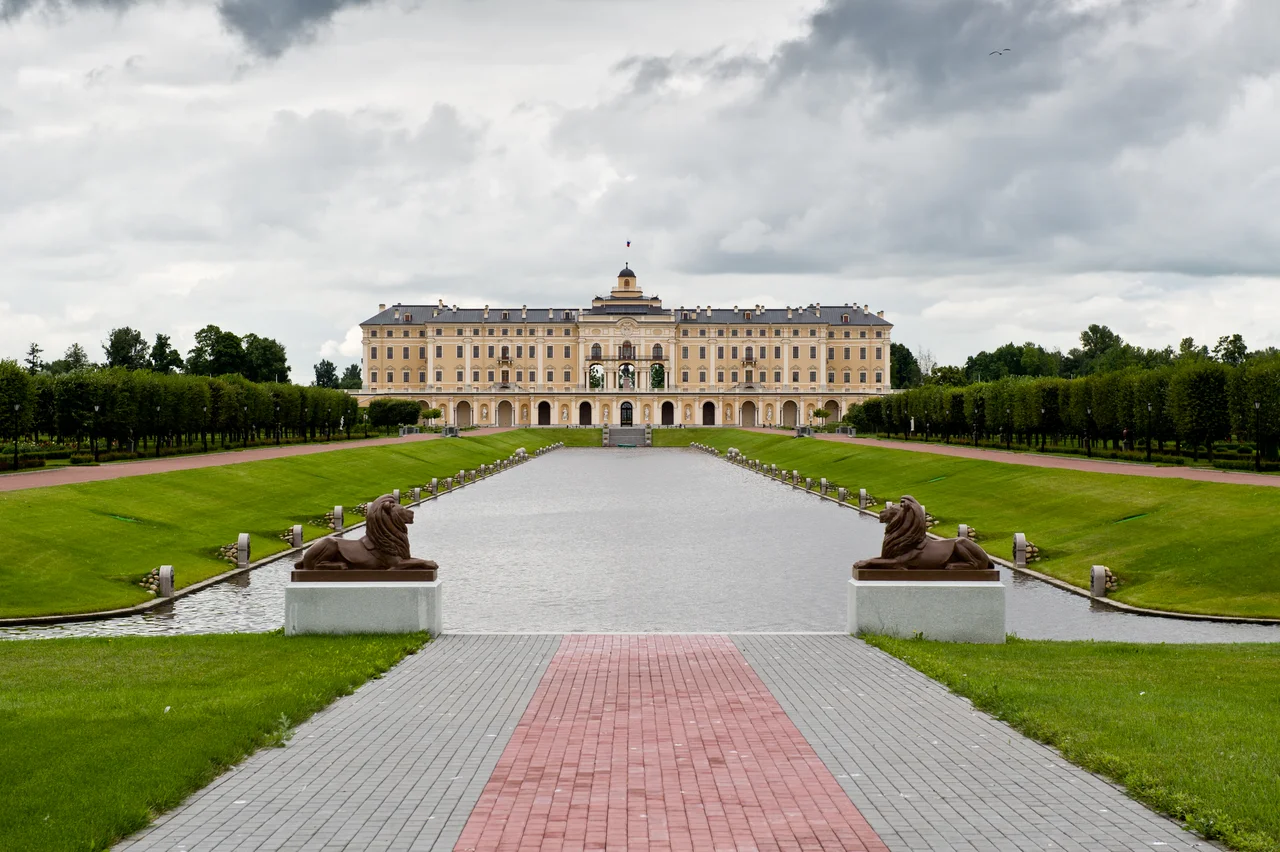

Constantine Palace
Peter the Great wanted his own Versailles. As early as 1709 he was sketching plans for a palace on the southern shore of the Gulf of Finland that would surpass anything in France, with grand fountains spraying continuously through the summer. The Italian architect Sebastiano Cipriani's first plan was too complex. The French architect Jean-Baptiste Le Blond got the commission in 1715 and died four years later. The Italian Nicola Michetti took over and laid the foundation on June 22, 1720. Then a German hydraulic engineer named Burkhard Münnich looked at the elevations and told Peter the truth: keeping the fountains running would flood the surrounding river basins, much of which sat below ten meters above sea level. Peter abandoned the dream. He built his Versailles a few kilometers west, at Peterhof. The palace at Strelna stood unfinished for a long time, eventually completed and reworked by Voronikhin and Stackenschneider, gutted by the Wehrmacht, restored by 1950, and then, in 2000, absorbed into the property portfolio of the Russian presidency.
The Grand Duke's House
In 1797 Tsar Paul I gave the still-evolving estate to his son, Grand Duke Konstantin Pavlovich. The palace took his name. Konstantin was the second son, technically not in line for the throne, and after a fire in 1803 the architect Andrey Voronikhin and the Italian-trained Luigi Rusca rebuilt the interiors in classical style, adding a belvedere on the roof and a ceremonial enfilade on the piano nobile. The artist Fyodor Shcherbakov painted the new ceilings. Then in the 1840s the palace passed to Grand Duke Konstantin Nikolaevich, son of Nicholas I, and the architect Andrei Stackenschneider added bay windows, balconies, and an eclectic mix of revival styles. A house church went in. The Konstantin family used the palace mostly in summer and autumn. Grand Duke Konstantin Konstantinovich, who wrote poetry under the pen name K. R., raised his large family there. His brother Dmitry, who actually owned the estate, lived in it more permanently with their mother Alexandra Iosifovna. The dethroned Greek queen Olga Konstantinovna kept her personal apartments here after the murder of her husband, King George I of Greece, in 1913.
Soviet Years
After the October Revolution the palace was nationalized and put to a long sequence of utilitarian uses. The First Strelna School-Colony moved in. Then in 1937 it became a sanatorium. Soviet Navy command training courses followed. When the German army occupied this stretch of the Gulf of Finland in 1941 the palace was almost completely destroyed. By the time Soviet troops reentered Strelna only the stone shell remained: roof gone, interiors burned, gardens torn up. Restoration began immediately. By 1950 the palace was structurally rebuilt, and in 1955 the building was handed to a naval school that trained hydrometeorologists, aerologists, radio operators, electrical engineers, and ship mechanics for polar stations and the merchant fleet. The cadets did much of the restoration work themselves over the next four decades. When the school closed in 1990 the palace was suddenly without an owner. It sat largely vacant through the 1990s, the gardens overgrown, the canal system silted in.
The Palace of Congresses
In 2000 the palace and roughly one hundred and forty hectares of surrounding land were transferred to the Directorate of the President of the Russian Federation. A massive restoration program followed. Facades and interiors were rebuilt from old drawings. Hydraulic engineers deepened the reservoirs to take yachts. Bridges and fountains that Peter the Great had drawn but never built were finally constructed. Three of the bridges open as drawbridges. The result is not exactly a restoration; it is a new construction shaped by what the palace had been and what each of its owners had added. After the work was done, the building acquired a second name: the Palace of Congresses. The reconstructed palace opened on May 30 and 31, 2003, timed to the tercentenary of Saint Petersburg. A consular village of twenty two-story cottages went in along the Gulf of Finland shore. The five-star Baltic Star Hotel, built to look like an old Russian estate, opened nearby. The former yacht club became a press center.
Where Heads of State Meet
In July 2006 the Constantine Palace hosted the 32nd G8 summit. Vladimir Putin, then president, brought George W. Bush, Tony Blair, Jacques Chirac, Angela Merkel, and the others to walk through Peter the Great's never-quite-Versailles and to sit at meeting tables in rooms that had been smoldering ruins six decades earlier. The palace hosted again in September 2013, when the G20 summit met in Saint Petersburg, dominated by the question of what to do about Syria. In 2015 the draw for the qualifying tournament of the 2018 FIFA World Cup was held inside the palace. The complex is a specially protected area now and visitors can enter only with guided excursion groups. The palace's second life as the Kremlin's seaside venue has been a deliberate piece of state-building. Whether you read it as restoration of national heritage or as the conscription of a Romanov estate into a particular kind of contemporary politics depends on where you stand.
The Statue and the Collection
At the main entrance now stands an equestrian statue of Peter the Great, a copy of one originally cast in 1910 for the bicentenary of the Treaty of Nystad and erected in Riga. The Riga original was hidden in a Latvian forest during Soviet times, recovered, and restored by entrepreneur Yevgeny Gomberg, who provided the casts from which the Strelna copy was made. Inside, the palace holds the Rostropovich-Vishnevskaya art collection, eight hundred and fifty-three items including eight works by Boris Grigoriev, donated to the state by Alisher Usmanov in 2007 after he bought the collection at Sotheby's the day before its scheduled auction. The exhibition was opened by Vladimir Putin in May 2008. Among the highlights is Grigoriev's painting Faces of Russia from his Race cycle, painted in Paris in 1921. Grigoriev was an émigré whose name was suppressed in his homeland for decades. His paintings are now hanging in a palace where the Russian president receives heads of state.
From the Air
Constantine Palace stands at 59.854°N, 30.058°E in Strelna, on the southern shore of the Gulf of Finland about 19 km west of central Saint Petersburg. The palace's symmetrical baroque facade with its central dome is visible from the gulf side, with the canals and consular village stretching toward the water. Pulkovo (ULLI) is roughly 22 km southeast. Note that as a working presidential residence the airspace immediately above and around the palace is restricted; check current NOTAMs before any approach. Best viewed from the gulf side approach to ULLI, with the palace silhouette visible against the inland tree line. Recommended observation altitude 3,000 to 5,000 ft AGL.
Nearby Stories
- Battle of Krasny Bor 20 km away
- Ingrian War 28 km away
- Yam Fortress 58 km away
- Ivangorod Fortress 107 km away
- Khutyn Monastery 121 km away
- Battle of Fredrikshamn 137 km away
- Battle of Svensksund (1789) 173 km away
- Battle of Kollaa 231 km away