
Battles of Wenden (1577–1578)
Some places get conquered three times in fourteen months. Wenden — modern Cēsis in northern Latvia — was one of them. Between August 1577 and October 1578, this single hilltop castle changed hands four times, was sacked once, was the site of a mass suicide by gunpowder, and finally became the place where Ivan IV's long, ruinous Livonian War effectively ended. Few towns in northern Europe have absorbed so much history into so small a space in such a short time.
Ivan's Bigger War
The Livonian War had been grinding on since 1558, when Ivan IV of Russia — the tsar history would call 'the Terrible' — invaded the territories of the old Livonian Confederation looking for an outlet to the Baltic. By the 1570s the war had drawn in everyone with a coastline on the eastern Baltic: the Tsardom of Russia, the Polish-Lithuanian Commonwealth, the Kingdom of Sweden, the Kingdom of Denmark, and the curious puppet 'Kingdom of Livonia' that Ivan had created under the Danish prince Magnus, Duke of Holstein. Ivan had survived a bad stretch in 1570-71, including a horrific massacre of Novgorod's own inhabitants by his oprichnina enforcers and the burning of Moscow by the Crimean Tatars. He recovered. By 1577 he was on the offensive again, sweeping through Livonia with tens of thousands of Russian soldiers, Cossacks, and Tatar auxiliaries — a different kind of army from the small mercenary forces his rivals fielded.
The Suicide in the Castle
In August 1577, Magnus of Livonia — the figurehead king Ivan had set up — besieged Wenden himself, hoping to make it a capital. Ivan deposed him almost immediately and sent his own forces to finish the siege. What happened next is one of the war's grimmer episodes. The garrison of Wenden, knowing Ivan's reputation and aware they had fired their cannons at him personally during the siege, were promised in return what the chronicles called 'a terrible fate' if the castle fell. Rather than surrender to that, a portion of the garrison gathered in the keep and blew themselves up with about four pounds of gunpowder. Wenden fell to Ivan in September 1577. He installed four new voivodes — Russian provincial governors — to administer the surrounding territory. The sack of Wenden was a great symbolic victory. It was also nearly the last one Ivan got.
An Anti-Ivan Coalition
Ivan had managed something rare: he had united nearly every other power in the region against him. John III of Sweden held only Reval (Tallinn). Stephen Báthory, the formidable new king of Poland-Lithuania, held only Riga. Frederick II of Denmark was confined to the island of Ösel, the modern Estonian Saaremaa. Magnus, released by Ivan, abdicated in 1578 and retired to Piltene in Courland. In November 1577, only weeks after the Russian sack, Polish forces retook Wenden. A Russian counter-attack in February 1578 was beaten back. Then in October 1578, Ivan tried again, sending another army to besiege the castle. This time a smaller Swedish-German-Polish relief force came up against him — the only occasion in the entire Livonian War when Sweden, Poland, and Lithuania actually fought together on the same battlefield. The right flank was Lithuanian cavalry under Andrzej Sapieha, about two thousand strong. The left was Swedish infantry under Göran Boye, also about two thousand strong.
What the Numbers Hide
The Russian cavalry was defeated first; their horses were captured in such numbers that the entire Swedish infantry rode them back to Reval afterward. A seventeenth-century Russian sinodik — a book of names of the dead to be prayed for — lists 162 men killed at Wenden, but the manuscript admits the list is incomplete and excludes much of the army. The wider Livonian War had, by this point, killed many tens of thousands of soldiers and far more civilians; modern estimates of the total dead from the conflict run into the low hundreds of thousands. The single chronicle phrase 'a massacre of 6,000 of its citizens' refers to one episode in this larger campaign. The October 1578 victory at Wenden forced Ivan to accept what he had spent twenty years trying to avoid: an unfavourable peace. The Truce of Jam Zapolski with Báthory in 1582 returned almost all Russian gains in Livonia. The war was over. Ivan had achieved nothing, and Russia would not gain a Baltic port until Peter the Great took one by force a century and a quarter later.
Cēsis Today
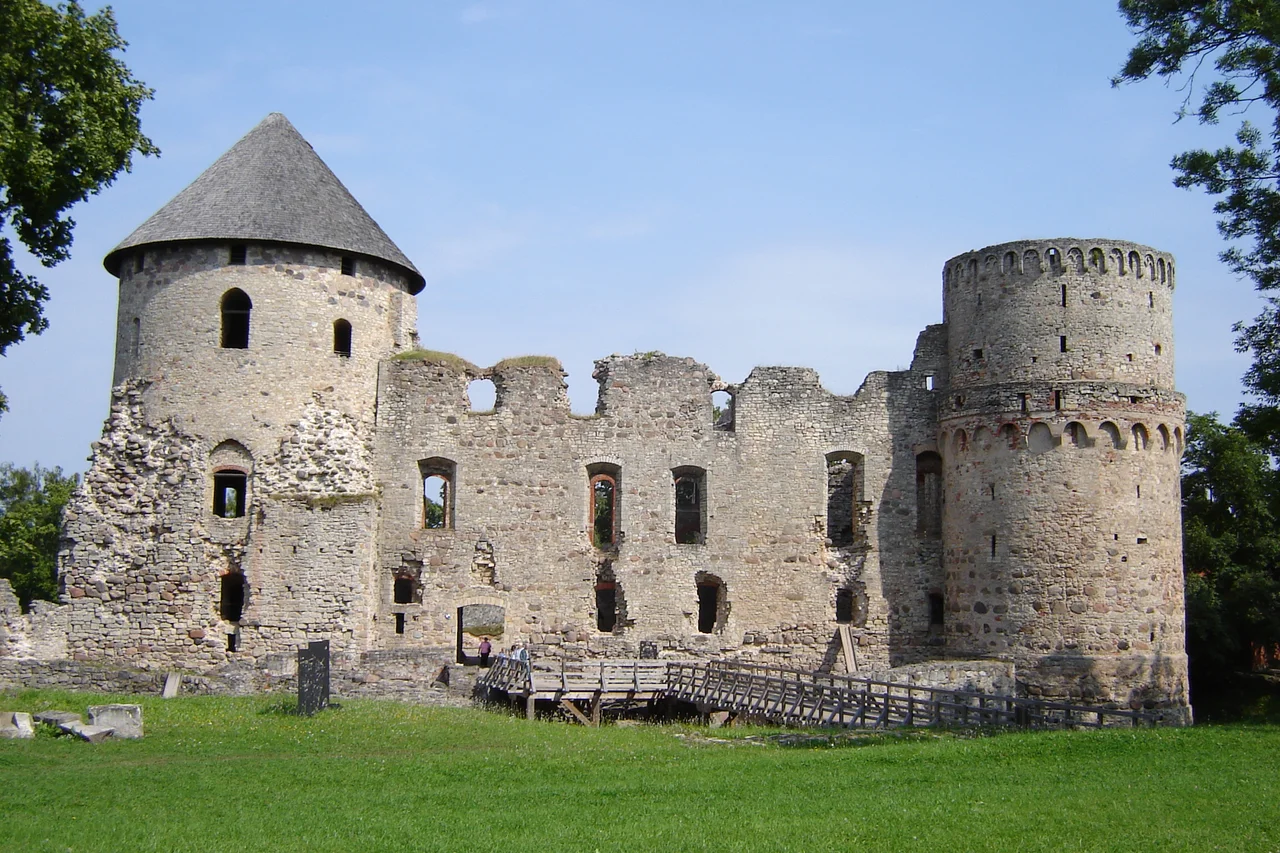
Modern Cēsis is a small Latvian town of about fifteen thousand, surrounded by the rolling forests, lakes, and ravines of Gauja National Park. The medieval castle whose garrison blew itself up is one of the best-preserved order castles in the eastern Baltic, with substantial intact towers, restored interior chambers, and a small museum. Visitors today are handed candle-lanterns to explore the unlit lower levels — a small touch that captures, briefly, what these stone passages would have felt like to the men who waited in them for Ivan's army outside the walls. From above, Cēsis sits on a low ridge between the meandering Gauja River and the surrounding agricultural plains, its red tile roofs gathered tightly around the dark hill of the castle and its cathedral spire. It is one of the prettiest small towns in northern Europe — and, for a short stretch in the late 1570s, one of the more violent places on the continent.
From the Air
57.31°N, 25.27°E, in northern Latvia at the town of Cēsis, in the rolling forested country of the Gauja River valley. Cruise at 5,000–10,000 ft for the best view of the wooded hills, the meandering Gauja, and the surrounding patchwork of lakes and farmland. Nearest major airports are Riga International (EVRA) about 80 km southwest and Tallinn Lennart Meri (EETN) about 230 km north. The medieval castle of Cēsis, with its surviving towers, is a striking landmark in the town center.
Nearby Stories
- Latvian War of Independence 19 km away
- Battle of Ērģeme 19 km away
- Battle of Salis 19 km away
- Riga Offensive (1917) 25 km away
- Gaujiena Castle 46 km away
- The Ethnographic Open-Air Museum of Latvia 49 km away
- Estonian War of Independence 55 km away
- Daugavpils Fortress 147 km away