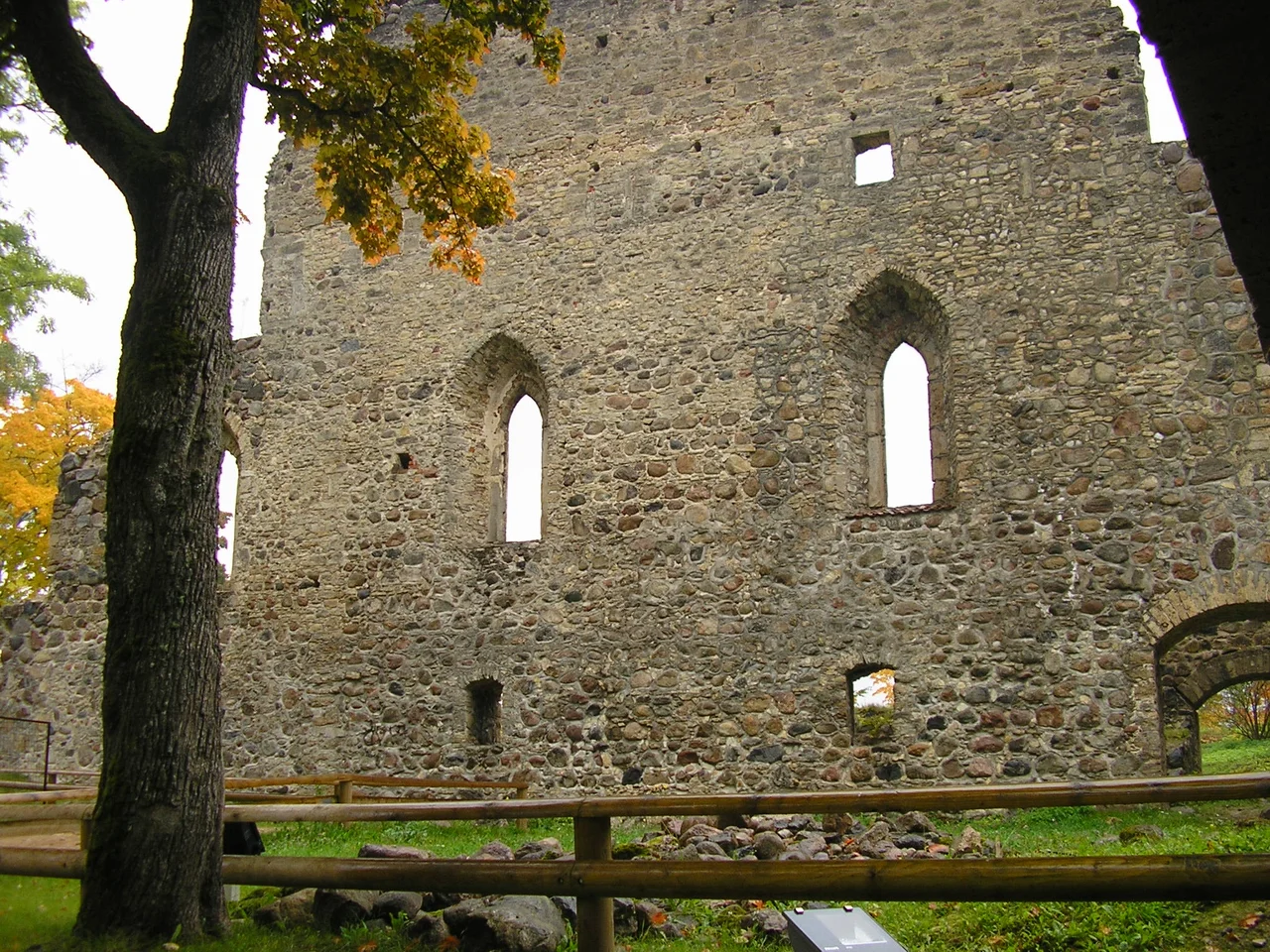

Sigulda Medieval Castle
On a wedge of high ground above the Gauja valley, three steep slopes form a natural fortress. Sometime between 1207 and 1209, a German military order called the Brothers of the Sword, founded only five years earlier in Riga as the first warrior-monk order outside the Mediterranean, began stacking dolomite blocks on the bluff. The walls were three meters thick. The basement vault was supported by a single Roman-style column. From the top, sentries could see across the river to where the Bishop of Riga's men were building a rival fortress at Turaida, on the other bank. Rivalry between the bishop and the order would define the next two centuries of Livonian politics, and the castle on the bluff at Sigulda was, from its first stone, a watch tower aimed at a friend.
Warrior Monks at the Gauja
The Livonian Brothers of the Sword, officially the Militia of Christ of Livonia, had been founded in 1202 by Bishop Albert of Riga and the Cistercian abbot Theoderich von Treyden. Their cape carried a red sword and a red cross. Their mission, as they understood it, was to defend the conquered Christian territories of Livonia and to extend them. In 1207, in a land division between Bishop Albert and the order, the Brothers received the territory along the left bank of the Gauja River. Master Venno of the order chose the bluff at Sigulda as his strategic anchor. According to the verse Rhymed Chronicles, the castle was begun under his direction. The Livonian Chronicle of Henry, written within decades of the events, says the Brothers used the castle as a base while fighting Livonian rebels who were attacking from a nearby fortress. By 1224, the year Pope's legate Wilhelm of Modena stayed at Sigulda and established a church and parish, the order's hold was secure.
Convent Castle and Land Marshal
In 1237, after the Brothers of the Sword were defeated by Lithuanians at the Battle of Saule, the order's surviving lands were absorbed by the Teutonic Order. The Sigulda castle became Livonian Order property. From the late thirteenth through the late fourteenth century, it was rebuilt in the convent type: a square central complex with an inner courtyard surrounded by three buildings, with three-meter dolomite walls, a chapel ten meters wide on the second floor with Gothic window lintels and a lancet arch, and weapon storage on the third. Local stone made up most of the construction; dolomite and limestone framed the architectural elements. From 1432, Sigulda Castle was the residence of the Land Marshal of the Livonian Order, the second-highest officer, ranked just below the Master himself who lived in nearby Cesis. For a century the castle ran the order's military affairs across what is now Latvia and southern Estonia. The four-story gate tower built around 1400, the drawbridge over the southern ditch, the machicolations rebuilt as firearms evolved in the second half of the fifteenth century, all date from this peak.
Wars and Ruin
The Livonian War broke the order in the mid-sixteenth century. Sigulda was damaged at the war's outset, and in 1562 the lands became part of the Duchy of Livonia under Polish suzerainty. From 1566 it served as the residence of the Polish governor Jan Hieronimowicz Chodkiewicz; the Poles repaired what they could. The Polish-Swedish War in the early seventeenth century damaged the castle again. In 1622 it was restored once more, with a new residential building and a sauna added. In 1625, the King of Sweden gave Sigulda to Privy Councillor Gabriel Gustafsson Oxenstierna, but the Swedish manor reduction program took it back to state ownership. A 1680 layout drawing of the castle survives in the Stockholm War Archive. Then came the Great Northern War, and the castle was abandoned. In 1737 it became private property, passing through the Governor of Livland Peter Lacy, then George Browne, then the von der Borch family, who in the early nineteenth century did what wealthy nineteenth-century landowners did with medieval ruins: admired them as romantic.
Reconstruction and Tourism
In 1867 a new gate was added, dated by an inscription, with the Borch family coat of arms above it. Two pseudo-Gothic arches were constructed alongside as the ruins were stabilized. The Kropotkin family built the New Castle next door from 1878 to 1881. After Latvia became independent in 1918, the Monument Board took over the ruin's care; Karl Woldemar von Lowis of Menar found a seventeenth-century reconstruction plan in the Stockholm archives in 1922, and the Estonian art historian Armin Tulse documented the actual construction phases. Serious archaeological work began in 1962 under architect Tatjana Vitola, with major excavations supervised by Normunds Treijs from 1987 to 1988 and Janis Ciglis in 1997. In 2011, the European Union co-funded a project titled Reconstruction of Sigulda Castle Ruins and Infrastructure Adjustment for Tourism Development; it concluded in 2012, and the castle reopened to visitors. Today you can climb the North Tower and the Main Gate Tower and look across to Turaida, eight hundred years after the first sentries did the same.
From the Air
The medieval castle ruins lie at 57.17°N, 24.85°E in Sigulda, about 50 km northeast of Riga, on a bluff above the Gauja River. The principal airport is EVRA (Riga International). From altitude, look for the deep sandstone gorge of the Gauja National Park, with the medieval ruins, the New Castle, and Turaida's red brick keep visible together across the valley. The North Tower and Main Gate Tower are the most prominent surviving elements of the medieval complex. Recommended viewing altitude FL180–FL280; the dark band of the Gauja's forested gorge is the unmistakable landmark.
Nearby Stories
- Freedom Monument 8.8 km away
- Daugavgrīva Fortress 23 km away
- Lielvārde Castle 27 km away
- Koknese Castle 36 km away
- Battle of Salis 40 km away
- Battle of Ērģeme 47 km away
- Battle of the Gulf of Riga 54 km away
- Battle of Selburg 73 km away