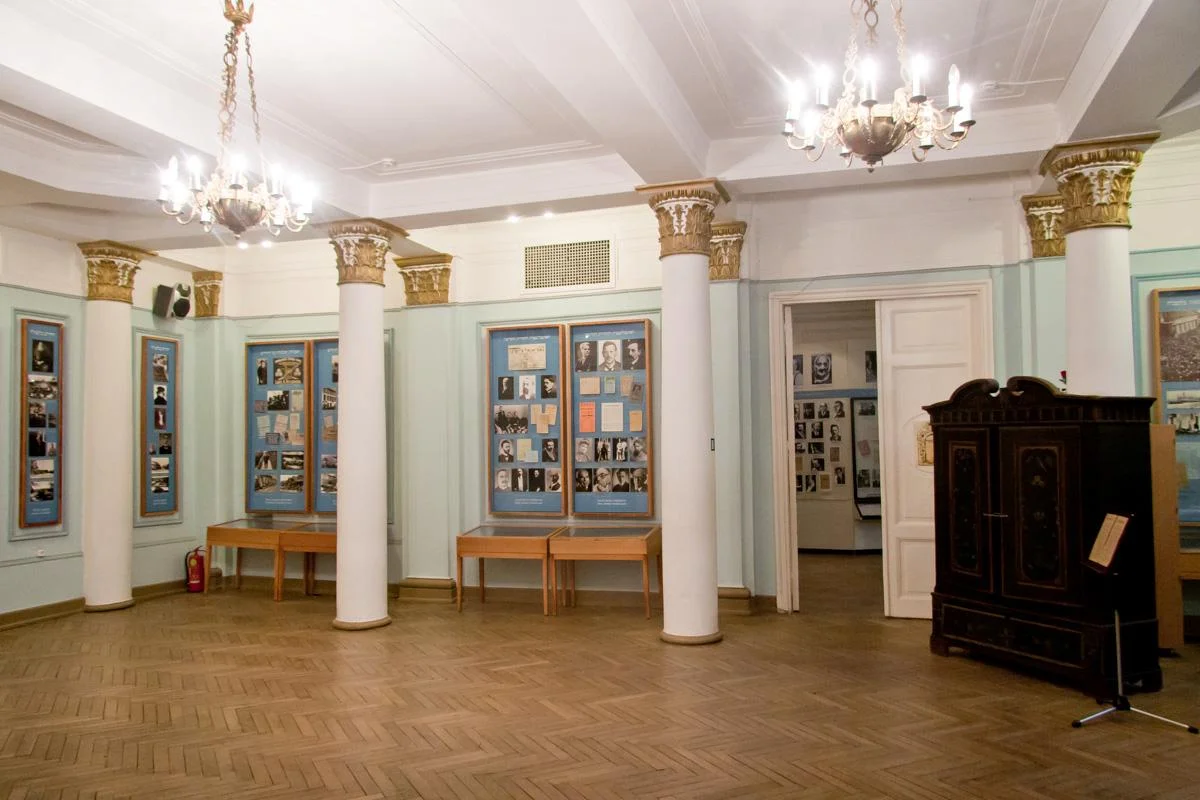

Jews in Latvia (museum)
A French filmmaker named Philippe Labrune was visiting the museum in Riga when he stopped in front of a photograph. Four women and a girl, taken sometime before 1941. The girl was perhaps ten years old. Labrune wanted to know who she was. The investigation took months. Her name was Sorella Epstein. She had been murdered at the age of ten in 1941, one of the seventy thousand Latvian Jews killed during the Holocaust. Labrune made a documentary about his search, broadcast in France in 2015. That photograph - one image among thousands in the museum's collection - represents what this museum does. It puts faces on numbers. It returns names to people who were murdered as anonymous statistics. It is the work of remembering, and it began in 1989 with a small group of survivors who refused to let the dead disappear.
Four Centuries of Latvian Jewish Life
Jews first arrived on what is now Latvian territory in the sixteenth century. They came from Lithuania, from Poland, from German lands - Yiddish-speaking, Orthodox in religious practice, working as merchants, peddlers, craftsmen, scholars. The community grew slowly under various Polish, Swedish, and Russian rulers, with periodic restrictions and expulsions. By the nineteenth century there were significant Jewish communities in Riga, Daugavpils, Liepaja, Jelgava, and dozens of smaller towns. The 1897 Russian census counted roughly 142,000 Jews in what would later become Latvian territory - about eight percent of the population. The interwar Latvian Republic that emerged after the First World War granted Jews full citizenship rights. Jewish schools, newspapers, theaters, sports clubs, and political parties flourished in Riga. The community elected representatives to the Latvian parliament. By 1935 there were ninety-three thousand Jews in Latvia, including a vibrant Hebrew and Yiddish cultural life that was producing writers, artists, musicians, and scientists known across Europe. The museum's first exhibition hall covers this period - the centuries of building, the institutions, the daily life, the people.
1918 to 1941
The second exhibition hall covers the interwar Latvian Republic, the period when Latvian Jewry reached its full flowering and then was destroyed. Twenty-three years of independence. Six theaters. Multiple newspapers. The Riga Jewish theater that performed in this very building, which was constructed in 1913-1914 by architects Edmund von Trompowsky and Paul Mandelstamm specifically as a Jewish club and theater. The interwar period was not without antisemitism - the authoritarian Ulmanis regime of the late 1930s restricted Jewish economic life - but the community survived and adapted. Then came the Soviet occupation of June 1940, which deported some Jews along with non-Jewish Latvians to Siberia, and the German occupation of June 1941, which began the systematic murder of Latvia's Jewish population almost immediately. The transition from one to the other was a matter of weeks. The community that had built this building, performed plays here, held weddings and lectures here, was overtaken by events that would destroy nearly all of them within eighteen months.
Rumbula and the Riga Ghetto
The third hall is the hardest. It documents the Holocaust on Latvian territory. Of approximately ninety-three thousand Jews living in Latvia in 1941, about seventy thousand were murdered between June 1941 and the end of 1942. The Riga Ghetto, established in October 1941, held about thirty thousand people. On 30 November and 8 December 1941, in two days of mass shootings at the Rumbula Forest outside Riga, Einsatzgruppe A and Latvian auxiliaries murdered roughly twenty-five thousand Jewish residents of the ghetto. Mothers carrying babies. Old men. Children. They were marched in columns from the ghetto to the killing pits, made to undress, and shot at the edge of the graves. The Rumbula massacre was the second-largest single shooting operation of the Holocaust after Babi Yar. The Jelgava massacres, the Liepaja massacres, dozens of smaller killings across the country - the museum documents them all. The hall also documents the small number of Latvian rescuers who hid Jewish neighbors at risk to their own lives. Yad Vashem has recognized roughly 140 Latvians as Righteous Among the Nations. They are honored. They were not enough.
The Building and Its Survival
The museum building has its own history. Built in 1913-1914 as the home of the Riga Jewish community, it served as a club, theater, library, and gathering place. The German occupation took it over in 1941 and used it as a German officers' club. The Soviet occupation that followed used it for political education - Communist Party congresses and ideological events were held in halls where Jewish weddings had once taken place. The building was returned to the Jewish community in the early 1990s, after Latvia regained independence. It is now a state-protected architectural monument. The museum was founded in 1989 by Holocaust survivors under the leadership of Margers Vestermanis, a Latvian Jewish historian who had survived the Riga Ghetto and joined the Soviet partisans during the war. Vestermanis spent the rest of his long life - he died in 2024 - documenting what happened to his community. The current director, Ilja Lenskis, took over in 2008 and has expanded the museum's educational and research programs. About fourteen thousand items make up the collection: documents, photographs, books, ritual objects, the personal effects of vanished families.
A Small Community Today
Roughly five thousand Jews live in Latvia today. The community is small, aging, and quietly determined. Riga has a functioning synagogue, a Jewish school, a kosher restaurant, a community center. The Jews in Latvia Museum is part of this community - private, small, accredited by the state, not heavily funded. It does not have the resources of the major Holocaust memorials in Washington, Jerusalem, or Berlin. What it has is intimacy. The visitor walks through three halls and meets specific people. Sorella Epstein at age ten, photographed before her death. The members of the Jelgava synagogue choir. The shopkeepers and rabbis and teachers and Communist organizers and Hebrew poets and sports club captains who made up Latvian Jewry. Their names are recorded here. Their photographs are displayed. Their stories, where stories survive, are told. The museum does not exist to make visitors feel comfortable. It exists to make sure that what happened here is not forgotten - and that what existed here, before what happened, is not forgotten either. The work continues.
From the Air
The Jews in Latvia Museum is located in central Riga at 56.96°N, 24.12°E, in the historic building of the Riga Jewish community on Skolas iela. Riga International Airport (EVRA) is about 10 km west of the city center. The museum is in the central district near the Old Town, surrounded by Riga's distinctive art nouveau architecture. The Rumbula Forest memorial - the site of the November-December 1941 massacre - lies about 12 km southeast of central Riga along the Daugava River. From altitude on clear days the historic core of Riga is visible as a tight cluster of medieval and art nouveau buildings on the right bank of the Daugava.
Nearby Stories
- Lielvārde Castle 16 km away
- Sigulda Castle 20 km away
- Lielstraupe Castle 21 km away
- Dobele Castle 24 km away
- Jelgava Palace 25 km away
- Battle of the Gulf of Riga 50 km away
- Battle of Salis 53 km away
- Firck Palace 62 km away