
Kaunas Cathedral Basilica
By April 22, 1413, the Bishop of Vilnius had already arrived in Kaunas to celebrate an indulgence feast inside a Gothic church dedicated to Saints Peter and Paul. The exact day construction began is lost, but that one document fixes the building as the work of Vytautas the Great, the Grand Duke who had finally accepted Christianity for his country only a generation earlier. What he commissioned would become, eight decades after the foundations were laid and after two centuries of additions, the largest Gothic church in Lithuania—eighty-four meters long, twenty-eight high, thirty-four wide. The construction work would not be formally finished until 1624.
Built and Burned and Built Again
A church standing across two centuries of construction is also a church standing across centuries of war. In 1655, during Russia's brutal war on the Polish-Lithuanian Commonwealth, the cathedral suffered severe damage. It was rebuilt by 1671 with Renaissance touches softening the Gothic frame. Then 1707 brought the Great Northern War and the Swedish Army to Kaunas, and the cathedral took new wounds. In 1732 a great fire destroyed the interior, the furnishings, and both towers. The interior that survives today—reworked in Rococo, soft and light against the heavy brick shell—dates largely from the rebuild that followed. Only one tower was raised again, funded by King and Grand Duke Stanisław August Poniatowski in 1771. The single asymmetric spire is an architectural autobiography: every fire and war this building has lived through is written in its profile.
The Tsar's Reluctant Cathedral
After the Partitions of the Polish-Lithuanian Commonwealth in 1795, Lithuania fell under the Russian Empire. From 1808 to 1864 the Augustinians ran the church by Russian order. The Russian authorities feared the influence of Bishop Motiejus Valančius, a Samogitian-speaking patriot who had been quietly resisting Tsarist policy, so after the failed January Uprising of 1863 they moved the seat of the Diocese of Samogitia from rural Varniai to Kaunas. The move was meant to neutralize Valančius by surrounding him with imperial supervision; it had the opposite effect. The church became a cathedral, Valančius preached and wrote and organized from inside it, and Lithuanian Catholicism gained a new institutional center. Pope Leo XIII formally elevated it to cathedral status in 1895.
Becoming Lithuania's Mother Church
When Lithuania became independent after the First World War, the cathedral's importance grew with the country. Pope Pius XI raised it to the rank of Minor Basilica in 1921. Following the 1926 Concordat with the Vatican, the Diocese of Samogitia was reorganized into the Metropolitan Archdiocese of Kaunas, and the church became the archcathedral—the principal Catholic church of Lithuania, a status it held until 1939 when Vilnius was returned to Lithuanian control. Listed on the Lithuanian Registry of Immovable Cultural Heritage in 1996, the cathedral welcomed Pope Francis on September 23, 2018, who celebrated Mass in the same building Valančius had once made into a quiet workshop of national survival.
Who Sleeps Beneath the Floor
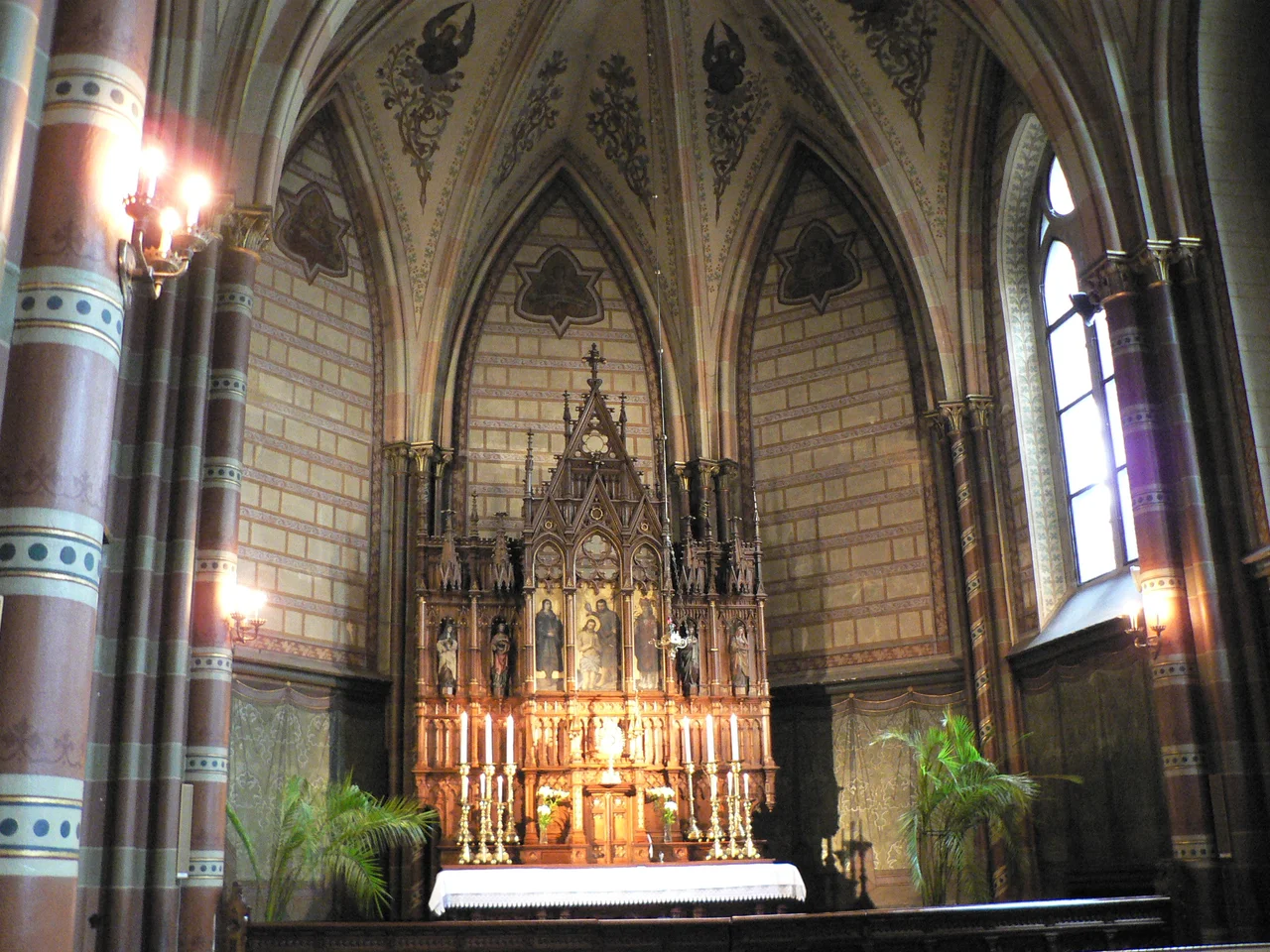
Walk into the Chapel of the Blessed Sacrament, an 1895 extension of the southern nave with neo-Gothic carved-wood furnishings, and you stand near three of the most consequential figures of Lithuanian religious and literary life. Motiejus Valančius is interred in a crypt of the church; he was bishop, historian, organizer of resistance to Russian Russification, and one of the best-known Lithuanian writers of the nineteenth century. Near the chapel wall stands a Neo-Gothic mausoleum to Maironis—pen name of Jonas Mačiulis—the Romantic poet whose verse helped a country imagine itself into existence. Cardinal Vincentas Sladkevičius, who steered Lithuanian Catholicism through the last Soviet decades and into independence, was buried here in 2000. To stand among their tombs is to stand at the literal center of how modern Lithuania was kept alive when its language and religion were both targets of empire.
The Brick Body
From outside, the cathedral looks heavier than its interior feels. Brick Gothic walls absorb the river light, and the single tower rises off-balance like an unfinished sentence. Inside, the Rococo whites and golds of the eighteenth-century rebuild lift the eye toward a vaulted ceiling that has watched fires, sieges, occupations, and crowds praying in three different official languages of the state. On a Sunday morning the cathedral fills with the same Lithuanian-language liturgy that Valančius first allowed in his seminary, and that Maironis later set to verse. The building has outlived every regime that tried to use it.
From the Air
Kaunas Cathedral Basilica is located at 54.90°N, 23.89°E, in the Old Town of Kaunas at Vilniaus Street. From the air the asymmetric tower and broad red-brick body are recognizable on the south bank of the Neris near its confluence with the Nemunas. Kaunas International Airport (EYKA) is about 12 km north; Vilnius (EYVI) is about 100 km east-southeast. The Old Town and confluence make excellent visual references.
Nearby Stories
- Raudonė Castle 19 km away
- Battle of Raseiniai 33 km away
- Trakai Island Castle 44 km away
- Tytuvėnai Monastery 45 km away
- Museum of Occupations and Freedom Fights 70 km away
- Vilnius Uprising (1794) 102 km away
- Biržai Castle 116 km away
- Osowiec Fortress 138 km away