.jpg)
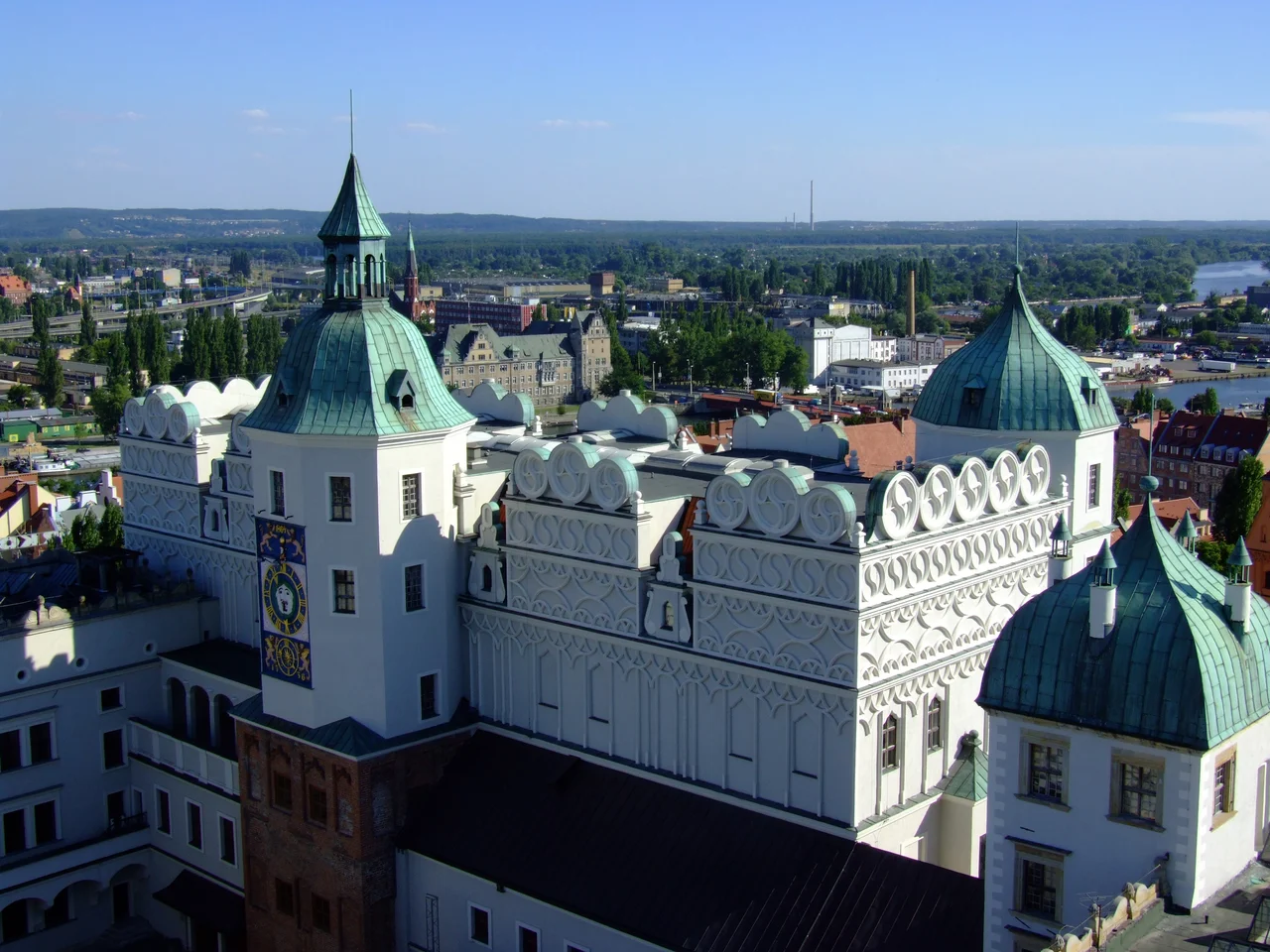
Ducal Castle, Szczecin
The burghers of Szczecin did not want a castle in their city. In 1346, when Duke Barnim III of Pomerania-Stettin announced he would raise one anyway, on the hill overlooking the Oder, the merchants protested. They lost. The duke leveled the older fortification that had stood there since 1249 and built his own ducal residence in its place - a statement of princely power written in stone above the harbor. For nearly three centuries the House of Griffin ruled the Duchy of Pomerania from this hill, until the line died out in 1637 and the castle began its long second life as a contested borderland prize.
The Griffin Court
The House of Griffin - in Polish the Gryfici, in German the Greifen - ruled Pomerania from 1121 until the male line went extinct in 1637, and historians still argue about whether they were originally Slavic or whether their roots reached back to the Polish Piast dynasty. Whatever their origins, by the late Middle Ages they had become a German-speaking dynasty embedded in the Holy Roman Empire while ruling a population that mixed Slavic Pomeranian and German settler stock. Duke Barnim III's original 1346 castle was expanded under Casimir V in 1428. In 1490 it was partially rebuilt to host the wedding of Duke Boguslaw X to Anna Jagiellonka, daughter of King Casimir IV of Poland - one of the rare moments when Pomerania's complicated loyalties to both the empire and the Polish crown briefly aligned. Between 1573 and 1582 Duke John Frederick brought Italian stonemasons north to rebuild the castle in the mannerist style under the design of Wilhelm Zachariasz Italus, adding two new wings to close the courtyard and giving the castle the elegant Renaissance silhouette it carries today.
A Future Empress in the Cradle
On May 2, 1729, in a small bedroom of this castle, a daughter was born to Christian August of Anhalt-Zerbst, the obscure Prussian general who governed Stettin for the king. They named her Sophie Friederike Auguste. She grew up in these halls, played in the courtyards, and at fourteen was sent east to marry the heir to the Russian throne. She converted to Orthodoxy, took the name Catherine, and in 1762 - after deposing her own husband - became Empress Catherine the Great. The girl from Stettin Castle would rule Russia for thirty-four years, expanding the empire into Crimea and Poland, corresponding with Voltaire, and eventually participating in the partitions that erased the Polish-Lithuanian Commonwealth. The plaque marking her birthplace was removed under Polish Communist authorities and only quietly returned after 1989. History in this part of Europe rarely settles.
Prussian, Then Polish
After the Griffin line died out the castle passed to Sweden, then to Brandenburg-Prussia, and through the 18th and 19th centuries it was repeatedly modified. Between 1840 and 1842 a tower in the classical style of Karl Friedrich Schinkel rose alongside the older walls, and the south wing was rebuilt in Frederician Rococo. Polish conservators today describe these Prussian-era renovations as devastating, stripping the castle of its Renaissance arcades and vaulting in favor of a Berlin-influenced grandeur that better suited the new imperial owners. About sixty percent of what remained was destroyed in World War II during the Soviet drive on the Oder. By 1945 the castle was a roofless shell.
Rebuilt as a Statement
Stettin became Szczecin in 1945 when the Potsdam Conference handed Pomerania to Poland and the German population was expelled west - a wrenching mass displacement that emptied the city of nearly all its prewar inhabitants and refilled it with Polish settlers from territories Poland had lost in the east. The new authorities faced a question: what to do with the ruined ducal castle of a German-speaking dynasty? They chose to rebuild it - but to rebuild it backwards, restoring the 16th-century Renaissance appearance documented in Matthaus Merian's 1653 engraving rather than the later Prussian alterations. The choice was deliberately political. The Renaissance castle was the work of the Griffins, whose Slavic descent supported the postwar narrative that Pomerania was historically Polish land returning home. Reconstruction took from 1958 to 1980. Today the castle is one of the largest cultural centers in West Pomerania, hosting the Castle Opera, exhibitions, and concerts in the same courtyards where Catherine the Great learned to walk.
From the Air
The Ducal Castle sits at 53.43 N, 14.56 E on Castle Hill in the Stare Miasto of Szczecin, on the west bank of the Oder roughly 65 km from where the river meets the Baltic at Swinoujscie. The pale Renaissance walls and distinctive twin towers - one with the classical 19th-century clock - are easily picked out from the air against the surrounding red roofs of the old town. Szczecin-Goleniow (EPSC) lies 35 km northeast. Berlin Brandenburg (EDDB) is 130 km southwest across the German border. The Oder lagoon and its complex of islands provides excellent visual reference.
Nearby Stories
- Kingdom of Prussia 10 km away
- Battle of Prenzlau 14 km away
- St. Mary's Church, Chojna 17 km away
- Gorzów Wielkopolski 40 km away
- Historical Technical Museum, Peenemünde 61 km away
- Stalag Luft III 195 km away
- Lilleø 248 km away
- Stutthof Concentration Camp 276 km away