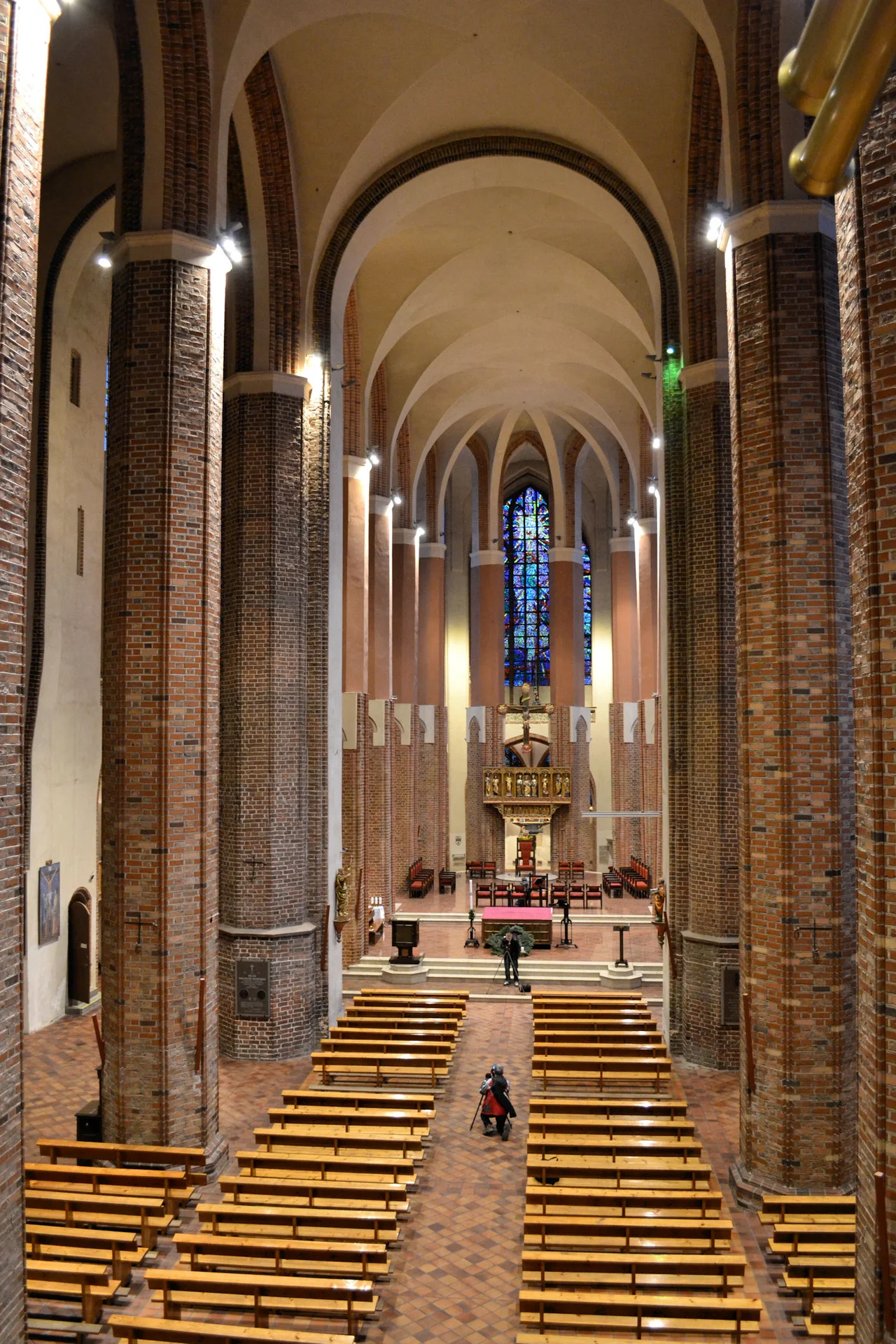

Szczecin Cathedral
The cathedral has lost two spires to storms, been gutted in a Baltic war, burned in another, and been bombed flat in a third. The wonder is not that the Archcathedral Basilica of St. James the Apostle still stands in Szczecin's Old Town. The wonder is that anyone, after 1944, thought it was worth saving at all. A government conservator did the math and pointed out that demolishing what remained would cost more than rebuilding it. So they rebuilt it — but not the way it had been.
Twelfth-Century Beginnings
Construction began in 1187, when the citizens of what was then the Pomeranian capital of Stettin commissioned a church modeled after St. Mary's in Lübeck. The Romanesque structure took until the 14th century to complete, by which point Gothic taste had taken over and reshaped the design. Around 1220, Pomeranian Duke Bogislaw II was buried inside, beginning a tradition of ducal interments that would continue for centuries. The cathedral was meant to anchor a port city perched at the mouth of the Oder where it widens into the lagoons that drain into the Baltic. It still does.
Storms, Wars, Reformations
In 1456 a storm collapsed one of the two original towers, taking part of the church with it. The reconstruction took until 1503 and turned the building into a single-tower hall church. The Reformation arrived in the 16th century, and St. James became Lutheran, part of the Pomeranian Evangelical Church. Then came the Scanian War of 1677, which destroyed the church a second time. The Baroque rebuild of 1690-1693 gave it a different silhouette altogether. In 1893 it was remodeled again, and in 1894 a storm — Stettin's third great church-killing storm in four centuries — collapsed the west tower. The 1901 reconstruction crowned the rebuilt tower with a 119-meter spire. For forty-three years that spire was the highest point in the city.
The Night of 16 August 1944
Allied bombers came over Stettin on the night of 16 August 1944. The 1901 spire collapsed under the bombs and the fires that followed. The north wall came down. Every altar burned. Every artwork inside was destroyed. When the smoke cleared the next morning, the cathedral was a roofless shell of brick walls. The war ended, and the city changed hands and changed names — Stettin became Szczecin, Pomerania became Polish, the Lutheran congregation was replaced by Catholic worshippers. For decades, postwar Polish authorities were reluctant to rebuild what had been a Protestant German cathedral. The conservator's argument finally won out in 1971: knock it down and you spend more than fixing it.
The Roof That Was Not Replaced
The 1971 reconstruction took three years. The north wall was rebuilt in a frankly modern style that has never quite agreed with the rest of the building. The tower was stabilized — but the spire was not restored. Instead, the rebuilders capped the tower with a short pyramid roof, leaving the church at sixty meters instead of the prewar 119. For decades it stood that way, a cathedral missing its crown. Then, in the early 2000s, a new spire was finally added, restoring the cathedral close to its 1901 silhouette. Today St. James is the second-tallest church in Poland and the largest in Western Pomerania, and it functions again as a working Catholic basilica. Bogislaw II is still buried inside, eight hundred years after they laid him there. The bricks have been laid and relaid by twenty generations of masons. The building has outlived its architects, its enemies, and three of its own roofs.
From the Air
Szczecin Cathedral stands at 53.42°N, 14.56°E in the Old Town of Szczecin, on the west bank of the Oder River about 65 km from the Baltic Sea. The cathedral's tower (now restored to roughly 110 m with the new spire) is the tallest landmark in the historic center and is visible from a wide approach into Szczecin-Goleniów Airport (EPSC), 45 km north. Berlin Brandenburg (EDDB) lies about 130 km west. Recommended viewing altitude 2,000-4,000 ft. The Oder Lagoon and the Polish-German border landscape make for striking context.
Nearby Stories
- Kingdom of Prussia 10 km away
- Battle of Prenzlau 14 km away
- St. Mary's Church, Chojna 17 km away
- Gorzów Wielkopolski 40 km away
- Historical Technical Museum, Peenemünde 61 km away
- Stalag Luft III 195 km away
- Lilleø 248 km away
- Stutthof Concentration Camp 276 km away