
Wöbbelin Concentration Camp
The camp existed for less than three months. Inside that brief span, roughly a thousand people died of starvation while German civilians went about their lives in comfortable homes four miles away. Wöbbelin opened in February 1945 because the SS needed somewhere to dump the prisoners they had marched out of camps further east, ahead of the advancing Allies. It was never meant to keep anyone alive. It barely tried.
The Reception Camp
Wöbbelin was a subcamp of Neuengamme, set in a flat patch of pine country near the Mecklenburg town of Ludwigslust. The SS-physician Alfred Trzebinski testified at his own trial that 648 people were held there through the end of March 1945. Then, in mid-April, transports began arriving from subcamps of Neuengamme and Ravensbrück, more than four thousand human beings packed into a place built to hold a fraction of that number. They came from Holland, Russia, Poland, Czechoslovakia, France, and from Jewish communities the Reich had already worked to destroy. They had survived years of camps, the death marches west, the cold, the exposure on cattle cars. They arrived at Wöbbelin to find nothing waiting for them. No food. No water. No shelter that mattered. The SS had no plan beyond keeping them out of Allied hands.
Three Weeks
What happened next was not a process or a system. It was a slow killing by neglect. With nothing to eat and almost nothing to drink, prisoners weakened, sickened, and died in numbers that piled the bodies four and five feet high inside the barracks. Some, in the final extremity, resorted to cannibalism — a fact recorded plainly in the Army's reports because there was no other way to record it. By the time American forces arrived, roughly one in five of the people who had reached Wöbbelin in April were already dead. They had names and birthplaces and families who would never know what became of them. Most lay in pits the SS had dug in the surrounding woods. The rest were still inside, mixed among the dying, in a building the size of an ordinary German barn.
May 2, 1945
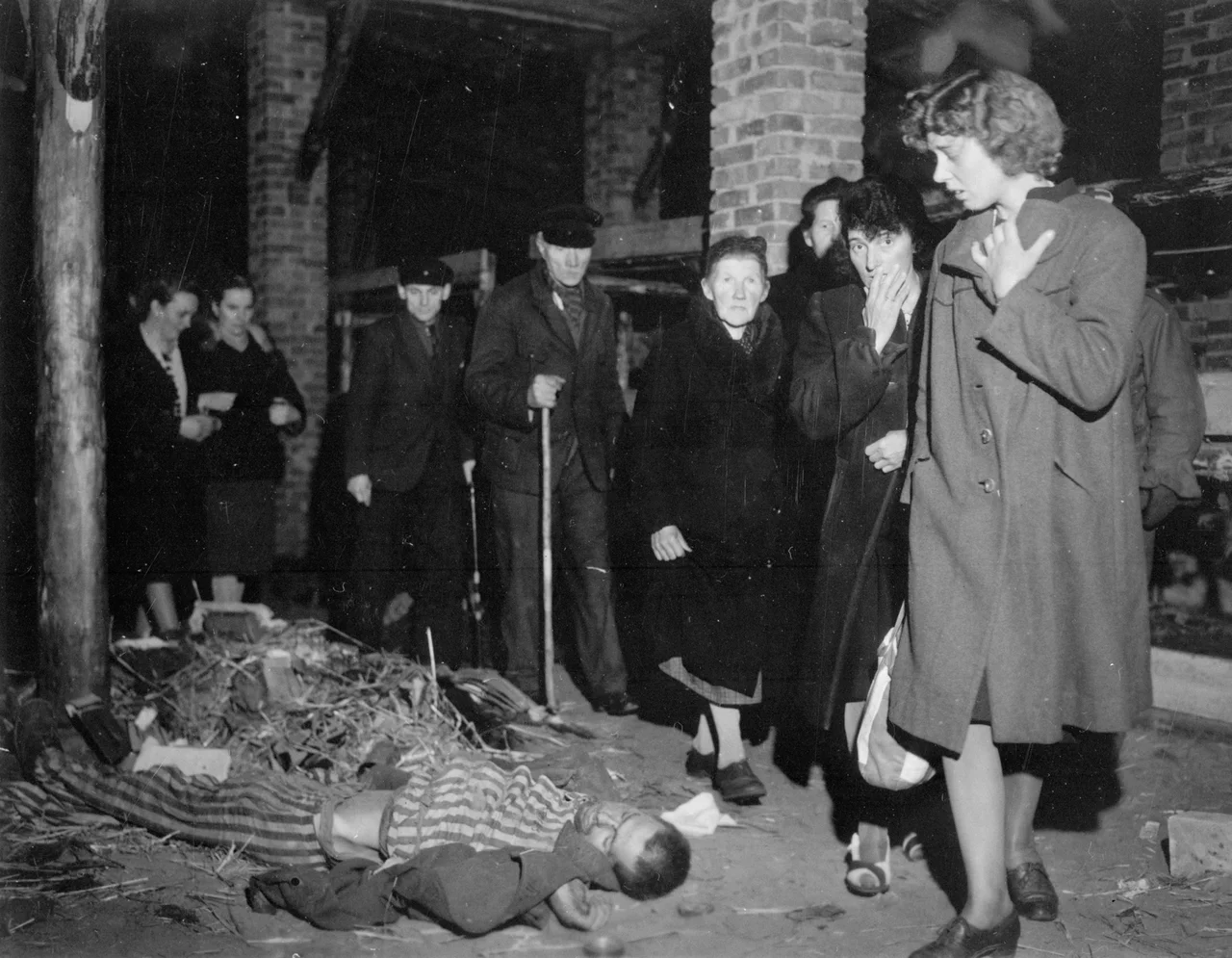
The 8th Infantry Division and the 82nd Airborne Division reached Wöbbelin on May 2, 1945. The war in Europe had five days left to run. The American soldiers who walked through the gate were combat veterans — they had jumped into Normandy, fought through the Bulge, crossed the Elbe — and they had seen things. None of them had seen this. The survivors emerging from the barracks were not survivors yet, only bodies that had not finished dying. Medics worked through the night. Engineers brought water. Cooks tried to feed people who could no longer eat. The ones the Army could save, it saved. The ones it could not save died on cots with American soldiers sitting beside them, holding their hands.
The Burial
Five days later, on May 7, the 82nd Airborne held a funeral for two hundred of the dead in the town of Ludwigslust. The Americans had ordered it. They had also ordered the townspeople to come — the same townspeople who had lived four miles from Wöbbelin without acting, without protesting, without, by their own later accounts, knowing. They came. Captured German officers came too. Several hundred paratroopers stood at attention. The Army chaplain spoke a eulogy that did not absolve anyone of anything. "Within four miles of your comfortable homes," he said, "4,000 men were forced to live like animals." In accordance with General Eisenhower's policy, the dead were buried in a public place, with crosses for the Christians, Stars of David for the Jews, and a stone monument so that no one could later pretend not to have seen.
What Remains
Wöbbelin today is a memorial. The Mahn- und Gedenkstätten Wöbbelin maintains the camp grounds, and the Ludwigslust palace garden — once the manicured front yard of a ducal residence — holds a grave field for the two hundred buried there in 1945. Werner Angress, a young German Jew who had escaped to America and returned as a paratrooper with the 82nd, helped liberate Wöbbelin. He spent the rest of his long life telling people what he had seen. So did Morton Katz. So did Arthur Neriani. They are gone now, but their oral histories sit in archives at Central Connecticut State University, voices recorded so the camp would not be forgotten. The dead at Wöbbelin had no graves of their own choosing. They have, at least, witnesses.
From the Air
Wöbbelin Memorial site lies at 53.367°N, 11.492°E in Mecklenburg-Vorpommern, Germany, just north of Ludwigslust and roughly 30 km south of Schwerin. The flat North German plain stretches in every direction, threaded by pine forest and the Stör Canal. Nearest major airports are Hamburg (EDDH) about 100 km northwest and Berlin Brandenburg (EDDB) about 200 km southeast. Best viewed from low altitude in clear weather; the memorial grove and the palace garden grave field at Ludwigslust are both visible from above.
Nearby Stories
- Gorleben 6.3 km away
- Scharnebeck Twin Ship Lift 28 km away
- Ebstorf Abbey 33 km away
- Battle of Wittstock 41 km away
- Friesack Camp 57 km away
- Historical Technical Museum, Peenemünde 133 km away
- Lilleø 144 km away
- Scharhörnbake 168 km away