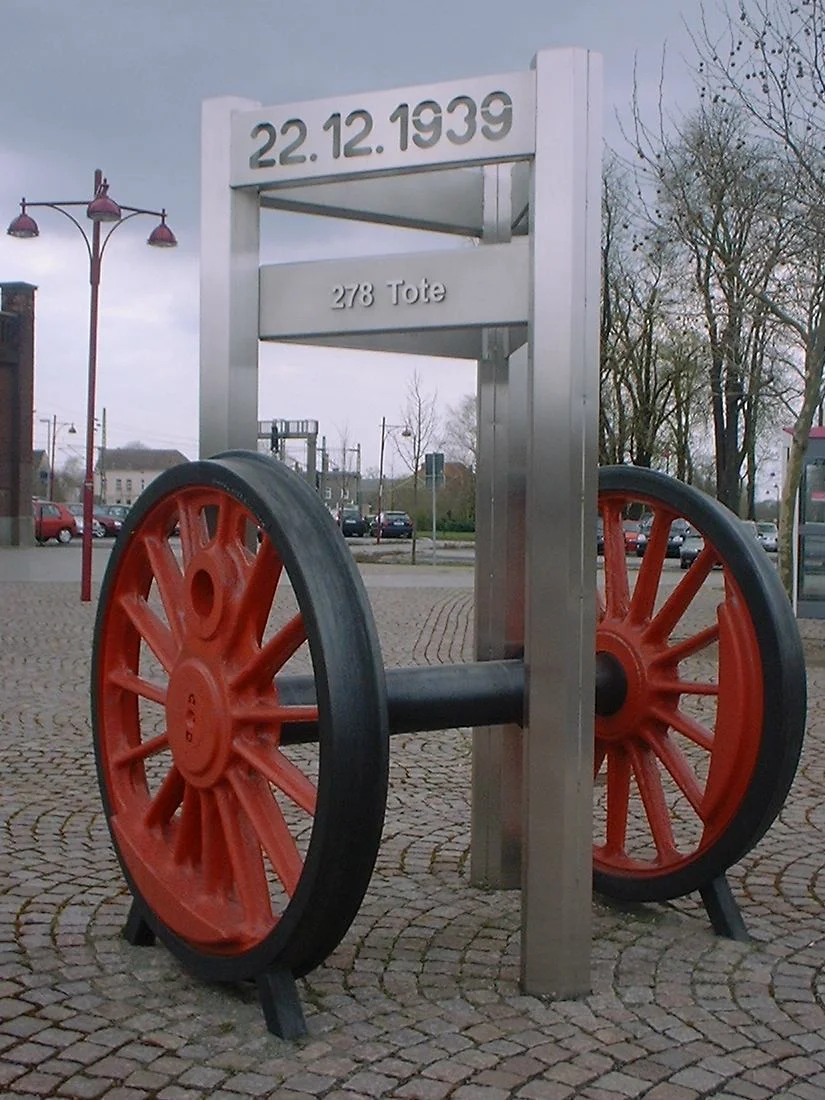

Genthin Rail Disaster
Christmas was three days away. The trains out of Berlin's Potsdamer Bahnhof on the night of December 22, 1939, were carrying soldiers home on leave, families traveling to relatives, students returning to provincial towns. Wartime austerity meant no extra coaches; the existing trains were jammed, often with passengers standing in the aisles. Wartime blackout meant station lights were out and signal sighting was difficult. Wartime shortages meant the locomotive of express D 180 was running without its automatic train protection, taken out for repairs but the engine put back into service anyway because nothing else was available. At 12:55 a.m. on the morning of December 22, D 180 plowed into the back of stationary express D 10 at about 100 kilometers per hour. The official Reichsbahn count was 186 dead. The memorial in front of Genthin station says 278.
The Last Train Before Christmas
Express D 10 had left Berlin Potsdamer Bahnhof at 11:15 p.m. bound for Cologne. The blackout slowed everything; lights at country stations were turned off, and crews had to work by feel. The train accumulated about thirty minutes of delay. Express D 180, scheduled to follow at 11:45 p.m. for Neunkirchen in the Saar, had fewer scheduled stops. Pulled by a powerful DRG Class 01 steam locomotive, number 01 158, it caught up to D 10 quickly and was running in the next signal block behind. The Berlin-Magdeburg railway was equipped with the Indusi automatic train protection system, which would have applied the brakes if a driver passed a stop signal. Locomotive 01 158's Indusi equipment had been pulled for repairs. The locomotive went out anyway, because the war had eaten the spare parts and the spare locomotives, and trains had to run.
Belicke and Genthin Ost
One station before Genthin, at Belicke block post, the D 180 passed a stop signal at danger. The driver later said all signals were green; the signalman insisted they were not. With Indusi installed, the brakes would have applied automatically. Without it, the train continued at speed. The Belicke signalman immediately telephoned ahead to the next box at Genthin Ost. The signalman there grabbed an emergency red lamp and waved it from the platform. The driver of D 10, the train ahead, saw the lamp first and threw his train into emergency braking; D 10 came to a stand at Genthin station at 12:51 a.m. Critically, the Genthin Ost signalman did not also reset his fixed signals to danger. He kept waving the red lamp, but the driver of the oncoming D 180 missed it, perhaps reading through the close lamp to the green fixed signal beyond, the one that had been set for D 10.
Four Minutes
At 12:55 a.m., D 180 hit the rear of D 10 at roughly 100 kilometers per hour. The rear four coaches of D 10 telescoped, the wooden frames driving into one another and crushing the passengers in their compartments. The locomotive of D 180 and six of its coaches derailed. People died in their seats, in the aisles, in the chaos of darkness and frozen ground. Emergency response was crippled by the same blackout that had contributed to the crash; rescuers needed special permission to bring up floodlights. Many local firemen had been drafted. The night was bitterly cold, with temperatures well below freezing, and people trapped in the wreckage froze to death before help could reach them. The driver and fireman of D 180 survived. The driver was later sentenced to three and a half years in prison.
Two Tragedies in One Day
On the same December 22, a second major accident occurred at the other end of Germany. On the Lake Constance Belt Railway, a freight train and an overcrowded passenger train collided at Markdorf, killing more than 100 people. Two catastrophes in twenty-four hours, both rooted in the wartime conditions: shortages, blackouts, undertrained replacement crews, equipment running past its maintenance schedule. The railway historian Albert Kuntzemuller called December 22, 1939, 'the darkest day in German rail history.' He was writing decades later, after the war and after far worse things. He still meant it. The official Reichsbahn casualty count for Genthin was deliberately conservative; later research, drawing on hospital records and family testimonies, supports the higher figure of 278 that is engraved on the memorial.
What Remains
The locomotive of D 180, number 01 158, was salvaged, repaired, and returned to service in 1941. It survived the war and the East German nationalization, was renumbered 01 1531, and is now preserved at the Bahnbetriebswerk Arnstadt railway museum in Thuringia. The site of the wreck at Genthin station is marked by a memorial in the station forecourt that lists the higher death toll. The station itself remains an active stop on the Berlin-Magdeburg line, with regional trains passing through where the express coaches once telescoped in the dark. The accident contributed to postwar German rail safety practice, including the universal installation of automatic train protection systems whose absence on D 180 had let the disaster happen. Among the dead were soldiers in uniform on Christmas leave, women carrying parcels for family, and children. Their names, in many cases, are recorded only on parish registers in the towns they never reached.
From the Air
Genthin sits at 52.40 degrees N, 12.16 degrees E in Saxony-Anhalt, on the flat terrain of the Berlin-Magdeburg corridor. The town is about 90 km west of Berlin and 50 km east of Magdeburg, along the Elbe-Havel Canal. Berlin Brandenburg Airport (EDDB) is the nearest major field, about 100 km east-southeast. Leipzig/Halle (EDDP) lies 130 km south. The rail line through Genthin is still active and clearly visible from altitude as a ruler-straight east-west alignment.
Nearby Stories
- Stork Farm Loburg 10 km away
- Battle of Fehrbellin 10 km away
- Gardelegen Massacre 14 km away
- Paretz 15 km away
- Treuenbrietzen 19 km away
- Holy Blood of Wilsnack 28 km away
- Free Republic of Wendland 36 km away
- Schöningen spears 43 km away