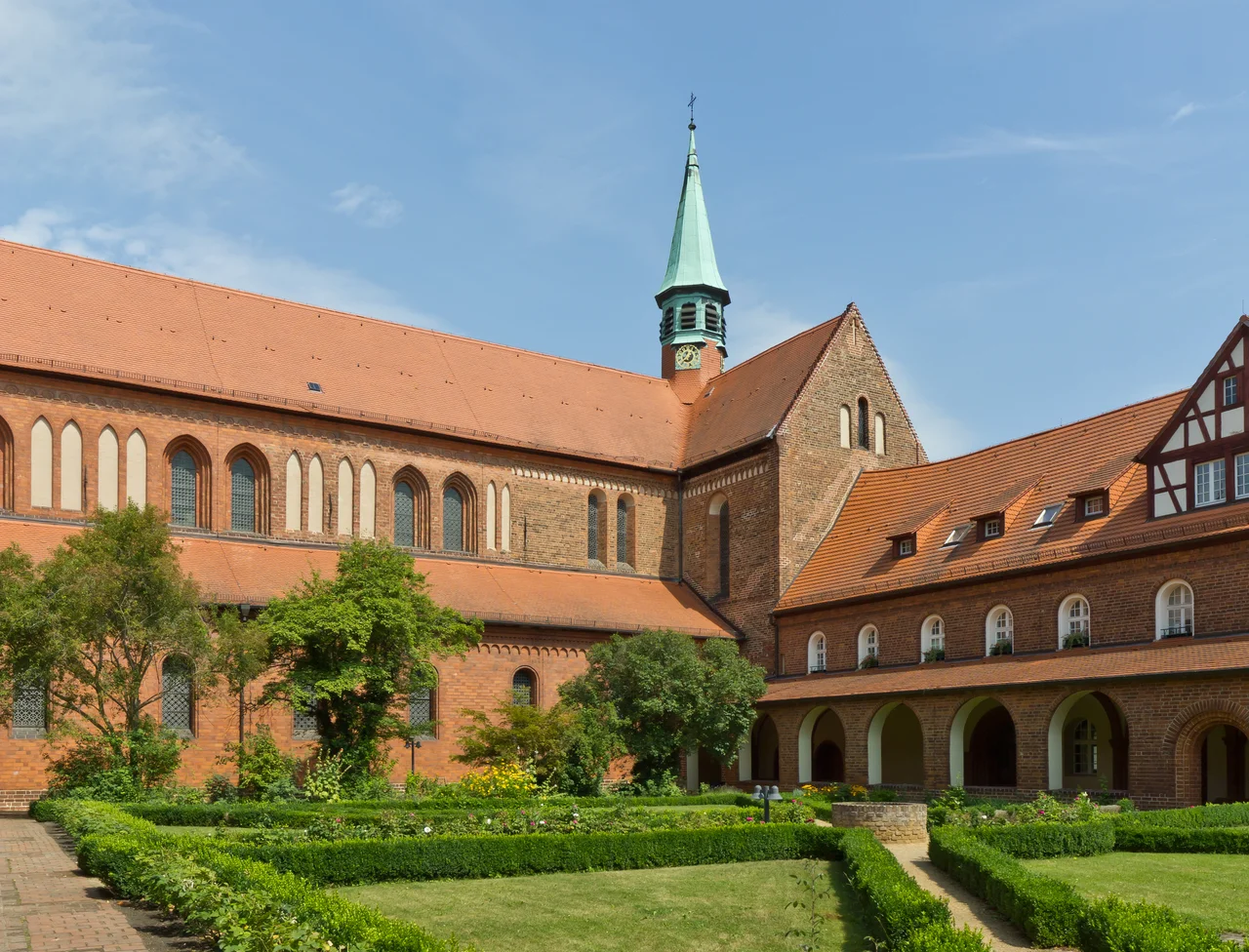

Lehnin Abbey
The legend has Otto I asleep beneath an oak in the Zauche forest, dreaming of a white deer that attacked him until he prayed to be saved. When he woke, he founded an abbey on the spot. This is the kind of story medieval rulers liked to tell about themselves: vision, danger, divine rescue, monastery. The historical Otto I of Brandenburg was the son of Albert the Bear, the Ascanian conqueror who had finally subdued the Slavic prince Jaxa of Kopenick in 1157 and established a Christian Margraviate over the lands east of the Elbe. Lehnin, founded in 1180 - twenty-three years after that conquest - was meant to be the family monastery: the place the Ascanians built churches and got buried. Otto himself was interred here in 1184. For nearly four centuries Lehnin functioned as both spiritual center and economic engine of the new Brandenburg, the brick-Gothic mother house from which Berlin's eventual rulers staked their claim to the territory.
Brick on Sand
Brandenburg has no useful building stone. The North German Plain is sand and clay, and the great medieval foundations had to invent themselves out of fired brick. Lehnin was a daughter house of Morimond Abbey in Burgundy, but it could not look like Morimond - it had to look like what brick can do. What it does, at scale, is striking. The abbey church rises in the deep red Brick Gothic that defines the architecture of the Hanseatic and Brandenburg world: pointed arches in baked clay, stepped gables, blind arcades, the surface broken into pattern by alternating glazed and unglazed bricks. Lehnin is one of the finest surviving examples in Germany. The church and cloister are largely Romanesque-to-Gothic transitional; the buildings around them date from later restorations, but the religious heart still reads as the late twelfth and thirteenth centuries that built it.
Frontier Monastery
The Cistercians were the medieval Catholic Church's land-development specialists. They were called east into the Slavic margraviates because they cleared swamps, drained fields, founded daughter houses, and turned wilderness into rent. Lehnin did all of this. From its base on the Zauche plateau south of the Havelland it founded Paradies Abbey in 1236 (today Klasztor Paradyz in Poland), Mariensee in 1258 (later relocated to Chorin), and Himmelpfort near Furstenberg in 1299. The Ascanians used the abbey as a tool of the Ostsiedlung, the German eastward settlement that brought Flemish, Frankish, and Saxon farmers into the Slavic borderlands. It was a project of conversion, conquest, and economic transformation - softened in some places, brutal in others - and Lehnin was its religious headquarters in Brandenburg.
Reformation, War, Romance
Joachim II of Brandenburg, the Hohenzollern elector who had succeeded the Ascanians on the Brandenburg throne, dissolved Lehnin in 1542 during the Reformation. The buildings became a hunting lodge; the Thirty Years' War battered them; the Great Elector Frederick William rebuilt parts as a summer residence for his consort Louise Henriette of Nassau, who died here in 1667. After her death the buildings declined again - used as a stone quarry, ironically, by the same state that had once relied on them as a source of legitimacy. What saved them was the nineteenth-century romantic rediscovery of Gothic ruins. King Frederick William IV of Prussia, who loved medieval architecture the way some kings love hunting, ordered restoration. Between 1871 and 1877 the church was substantially rebuilt, and a place that had nearly been forgotten became a national heritage site again.
The Deaconesses
In 1911 the Prussian Union of Churches bought the abbey to house the Luise-Henrietten-Stift - a Protestant women's deaconess community whose deaconesses adopted Cistercian customs as a kind of historical homage to the place. The Nazis suppressed them and seized parts of the complex for Wehrmacht and SS use during the war. From 1949 onwards the GDR turned Lehnin into a hospital, and today it operates as a geriatric rehabilitation clinic and nursing home, the church and cloister still maintained as a parish and historical site. Buried under the brick floors are Otto I, Matilda of Groitzsch, Herman and Albert III of Brandenburg-Salzwedel, and Catherine of Saxony - the founding generations of a state that would become Prussia and then Germany. Outside, the village of Lehnin keeps its pace; the Klostersee glints to the north; the wooded plateau rolls away as it has since Otto's reported nap.
From the Air
Located at 52.32 degrees N, 12.74 degrees E on the Zauche plateau in Brandenburg, about 35 km southwest of Berlin and 15 km southwest of Potsdam. The red brick of the abbey church stands out against the surrounding wooded heath at low to medium altitudes. Nearest major airport: EDDB (Berlin Brandenburg) about 50 km east. EDDP (Leipzig/Halle) about 145 km south-southwest. Late afternoon side-light brings out the brick texture and the stepped gables.
Nearby Stories
- Schönhausen Palace 3.8 km away
- Battle of Nauen 5.3 km away
- Berlin Brandenburg Airport 12 km away
- Genthin Rail Disaster 16 km away
- Dessau-Wörlitz Garden Realm 19 km away
- Wittenberg 22 km away
- Spreewald 46 km away
- Holy Blood of Wilsnack 50 km away