
Jewish Museum Berlin
Glikl bas Judah Leib was a businesswoman in 17th-century Hamburg. She raised fourteen children, ran her late husband's gemstone trade, paid her debts, prayed in Yiddish, and wrote a memoir in seven volumes that survives. She is one of the people whose life the Jewish Museum Berlin asks you to meet before it shows you what was lost. Daniel Libeskind's zigzag building on Lindenstraße — a metal lightning bolt of zinc cladding, opened in 2001 and now the largest Jewish museum in Europe — does not begin with the Holocaust. It begins with a thousand years of Jewish life in German lands. The point is to know who the people were before showing what was done to them.
Two Thousand Years in the Rhine
Jewish communities settled along the Rhine in the early Middle Ages. Speyer, Worms, and Mainz — the three cities Jewish tradition called "Shum" — became centres of Talmudic scholarship and Yiddish literature in the eleventh and twelfth centuries. The new core exhibition, opened in August 2020, walks through five chapters: medieval Ashkenaz, the early modern courts, the era of emancipation that began with Moses Mendelssohn's Berlin in the 1700s, the catastrophe of National Socialism, and Jewish life in Germany since 1945. Visitors meet specific families through their objects — a kiddush cup that travelled from Frankfurt to Argentina in 1939, a teacher's wedding photograph, a child's toy that survived because relatives in New York kept it. The point is the texture of lives lived, not abstractions.
Libeskind's Architecture as Memorial
Daniel Libeskind won the design competition in 1989 with what jurors nicknamed Blitz — "Lightning." The building has no ground-floor entrance of its own. You descend from the baroque Kollegienhaus next door into three slanting underground corridors he called the Axes, representing three paths of German Jewish life: continuity, emigration, and the Holocaust. The Axis of Continuity rises to the permanent exhibition. The Axis of Emigration leads to the Garden of Exile — 49 concrete pillars set on a tilted floor that disorients you the way exile disorients. The Axis of the Holocaust ends at the Holocaust Tower: an unheated, unlit concrete shaft 24 metres tall, sealed by a heavy door, with one slit of daylight high overhead. You stand in it and listen to the building. That is the exhibit.
The Voids
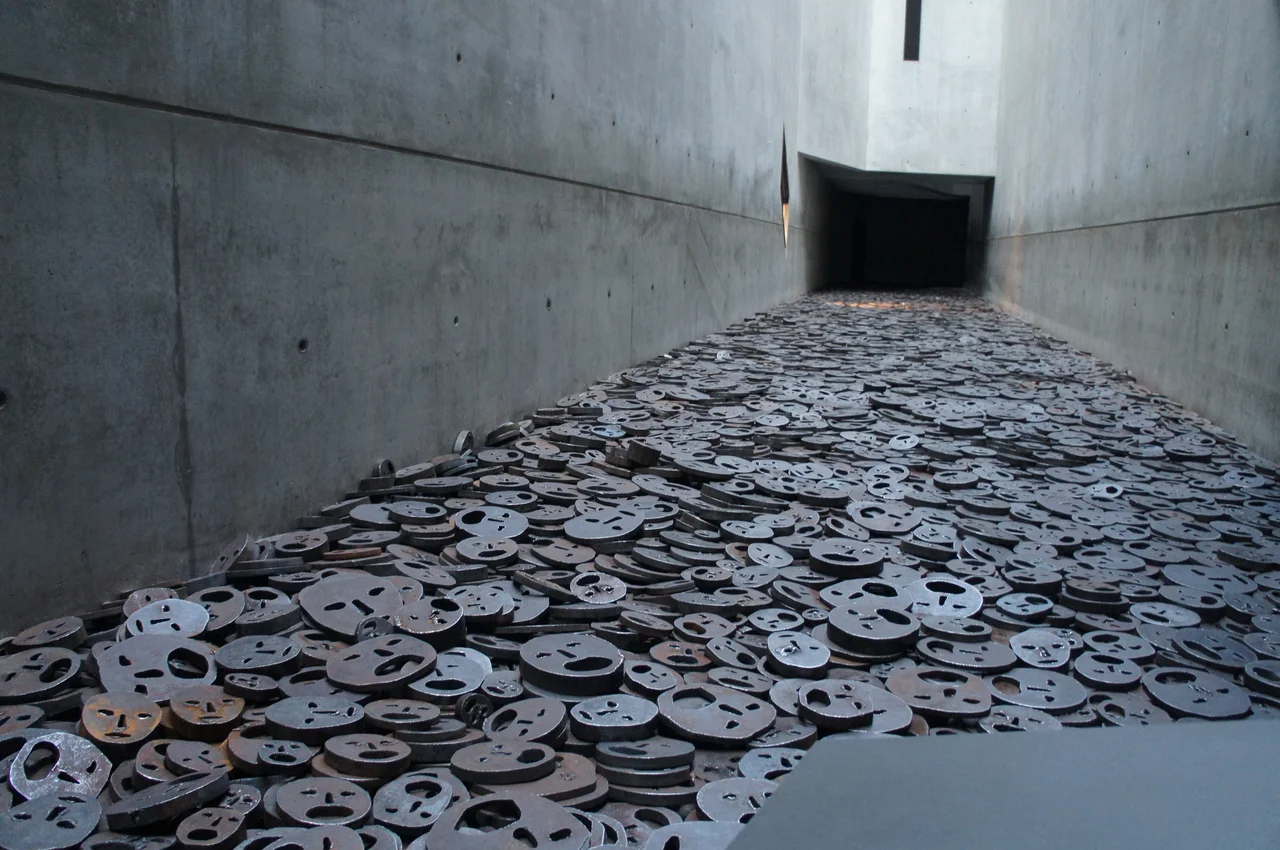
Cutting straight through the entire zigzag building, from basement to roof, runs a series of empty vertical spaces Libeskind called the Voids. They are roughly 20 metres tall, sealed off, mostly unenterable, lined in raw concrete. Bridges cross some of them on the upper floors. The Voids are the architectural argument: they represent, as the museum puts it, what can never be exhibited — "humanity reduced to ashes." One Void is enterable: the Memory Void, where the Israeli artist Menashe Kadishman has scattered ten thousand iron faces across the floor. Walking on them produces a metallic clatter that fills the shaft. Visitors are invited to step on the faces. The sound is part of the work.
The First Museum, the Last Exhibition
The original Jewish Museum in Berlin opened on 24 January 1933 — six days before Hitler became Chancellor. Karl Schwartz built it next to the Neue Synagoge on Oranienburger Straße to demonstrate that Jewish history was living history, with busts of Moses Mendelssohn and Abraham Geiger in the entrance hall and contemporary works by Lesser Ury and Arnold Zadikow on the walls. The last exhibition before the Nazis shut it down in 1938 was a retrospective of the German Impressionist Ernst Oppler. The collections were seized. Today the city's Jewish community numbers roughly 12,000 — a fraction of what existed before 1933, many of them post-Soviet immigrants who arrived in the 1990s. The museum's final video installation, called Mesubin ("The Gathered"), brings contemporary Jewish voices into the building. The story does not end.
What the Building Asks
By December 2017 the museum had welcomed more than 11 million visitors. Across the street stands the W. Michael Blumenthal Academy, also designed by Libeskind, named for the museum's founding director — a German Jew who fled to Shanghai with his family in 1939, later served as Jimmy Carter's Treasury Secretary, then came home to run a museum about the country that had expelled him. There is a Diaspora Garden and a children's museum shaped like Noah's Ark. Hetty Berg has directed the museum since 2020. The building is now itself part of the collection: zinc cladding, concrete voids, a tower with a single slit of light. You leave knowing more than you came in with — and aware that knowing is not the same as understanding.
From the Air
The Jewish Museum Berlin sits at 52.50°N, 13.40°E in the Kreuzberg district, immediately south of the Spree River and east of Anhalter Bahnhof. The Libeskind building is recognisable from the air by its angular zigzag plan and zinc cladding that catches sun differently from surrounding rooftops. Berlin Brandenburg (EDDB) lies about 22 km southeast. The museum is well within Berlin's restricted central airspace. From low altitude in clear weather, the building's lightning-bolt footprint is unmistakable against the conventional grid of the surrounding streets.
Nearby Stories
- Battle of the Seelow Heights 24 km away
- Lehnin Abbey 25 km away
- Kingdom of Prussia 43 km away
- Lutherhaus 45 km away
- Lichtenburg Concentration Camp 73 km away
- Szczecin Cathedral 84 km away
- Ludwigslust Palace 121 km away
- Czocha Castle 156 km away