.jpg)
Copenhagen City Hall
On the second floor of Copenhagen's city hall, behind glass, sits a clock with twelve dials and 1,433 individually machined parts that measures, among other things, the precession of the Earth's axis on a cycle of 25,753 years. Jens Olsen spent the last decade of his life designing it. He died in 1945, ten years before the clock was finished and switched on by King Frederick IX in 1955. The clock is in many ways the truest object in the building: a piece of patient, methodical Danish craftsmanship surrounded by the National Romantic brick and statuary of Martin Nyrop's 1905 Rådhus. The building is the sixth city hall Copenhagen has had. The five before it kept being moved or burning down or being rebuilt, all clustered around the old market squares of Gammeltorv and Nytorv. This is the only one with a clock that runs out a calendar twenty-five thousand years long.
Five Halls Before This One
Copenhagen has been keeping civic records since the medieval period, and somewhere near the old market square of Gammeltorv stood the first city hall, though almost nothing is known about it — not its appearance, not its exact location, not when it was built. The second was raised at the end of the 14th century at the corner of Nørregade and Studiestræde, opposite the Church of Our Lady. King Christian IV had it rebuilt in the early 17th century into a small Renaissance building with curved gables and a slim octagonal stair tower, though it later served as a bishop's palace. The fifth city hall, on Nytorv, was finished only in 1815 — its construction delayed by a shortage of materials and by the British naval bombardment of Copenhagen during the English Wars. Designed in the Neoclassical style by Christian Frederik Hansen, it was meant to house both the city hall and the courts. It still stands today, in use as the Copenhagen Court House. By the late 19th century, the city had outgrown it.
Nyrop and the National Romantic
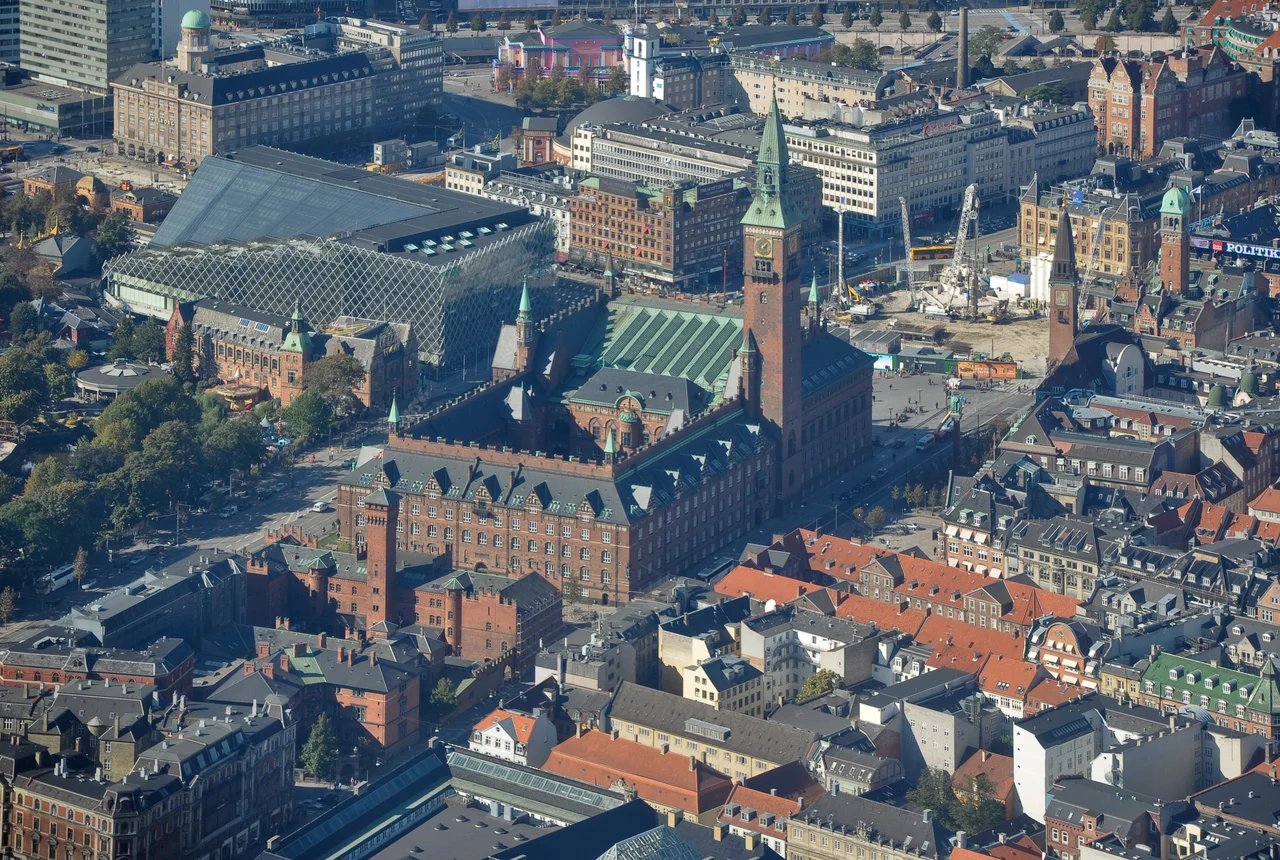
After an architectural competition, Martin Nyrop won the commission to design Copenhagen's sixth city hall. Construction began in 1892 and took thirteen years; the building was inaugurated on 12 September 1905. Nyrop chose the National Romantic style, which in Denmark meant a return to red brick, traditional craftsmanship and Nordic motifs — but he openly drew on the city hall of Siena, the Palazzo Pubblico, for the silhouette. The result is a long brick building with a richly ornamented front facing City Hall Square, a gilded relief of Bishop Absalon — the founder of Copenhagen — above the balcony, and a narrow clock tower rising 105.6 metres into the Copenhagen sky. In a city where the building code keeps almost everything low, this tower is one of the tallest things on the skyline. The plan is two long wings along Vester Voldgade and H.C. Andersens Boulevard, joined by three transverse blocks. Between the transverse blocks are the covered Main Hall — a great vaulted civic room — and the open-air City Hall Garden.
The Clock That Runs for Twenty-Five Thousand Years
Jens Olsen was a Danish locksmith and astronomer who began designing his world clock in 1928. He worked on it for sixteen years and spent the last decade of his life on the calculations. He died in November 1945. The clock was finally completed in 1955 and inaugurated by King Frederick IX. It sits in its own small chamber on the second floor of the city hall. Behind the glass, the mechanism includes a perpetual calendar good for 570,000 years; sidereal time; sunrise and sunset for Copenhagen; the position of the planets in the solar system; the orbit of the moon; and a celestial pole motion dial — the precession dial — that takes 25,753 years to complete a single revolution. Some of its components are predicted to wear out only after a millennium of continuous operation, by which time the engineers who maintain it will have had to replace them anyway. It is widely held to be one of the most accurate mechanical clocks ever built. To stand in front of it is to look at a piece of machinery that will, if maintained, still be ticking through human civilisations not yet imagined.
Copenhagen on the Big Screen and the Small
The Rådhus has had a quiet but persistent role in Danish popular culture. In the 1978 comedy Olsen-banden går i krig — the tenth film in the much-loved Olsen Gang series — Egon Olsen ends up tied up outside the city hall tower clock, a sequence Danes still recite from memory. In 2007 the National Bank of Denmark issued a 20-krone commemorative coin featuring the tower. More recently, the atrium served as the location for the hospital scenes in the 2015 film The Danish Girl, in which Eddie Redmayne plays Lili Elbe, the Danish painter who underwent some of the earliest documented gender confirmation surgeries in the late 1920s and early 1930s. None of these uses change what the building does day to day. The Lord Mayor of Copenhagen still runs the city from here. The City Council still meets here. And every half hour, the tower clock chimes, while in the small chamber two floors below, Jens Olsen's machine quietly turns toward the year 27,955.
From the Air
Copenhagen City Hall stands at 55.675°N, 12.570°E, on City Hall Square (Rådhuspladsen) in central Copenhagen. The 105.6-metre clock tower is one of the tallest landmarks in the city's low skyline and visible from a wide area. Copenhagen Airport (EKCH) is 8 km southeast on the island of Amager. From altitude, central Copenhagen is identifiable by its position on the eastern shore of Zealand opposite Sweden, with the long green strip of Tivoli Gardens immediately south of the city hall and the harbour to the east.
Nearby Stories
- Kullen Lighthouse 45 km away
- Lilleø 60 km away
- 2024 Baltic Sea Submarine Cable Disruptions 60 km away
- Rosenholm Castle 127 km away
- Historical Technical Museum, Peenemünde 146 km away
- Vaxjo Cathedral 156 km away
- Müritz National Park 216 km away
- Kalmar Castle 237 km away