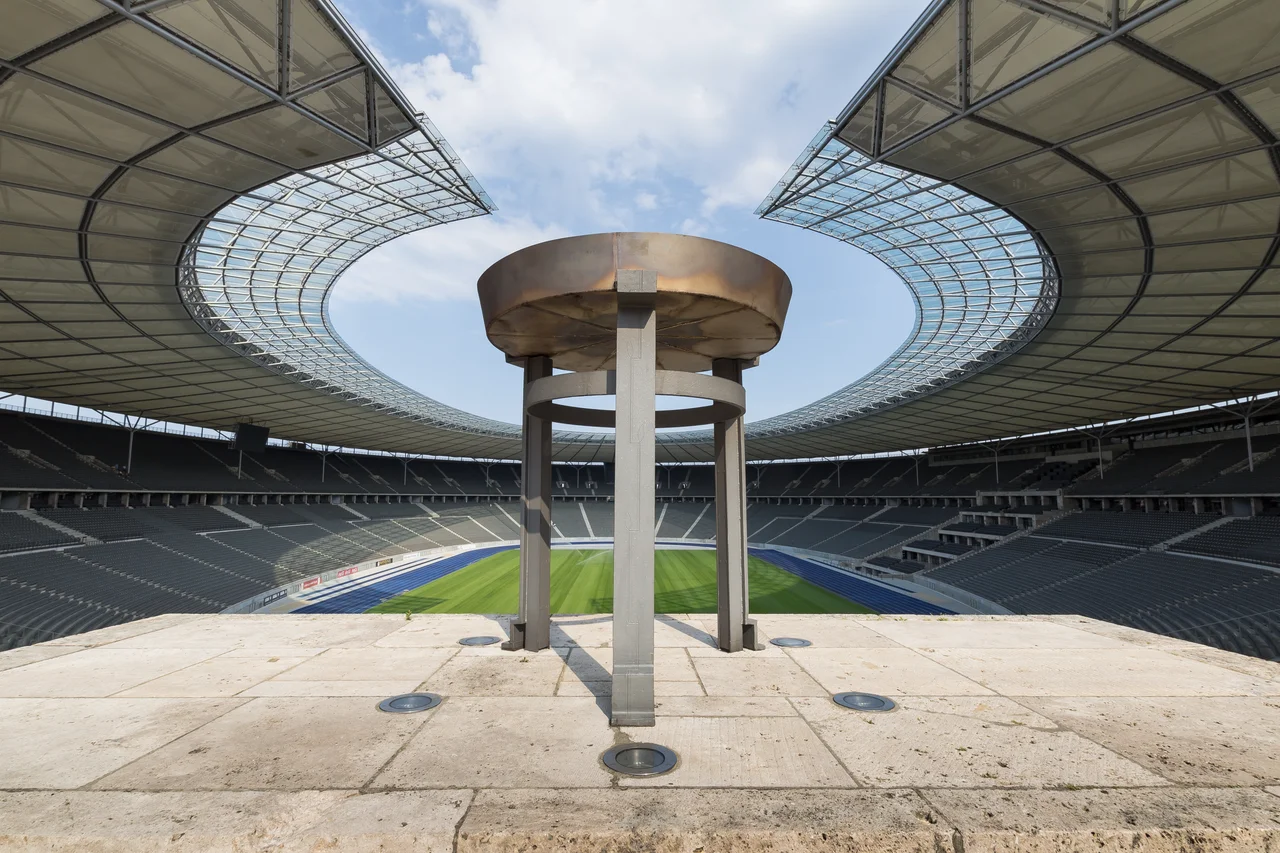

Olympiastadion (Berlin)
On 4 August 1936, in front of 110,000 spectators and the Fuhrer of Nazi Germany, an African-American sprinter from Cleveland named Jesse Owens won the 100 metres in 10.3 seconds. He went on to take the long jump, the 200 metres, and a leg of the 4x100 metres relay — four gold medals at a Games staged to demonstrate Aryan supremacy, by an athlete the regime considered subhuman. Owens later said the snub he remembered was not from Hitler but from his own president: Franklin Roosevelt never invited him to the White House. The Olympiastadion still stands. It still has a permanent capacity of 73,856 — slightly reduced from the original by the lowering of the playing surface in 2004 — and it still has the limestone walls that the Soviet army shot up in April 1945. Walk to the Marathon Gate and you can put your hand on a building that has watched a great deal of the twentieth century happen.
What the Architect Was Asked to Build
The IOC awarded the 1936 Games to Berlin in 1931, before the Nazis came to power. The original commission was modest — restore the Deutsches Stadion of 1916, which Werner March's father Otto had built into the same site. After 1933 the brief changed. Hitler personally ordered a complete new complex called the Reichssportfeld, 132 hectares of monumental architecture meant to serve, after the Games, as a permanent stage for Nazi mass spectacle. March kept the lower half of the stadium recessed twelve metres below grade — Berlin sand makes deep stadium bowls easy — and rose the upper bowl in pale Franconian limestone. Construction took two years. To the west he built the Maifeld, a 250,000-capacity parade ground for May Day rallies, and beyond it the Glockenturm, the 77-metre Bell Tower carrying the Olympic Bell with its motto Ich rufe die Jugend der Welt: I call the youth of the world. To the south sat the Waldbuhne, an open-air amphitheatre still in use for summer concerts.
1936
The 1936 Games were the first Olympics with television transmission — twenty-five viewing rooms scattered around Berlin and Potsdam — and the first with a full torch relay, an idea from Carl Diem, an advisor to Joseph Goebbels. The torch travelled 3,000 kilometres from Olympia in Greece, foreshadowing the route the Wehrmacht would later take through several of the same countries. Leni Riefenstahl filmed everything for her propaganda film Olympia, released in 1938. Owens won four golds. The German runner Luz Long took silver in the long jump and embraced Owens publicly afterward — an act of sportsmanship visible to 100,000 spectators and an act of moral courage in 1936 Germany. Long died on the Italian front in 1943. Owens went home and could not get a job; he eventually made his living for years racing against horses at exhibitions. The street outside the stadium's east entrance is now Jesse-Owens-Allee.
April 1945, and After
When the Soviet 5th Shock Army fought through Charlottenburg in late April 1945, the Olympiastadion saw close combat. The Bell Tower had been used by the SS to store film archives; the Soviets accidentally set the contents on fire and the tower burned out as a chimney. The British engineers demolished the structurally compromised tower in 1947. The Olympic Bell fell 77 metres, cracked, and has been mute ever since. The bell now sits at ground level as a memorial. The British rebuilt the tower in 1962, again under the supervision of the original architect Werner March, working from his own blueprints. The stadium itself survived almost intact, suffering mostly machine-gun damage. From 1945 to 1994 the British military occupation forces used the surrounding Reichssportfeld as their Berlin headquarters, holding annual Queen's Birthday parades on the Maifeld. The Bundesliga side Hertha BSC moved in as the football tenant in 1963 and remains.
The Building That Refuses to Resolve
After reunification Berliners argued openly about whether to demolish the stadium. Some wanted it gone. Others wanted to let it crumble like the Colosseum, a deliberate ruin. Neither side won. The decision in 2000 was to renovate it for the 2006 World Cup, lower the pitch by 2.65 metres for football sightlines, add a 37,000 square metre transparent roof, and change the running track from red to Hertha BSC blue. The cost was €242 million. The 2006 World Cup final was played here — Italy beat France after Zinedine Zidane's headbutt of Marco Materazzi in extra time — and so was the 2015 Champions League final and the UEFA Euro 2024 final on 14 July 2024, when Spain beat England 2-1. Usain Bolt set the 100m and 200m world records here in 2009, both still standing. The limestone walls have been cleaned but not replaced. They are the same stones that watched 1936. The argument the renovation refused to settle is the right argument to keep refusing.
From the Air
Located in the Westend district of western Berlin at 52.515 degrees north, 13.239 degrees east, in the larger Olympiapark complex. From the air at 2,000 to 5,000 feet AGL the stadium reads as a flat oval embedded in the ground with a pale limestone rim and a partially-translucent roof. The Maifeld extends west to the reconstructed Bell Tower; the Waldbuhne amphitheatre sits beyond. The Havel river system lies to the west. Nearest airport is Berlin-Brandenburg (EDDB), 25 km southeast.
Nearby Stories
- Genthin Rail Disaster 35 km away
- Kingdom of Prussia 35 km away
- Lutherhaus 38 km away
- Battle of the Seelow Heights 47 km away
- Ravensbruck concentration camp 51 km away
- Lichtenburg Concentration Camp 63 km away
- Ludwigslust Palace 102 km away
- Semperoper 128 km away