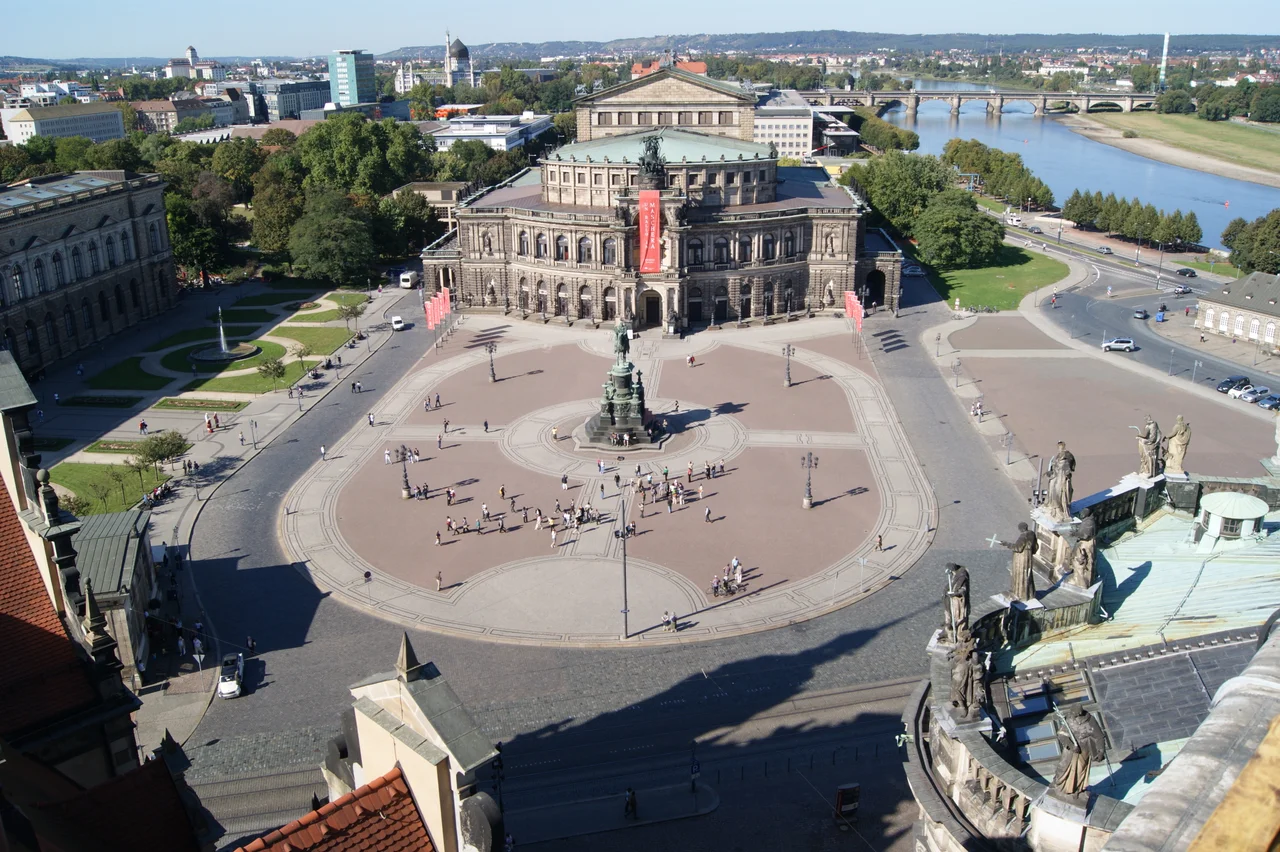

Semperoper
On the night of February 13, 1945, Carl Maria von Weber's Der Freischutz was on the bill at the Semperoper in Dresden. The performance never finished. The first wave of British Lancasters appeared over the city around 10 p.m., the firestorm followed, and by morning the opera house was a roofless shell with its interior burned out. Forty years later, on February 13, 1985, exactly to the day, the rebuilt Semperoper reopened. The first opera back on the program was Der Freischutz. There is a kind of brutal symmetry in the sequence that the building's history rewards. Burned in 1869, rebuilt by 1878. Burned in 1945, rebuilt by 1985. Wagner premiered three operas here. Richard Strauss premiered nine.
Semper's first house
Gottfried Semper was thirty-eight years old, a young architect with one major commission, when his first opera house opened on April 13, 1841 with a Weber program. The building stood on the Theaterplatz between the Zwinger palace and the Elbe in the historic center of Dresden. Critics could not quite agree what style it was. Semper had pulled in early Renaissance arches, baroque massing, and Corinthian columns from the Greek revival, all of which made it eclectic in the precise nineteenth-century sense of the word. Whatever the label, the building was widely considered one of the most beautiful opera houses in Europe. Semper himself would lose it. He took part in the May 1849 uprising in Dresden, a failed revolutionary moment that drove him into exile. He spent the 1850s and 1860s working in London and Zurich, and never lived in Dresden again.
The fire and the second house
On September 21, 1869, a faulty stovepipe set the building on fire. By morning there was nothing salvageable. The citizens of Dresden wanted Semper back to rebuild it. Semper, still in exile, designed the second building from Vienna. His son Manfred Semper supervised construction in his place. The new opera house opened in 1878 in the neo-Renaissance style, sturdier and more ornate than the first, with the great curved facade and the four-horse bronze quadriga on the entrance pediment that everyone now associates with the building. Richard Wagner had already premiered three operas in the original house decades earlier, conducting his own Rienzi in 1842, The Flying Dutchman in 1843, and Tannhauser in 1845, before politics drove him out of Dresden along with Semper. In the second building, the great premieres came from Richard Strauss: Salome in 1905, Elektra in 1909, Der Rosenkavalier in 1911, Arabella in 1933, Daphne in 1938.
February 1945
The bombing of Dresden on the nights of February 13 and 14, 1945, killed roughly 25,000 people and destroyed almost the entire historic center. The Semperoper was gutted. The exterior shell stood, blackened and roofless, but the auditorium, the stage machinery, the foyers, the painted ceilings were all gone. After the war, Dresden became part of the Soviet zone and then the German Democratic Republic. The shell stood empty for a long time while other rebuilding took priority. In the 1970s the East German government finally committed to a faithful reconstruction. Architects rebuilt the auditorium and lobby spaces almost identically to their pre-war appearance, drawing on photographs, drawings, and the memories of musicians and stagehands who had worked in the original. The stage machinery was modernized and a new service building added behind. The whole project took more than a decade.
The flood, and what keeps coming
Reconstruction was completed for the February 13, 1985 reopening. Seventeen years later, in August 2002, the Elbe flooded across central Dresden and water poured through the Semperoper at basement level, soaking the new stage machinery and the storage rooms. International donations and emergency repairs got the house reopened by December of the same year. The Sachsische Staatskapelle Dresden, which traces its history back to 1548 and is one of the oldest continuously functioning orchestras in the world, plays here. So does the Semperoper Ballet. New operas still premiere. In 2024 Christian Thielemann ended his twelve-year tenure as chief conductor of the Staatskapelle. Nora Schmid took over as Intendantin in 2024, only the second woman in the role. The repertoire keeps coming, the audiences keep filling the seats, and the building does what opera houses do, which is to look permanent while quietly burning down and being rebuilt every century or so.
From the Air
The Semperoper stands at 51.05 N, 13.74 E on the Theaterplatz in central Dresden, on the south bank of the Elbe just west of the Zwinger palace and the Hofkirche. Dresden Airport (EDDC) is 8 km north. The opera house, the Zwinger, the Hofkirche, and the Royal Palace form a tight ensemble of recognizable baroque architecture on the south bank, with the Elbe curving past on the north side and the famous Bruhl's Terrace rising above the river.
Nearby Stories
- Ústí Massacre 19 km away
- Colditz Castle 39 km away
- Lichtenburg Concentration Camp 48 km away
- Czocha Castle 62 km away
- Lutherhaus 104 km away
- Battle of Kunersdorf 113 km away
- Krzeszow Abbey 117 km away
- Salzburg 333 km away