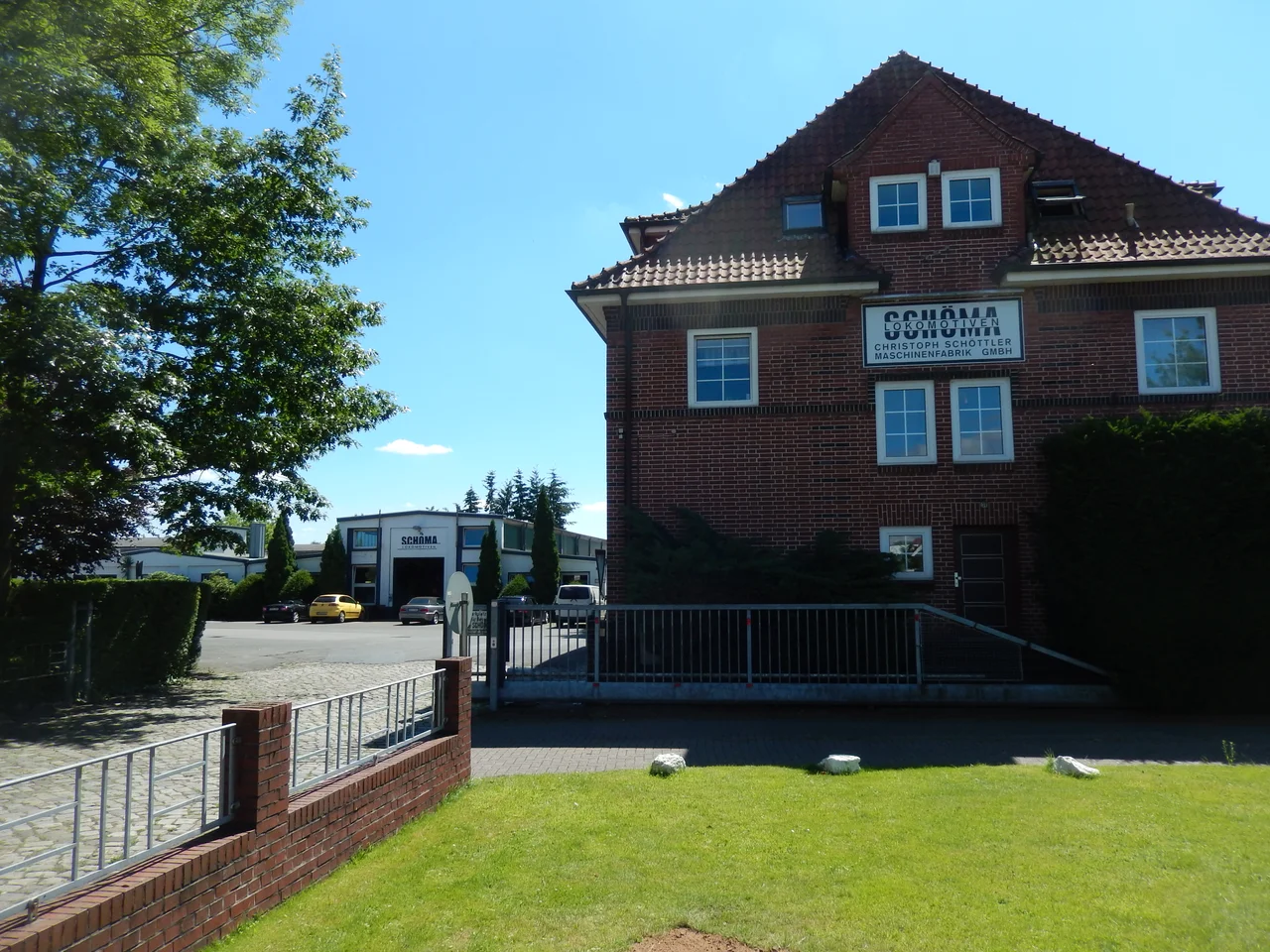

Schöma
By the time the 6,000th locomotive rolled off the assembly line, the company that built it was celebrating its seventy-fifth birthday. That is roughly one locomotive a month, every month, for three-quarters of a century — and most of them were one-offs, hand-built to specifications nobody else needed. Schöma occupies a flat industrial site in Diepholz that you would drive past without noticing, but the machines it produces have spent decades dragging spoil out of subway tunnels under Singapore, hauling peat across northern German bogs, and switching freight on Pacific island railways that no one outside the islands has ever heard of. The Schöttler family has run the place for four generations, and they are still here.
A Family Quarrel in 1930
The story begins with a falling-out. Christoph Schöttler worked for his father's firm, the Diepholzer Maschinenfabrik Fritz Schöttler — DIEMA for short — and the two men disagreed about what the company should build. So in 1930 Christoph left, founded his own machine works on the former DIEMA premises, and called it SCHÖMAG. A few years later he shortened the name to Schöma. He started by making mill machinery and tractors, the way his father had taught him, but he soon shifted to rail vehicles, and that decision shaped everything that followed. By the time the original DIEMA had faded, Schöma had become one of the most important manufacturers of field railways, mine railways, and narrow-gauge diesel locomotives in Europe.
The Tunnel Locomotive Pivot
In 1970 the company made another bet that paid off for decades: it began designing tunnel locomotives — short, powerful, narrow-gauge machines built to haul spoil out of subway and utility tunnels being dug under cities everywhere. Today these tunnel locomotives are the majority of what Schöma produces. They show up wherever a metro is being expanded, wherever a sewer trunk line is being driven through bedrock, wherever a power-grid tunnel needs construction support. Most of the world rarely thinks about how the material excavated from a subway tunnel actually gets out. The answer is often a Schöma diesel, painted in the bright safety colors of whichever contractor bought it, running on temporary track laid in the dark.
The Locomotive on the Roundabout
Drive west out of Diepholz toward Damme, on the highway through Lohne (Oldenburg), and at one roundabout a 1943 Schöma narrow-gauge locomotive sits permanently parked, an empty peat car still hooked to its drawbar. It was installed on 19 May 2011. For decades that exact type of machine had hauled peat out of the Südlohner Moor, on the foothills of the Dammer mountains, to be burned for fuel or processed into compost. The peat industry that supported it is essentially gone — the bog has been drained and protected — but the locomotive remains, about seven kilometers from the Diepholz factory that built it, as a monument to a vanished local trade and to the company that outlived it.
Island Railways and One-Off Engineering
Schöma also builds the locomotives that run on island railways — narrow-gauge or normal-gauge lines on places where importing a custom machine is easier than tooling up a local foundry. The company designed its own engines, its own transmissions, even its own drive shafts, because the supply chain for the kind of weird small locomotive a Pacific phosphate mine or a Caribbean tourist line needs simply does not exist off the shelf. Each project is essentially bespoke. The factory also rebuilds used locomotives, dragging machines from forty years ago back into service with new engines, new electrics, and the same patient narrow-gauge engineering the company has been doing since Christoph Schöttler walked out of his father's shop.
Four Generations, Still Family-Owned
As of 2012, the fourth generation of the Schöttler family took over running the company. In an industry where consolidation has eaten most of the small specialty builders, Schöma has stayed independent and stayed in Diepholz. It is the kind of German Mittelstand story that gets written about in business magazines but rarely seen up close: a small town, a single family, a narrow technical specialty held tightly enough that the larger world has to come to them. The locomotives are built within sight of the rivers Hunte and Lohne, by people whose grandparents probably worked on the previous generation of the same machines.
From the Air
Coordinates 52.61 N, 8.38 E — the Schöma works sit on the eastern edge of Diepholz, in flat central Lower Saxony. View from 3,000 feet — the factory complex appears as a cluster of industrial buildings just east of the historic Diepholz town core, where the rivers Hunte and Lohne meet. The roundabout-mounted 1943 locomotive is about 7 km west, on the highway between Vechta and Damme in Lohne. Nearest airports: Bremen (EDDW) 60 km northeast, Münster/Osnabrück (EDDG) 80 km southwest. Terrain is uniformly flat, under 50 meters elevation; the surrounding landscape includes drained peat bogs and Geest ridges.
Nearby Stories
- Wildeshausen Geest 8.1 km away
- Osnabrück (district) 8.6 km away
- Ibbenbüren 12 km away
- Esterwegen concentration camp 13 km away
- Minden 13 km away
- Schnoor 18 km away
- Emsland Railway 29 km away
- Minden Aqueduct 39 km away