
Emsland Railway
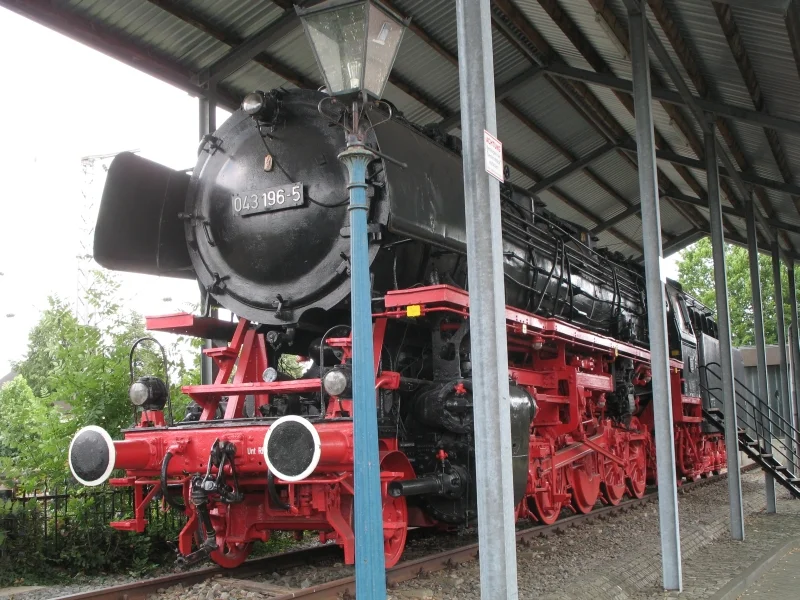
On 26 October 1977, two steam locomotives ran from Rheine to Emden and back along the Emsland line. They were the last working steam engines on the Deutsche Bundesbahn network, and everyone knew it. Within days the federal railway banned steam from its tracks entirely. Class 042 and 043 freight engines had been hauling ore from Emden to the Ruhr for years past the date when every other line in Germany had switched to diesel and electric. The Emsland line was the last holdout, and 26 October was the end. A few weeks later, locomotive 043 196-5 was rolled into position in front of Salzbergen station, where it has stood ever since.
A Line Built Out of Order
The Royal Hanoverian State Railways opened the Emsland line in two awkward pieces. The first section, between Emden and Papenburg, started running on 24 November 1854 - and connected to nothing. It was a stranded railway, useful only for shuttling freight between two ports, waiting for the rest of the network to catch up. The gap from Osnabrück through Rheine and Salzbergen finally closed in June 1856, and trains could run all the way from Minden to Emden for the first time. The decision to build the Emden end first was political: the Kingdom of Hanover wanted to demonstrate commitment to its western coast before investing in the inland connection. The strategy worked. By 1880 the line was nationalized into the Prussian State Railway, and Rheine had grown into one of the most important junctions in northwest Germany.
The Lingen Workshops
Almost as soon as the line opened in 1855, central workshops appeared in Lingen to maintain the locomotives and wagons that worked it. The site grew into the Königlich Preußische Eisenbahnhauptwerkstätte Lingen - the Royal Prussian Railway Central Workshop - and for the next 130 years it was the beating mechanical heart of railway operations across this part of Germany. Steam locomotives came in for overhaul, were stripped to their boilers, rebuilt, and sent back out. The workshops kept doing this work until 1985, eight years after the last steam locomotive ran in regular service. The transition to diesel and electric took decades to complete, and Lingen was where it happened, one engine at a time.
Langer Heinrich and the Ore Trains
Among railway enthusiasts the most famous trains on the Emsland line were called Langer Heinrich - Long Henry - the heavy ore hauls that brought iron from the port of Emden down to the steel mills of the Ruhr. They were enormous trains, often double-headed, requiring class 042 or 043 locomotives working at full output for hours on end. The class 042s were converted oil-burners; the 043s were among the largest steam freight engines ever built in Germany. Photographers came from across Europe to watch them. The farewell tours of 23 October 1977 ran a pair of these locomotives the full length of the line one last time, and three days later the service ended for good.
The Transrapid Years
The Emsland was also chosen, in the 1980s, for something stranger. A 31.5-kilometer Transrapid magnetic-levitation test track was built parallel to parts of the line near Lathen, where the company developed the maglev technology eventually exported to Shanghai. For two decades visitors could watch the test trains streak past at over 400 km/h, gliding without wheels. On 22 September 2006 a Transrapid running at 170 km/h struck a maintenance vehicle that had not been cleared from the track. Twenty-three people died. The test track never recovered. Operations ended definitively in 2011, and the elevated guideway was dismantled. Today the Stadler FLIRT electric multiple units that run the regional service hit a maximum of 140 km/h - fast, modern, ordinary trains on a line that has spent 170 years specializing in railway endings.
From the Air
The Emsland line runs roughly south-to-north between 52.28 N (Rheine) and 53.36 N (Emden), following the Ems River through Lower Saxony. The waypoint at 52.65 N, 7.31 E places you near Lingen, the historical operational heart of the line. From 5,000-8,000 feet the river and the parallel Dortmund-Ems Canal are easy to follow, with the railway tracing the eastern bank for most of its length. Nearest airports: Münster Osnabrück (EDDG) to the south, Bremen (EDDW) to the northeast. Weather can be overcast for extended periods; the best flying is in late spring.
Nearby Stories
- COVID-19 protests in the Netherlands 3 km away
- Westerbork Transit Camp 4.9 km away
- Schüttorf 7.4 km away
- Sellingerbeetse 8.8 km away
- Hardenberg 8.8 km away
- British Occupation Zone in Germany 11 km away
- Friesoythe 15 km away
- Quakenbrück 15 km away