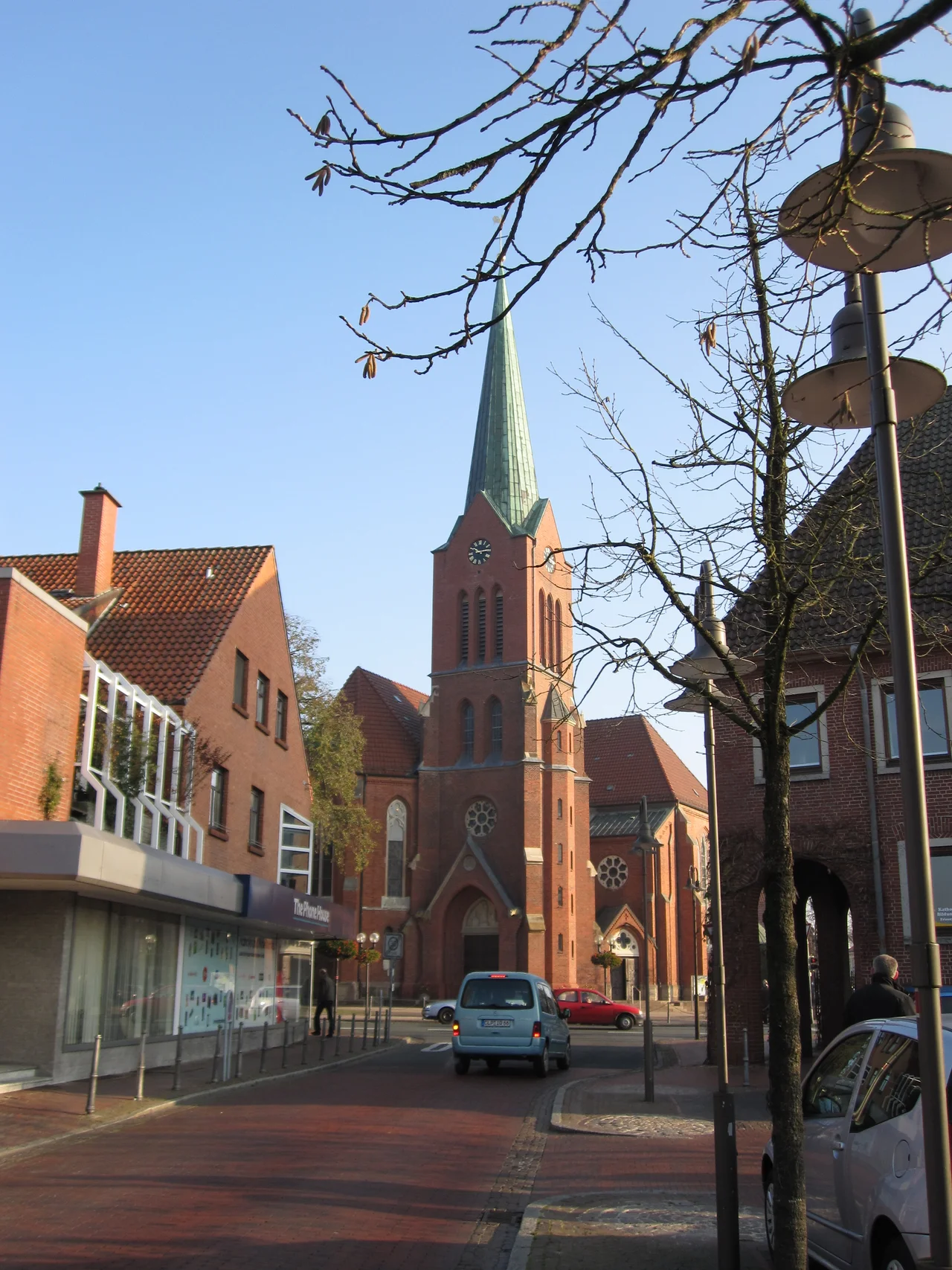

Friesoythe
Almost every house you see in the centre of Friesoythe is younger than the town's grandparents. The brick gables, the parish square, the convent on the edge of town that somehow survived everything around it - all of this is the second draft. The first draft burned for eight hours on 14 April 1945, when Canadian flamethrower carriers worked their way through the streets and the war diary keeper described the scene as a reasonable facsimile of Dante's Inferno. Today the town carries on as a small Lower Saxon market centre on the River Soeste, where farmers come in from the surrounding Cloppenburg district and the Catholic parish bells still mark the hours. But the architecture is the architecture of a place that had to start over.
A Medieval Beginning on the Soeste
Friesoythe grew up in the 1220s as a fortified market on the River Soeste, where a strategic crossroads cut through the boggy ground of the Oldenburger Münsterland. For most of its life it was an unremarkable Catholic country town in the Grand Duchy of Oldenburg - the kind of place that produced a steady trickle of local notables and not much drama. Heinrich Totting von Oyta, born here around 1330, made his way to Vienna and helped found the Catholic Faculty of Theology at the new university there. Otherwise the medieval and early-modern centuries passed in cattle markets, peat cutting and the slow rhythm of a parish where the Soeste turned the watermills and the priest baptised the next generation.
April 1945
By the spring of 1945 the war was almost over and everyone knew it. The Canadians had crossed the Ems at Meppen and were pushing across the sodden Westphalian Lowland toward Oldenburg, twenty miles east of Friesoythe. Most of the town's four thousand residents had read the situation correctly and walked out into the countryside on 11 and 12 April, carrying what they could. Several hundred German paratroopers stayed to defend the crossroads. On the morning of 14 April the Argyll and Sutherland Highlanders of Canada took the town in a dawn assault. By 10:30 it was theirs - and then, around the same time, Lieutenant-Colonel Frederick Wigle was killed in a confused firefight at his tactical headquarters. A rumour spread, wrongly, that a civilian had pulled the trigger.
The Long Eight Hours
Major-General Christopher Vokes did not ask many questions. He gave the order, verbally, never on paper: raze the goddam town. The Argylls had already started burning houses in fury over Wigle's death. Now Wasp carriers with flamethrowers moved methodically through Friesoythe while soldiers worked the side streets with petrol cans and phosphorus grenades. Ten civilians from the town and another ten from the surrounding villages were killed in the fighting and what followed - elderly people who had stayed behind, families pulled from cellars, residents reportedly dragged from their houses before the houses came down. According to the German assessments afterwards, 85 to 90 per cent of Friesoythe was destroyed. Of 381 houses in the town proper, 231 were levelled and 30 more badly damaged. A Canadian nurse wrote home a few days later that the convent on the edge of town was the only building left standing. The rubble was bulldozed into the cratered roads so the division's tanks could keep moving east.
Two Kinds of Memory
The aftermath was almost as strange as the event. The Argylls' war diary mentioned only that 'many fires were raging.' Higher up the chain - division, corps, army - there was no official record of the deliberate destruction. The Canadian Army's official history, when it appeared in 1960, called it a 'mistaken reprisal' and noted that 'there is no record of how this came about.' Vokes himself, writing forty years later, said he had 'no great remorse over the elimination of Friesoythe.' The town had a different problem: it had to be rebuilt. The 1970 commemorative volume *Friesoythe 25 Jahre danach* gathered the local accounts, the German historian August Wöhrmann pieced together what the paratroopers had done, and the new town rose on the old street grid. The convent still stands on the edge of town. So does the parish church, and the marketplace, and the rebuilt gables that look, at a glance, as if nothing had ever happened here.
From the Air
Friesoythe sits at 53.02 degrees north, 7.86 degrees east, on the River Soeste in the Cloppenburg district of Lower Saxony. From cruising altitude the town appears as a compact red-roofed cluster on the flat North German Plain, about 32 km west of Oldenburg and 60 km southwest of Bremen. Nearest larger airports are Bremen (EDDW) to the northeast and Münster-Osnabrück (EDDG) to the southwest; the small Cloppenburg-Varrelbusch airfield (EDWV) lies about 20 km to the south. The terrain is uniformly flat moor and farmland, often hazy in the wet North Sea climate.
Nearby Stories
- Nienhaus 5.8 km away
- Quakenbrück 7.1 km away
- Meppen 7.9 km away
- Ems 12 km away
- Wiesmoor 19 km away
- Valentin submarine pens 25 km away
- Teufelsmoor 31 km away
- Minden 59 km away