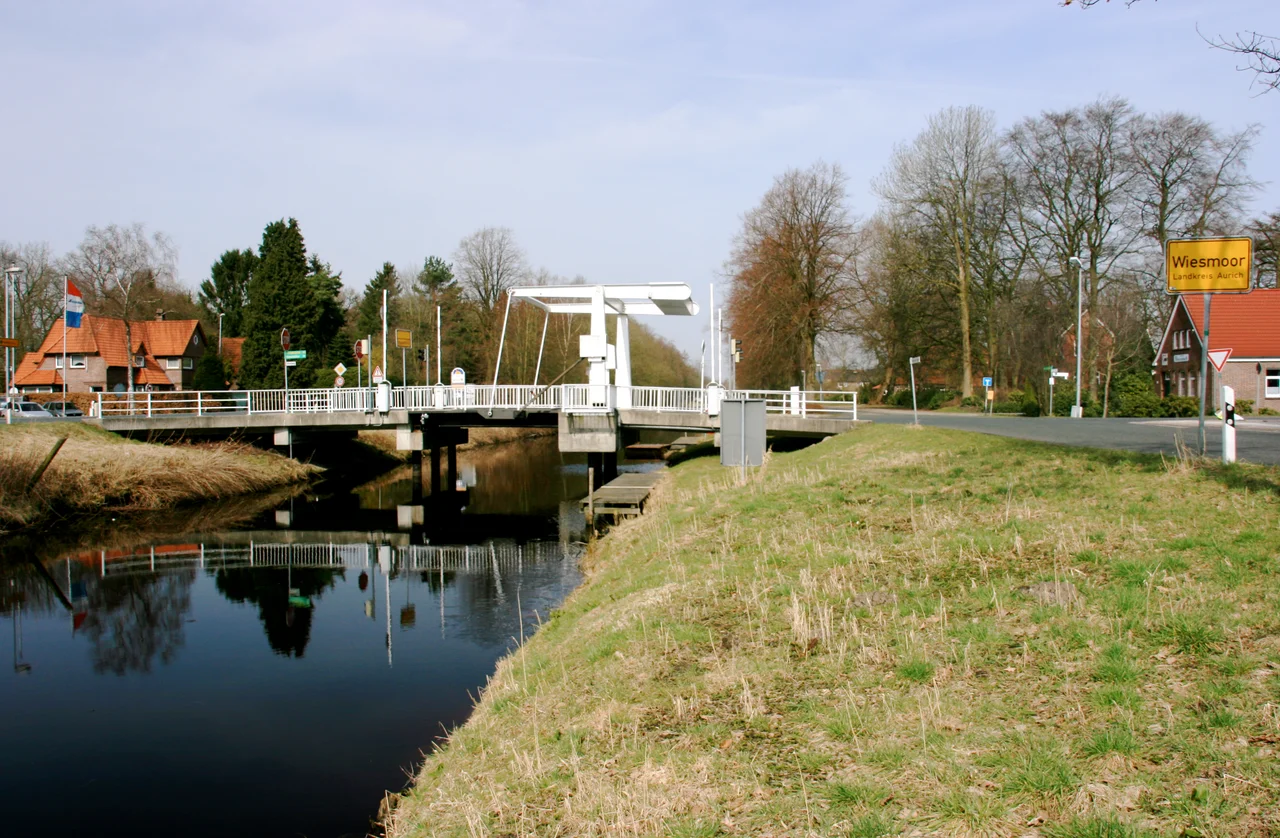

Wiesmoor
In 1925, the engineers at the Wiesmoor peat-burning power station noticed that they had a problem and an opportunity stacked on top of each other. The plant ran hot. Waste heat poured out by the megawatt, energy with nowhere useful to go in the middle of a drained East Frisian bog. So they piped it into glasshouses. By the 1930s, the greenhouse complex at Wiesmoor covered roughly 75,000 square meters and was the largest in Europe — a small ocean of glass, lit from below by the heat of a power plant burning the bog the town stood on. Today the peat power station is gone, decommissioned in 1966 and replaced by a gas turbine plant that was itself demolished in 1995. The greenhouses remain. The town calls itself the Blütenstadt, the Flower City, and runs an annual festival that ends with a queen parachuting into a sports ground.
The Newest Old Town in East Frisia
Wiesmoor is the youngest town in East Frisia. It received its town rights on 16 March 2006, and two days later celebrated the centenary of its founding — a 100-year-old settlement granted formal township only on its hundredth birthday. The chronology has a strange recursive quality. Almost all the quarters that make up modern Wiesmoor are older than the town center itself, because the planned 1906 settlement was dropped into the middle of a much older landscape of bog villages: Marcardsmoor, Hinrichsfehn, Voßbarg, Wilhelmsfehn, Wiesederfehn, Zwischenbergen. The new center grew up between them, then absorbed them. The bog underneath, the East Frisian raised bog, had once held peat layers up to eight meters deep, the product of post-glacial accumulation over thousands of years.
Industrial Peat and a Prussian Plan
Around 1900 a Prussian agricultural ministry official named Dr. Eberhard Ramm proposed something audacious: harvest peat by industrial machine instead of by hand spade. The traditional Fehn colonies had cut peat one strip at a time for centuries, but Ramm imagined large-scale mechanical extraction feeding directly into a purpose-built power plant. He partnered with Carl Friedrich von Siemens. In 1906 the Nordgeorgsfehnkanal was cut through the bog to drain the area. Specialists and prison laborers arrived first. By 1907 ordinary residents began moving in. By 1909 the peat power plant was producing electricity, eventually distributing it from the Ems to the lower Elbe — a remarkable reach for a generator burning compressed bog. Siemens owned it until 1921, when North West German Power Plants took over. At its peak in 1952 the plant employed about 1,200 people and consumed roughly 120,000 tons of peat a year.
Greenhouses, Cucumbers, and a Blossom Queen
The waste-heat greenhouses, expanded after the war by the Ernst Benary flower company with twenty new houses and forty hectares of outdoor growing, turned Wiesmoor into a serious horticultural producer. About 200 people worked the greenhouses in the early 1950s, growing tomatoes and cucumbers that traveled to neighboring European countries and flowers in industrial volume. The first Blütenfest, the flower festival, was held in 1952, on the first weekend of September. It still runs that weekend every year. Each festival selects a new Blütenkönigin — a Blossom Queen — and the outgoing queen, by long tradition, parachutes over the sports field on Saturday evening to signal the start of the party. Monday closes with Kanal in Flammen, fireworks along and over the Nordgeorgsfehnkanal that drained the bog a century earlier.
Honesty About 1944 and 1989
Two harder dates sit in the town's chronology. During the Second World War, the Wiesmoor area held a forced-labor subcamp attached to the Nazi prison in Emden — part of the broader system of forced labor under German rule, and a piece of local history the town now acknowledges in its civic record. And on Friday 13 January 1989, a Royal Air Force Panavia Tornado from 14 Squadron flying low over the Hinrichsfehn district collided with a German Alpha Jet of Jagdbombergeschwader 43 at around 9:50 in the morning. Wreckage came down near a primary school. Both Tornado crew were killed: navigator Fl Lt Alan George Grieve, 28, of Forres in Moray, who left behind his wife and an 18-month-old daughter; and pilot Fl Lt Michael Peter Staveley Smith, 37, married with two sons. The German pilot, Hermann Späth, 38, ejected and survived. The 1995 demolition of the gas turbine power plant that had replaced the peat one closed the industrial chapter that had created the town. The Luftkurort designation Wiesmoor earned in 1977 — air-spa status for the quality of its air — closed it, in a sense, twice.
From the Air
Wiesmoor sits at 53.4 N, 7.733 E in the southeastern Aurich district, about 30 km inland from the North Sea and roughly central in the East Frisian peninsula. From altitude look for the long, straight Nordgeorgsfehnkanal cutting east-west, with the town's regular grid pattern along it and clusters of glasshouses catching the light. Surrounding country is dark cultivated former bog. Closest sizable cities: Wilhelmshaven (30 km NE), Oldenburg (45 km SE), Bremen (80 km SE), Groningen (80 km SW). Nearest airports: Wilhelmshaven (EDWI) about 25 km north, Bremen (EDDW) about 80 km southeast, Emden (EDWE) about 40 km west. Light aircraft can use Leer-Papenburg (EDWF) about 35 km southwest. Best visibility is on cool, clear high-pressure days; the bog releases ground fog in autumn and early winter.
Nearby Stories
- Wilhelmshaven LNG Terminal 3.5 km away
- Veenkoloniën 6.1 km away
- Varel 6.2 km away
- Juist 7.6 km away
- Delfzijl 7.8 km away
- Dornumersiel 9 km away
- Esterwegen concentration camp 10 km away
- Hatten 19 km away