
Varel
Voltaire wrote to her. Frederick the Great considered her a confidante. The woman they were courting with their letters was not in Paris or Berlin but in a small town on the muddy Jade Bight, where the North Sea bites a notch into the German coast and the wind comes off the water with nothing to slow it down. Charlotte Sophie of Aldenburg ruled Varel as countess from her castle on the edge of the marshes, an unlikely correspondent for the brightest minds of the Enlightenment, and an even more unlikely lord of a damp Frisian backwater that today holds about 24,000 people and the memory of a much stranger past.
Where the Land Gives Up
Varel sits about 15 kilometers south of Wilhelmshaven and 30 kilometers north of Oldenburg, perched on the Geest - the slightly higher, sandier ground that German geographers distinguish from the wet marshes below. For centuries the town hugged this dry shelf while the lowlands stayed dangerous, prone to flooding from a North Sea that has redrawn this coast more than once. Then came the dykes. As earthworks pushed the water back, Varel crept downhill into ground that had once belonged to the tides. Today three-quarters of the municipality is farmland, and a surprising tenth is forest - unusually wooded for a coast where most towns face out across treeless polder. Walk to the western edge of the district at Dangast, and the land simply gives up. Mudflats stretch toward the horizon, and at low tide you can walk out onto them, the Wadden Sea's strange shining floor.
The Countess and Her Letters
Charlotte Sophie of Aldenburg was born in 1715 and inherited Varel as her own ruling territory - a small dot of female sovereignty in a Europe that mostly did not allow such things. She corresponded with Voltaire, the sharpest pen of the French Enlightenment, and with Frederick II of Prussia, whose army would soon redraw the map of central Europe. What they made of this Frisian countess on the edge of nowhere is part of the puzzle: she was clearly something more than a curiosity to them, a woman whose mind could meet theirs across the long lag of 18th-century post. Her castle stood until the 19th century, when fire gutted most of it and the rest was pulled down. Only one building survives from the complex, and it happens to be the most extraordinary thing in Varel.
Münstermann's Towering Altar
The castle church is the oldest building in town. Its first stones were laid in 1144; the tower went up between 1200 and 1250 as twin spires, rebuilt into its present shape in 1651 and reshaped again in 1737. But the reason art historians come to Varel is not the architecture - it is what stands inside. Between 1613 and 1618, the woodcarver Ludwig Munstermann carved the altar, font, and pulpit, and his altar climbs nearly ten meters into the church's gloom. It is one of the great surviving works of Northern German Mannerism, a style that took the calm of the Renaissance and twisted it into something restless and elongated, all writhing figures and exaggerated gestures. Before the Reformation, the church was dedicated to Saint Peter. Today it is plain Lutheran, no patron saint, and Munstermann's altar dominates the space like a frozen forest of saints and angels reaching for a heaven the Reformation no longer quite believed in.
An Unlikely Roster
For a town this size, Varel keeps producing people who outgrew it. Johann Gerhard Oncken, born here in 1800, would found the German and continental European Baptist churches - a quiet Frisian whose theology rippled across a continent. Lothar Meyer was born in 1830 and would later arrange the chemical elements into a periodic table independently of Dmitri Mendeleev, an achievement usually credited solely to the Russian; Mendeleev published his table in 1869; Meyer published his comprehensive version in 1870, within months of each other. His younger brother Oskar Emil Meyer became a physicist who studied the viscosity of gases. The dramatic soprano Hildegard Behrens was born in Varel in 1937 and grew up to sing Brunnhilde at the Met. More recently the footballer Deniz Undav, born here in 1996, has become a fixture in the German national team. Something about this damp corner of Friesland keeps sending people out into the world.
Twin City, Far Away
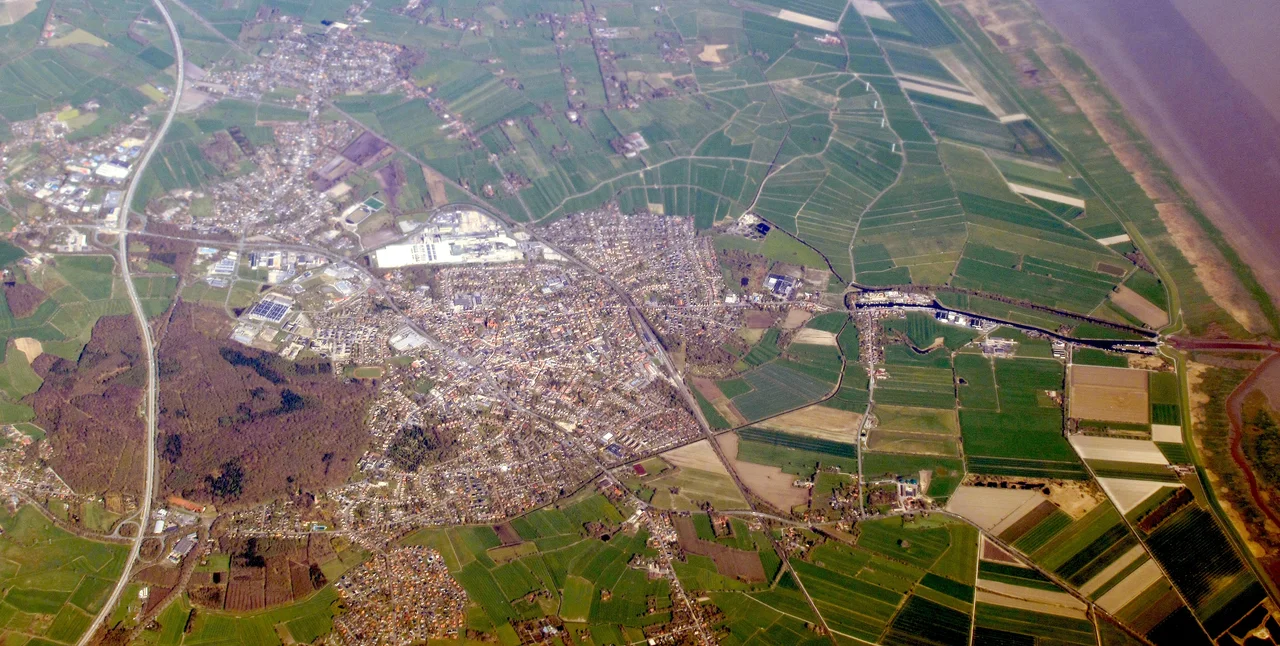
Varel is twinned with Jackson, Michigan, an industrial American town a continent and an ocean away. It is the kind of pairing that town twinning produces - improbable, slightly absurd, and somehow durable. From the air, Varel reveals itself as a compact cluster of red roofs ringed by patchwork fields, the green of forest pressing in from the south and the wide silver of the Jade Bight to the north. Twenty-one named localities make up the municipality, with names that read like a Frisian poem: Altjuhrden, Borgstede, Dangast, Obenstrohe, Streek. Somewhere down there, Munstermann's altar is still climbing toward its dark ceiling, and Charlotte Sophie's letters are still in archives, waiting for the next reader to be surprised that a small town on a muddy bay once spoke directly to the Enlightenment.
From the Air
Coordinates 53.40N, 8.14E, on the southern shore of the Jadebusen (Jade Bight) in northwestern Germany. Recommended viewing altitude 2,500-4,000 ft for a clear sense of the town's position between the bight, the agricultural Geest, and the forested southern reaches. Visual landmarks: the broad silver-grey notch of the Jade Bight to the north, Wilhelmshaven's port cranes about 15 km north-northwest, and the city of Oldenburg about 30 km south. The mudflats at Dangast, on Varel's western edge, are visible at low tide as a distinct lighter band along the shore. Nearest airports: Wilhelmshaven-Mariensiel (EDWI) about 13 km northwest, Jever (EDWJ) about 25 km northwest, Bremen (EDDW) about 60 km south-southeast for any meaningful airline service. North Sea coastal weather brings frequent low cloud, sea fog in spring and autumn, and strong west winds; the best visibility is usually a clear high-pressure day in late summer.
Nearby Stories
- Alexander von Humboldt 1.6 km away
- Vossbarg 5.2 km away
- Saterland Frisian language 6 km away
- Hatten 9.6 km away
- Hohe Weg Lighthouse 10 km away
- Teufelsmoor 10 km away
- Spiekeroog 18 km away
- Lilleø 227 km away