
Saterland Frisian language
Bäte dusse Sküüldouk wädt Seeltersk boald. Under this face mask, Saterlandic is spoken. The sentence appeared on cloth masks during the winter of 2020-2021, when a regional contest in the Saterland came up with a new word - Sküüldouk - for something the world had never needed before. About 2,000 people in three villages of Lower Saxony still speak the language well enough to invent in it. They are the last fluent speakers of East Frisian, a branch of the Germanic family that survived everywhere else only as place names. Seeltersk is older than German. It is closer to English, in some deep grammatical ways, than to the High German spoken in the next village over. And it is still being used to discuss what to call a mask.
Islands of Sand
The Saterland is not, geologically, an island. But for almost a thousand years it behaved like one. When Frisian settlers arrived here around 1100 AD, fleeing storm floods on the North Sea coast, they found a few sandy ridges rising out of an immense raised bog. The villages they built - Ramsloh, Scharrel, Strücklingen - sat on those ridges like ships at anchor. The surrounding moor was nearly impassable. Until the nineteenth century the only reliable route in or out was the river Sagter Ems, which the Saterlanders called the Seelter Äi. In winter you could sometimes walk over the frozen bog. The rest of the time, you were where you were. East Frisian, which was rapidly being absorbed into Low German across the rest of the East Frisian peninsula by the early 1500s, survived in the Saterland the way rare plants survive in cold pockets of mountain valleys: protected, accidentally, by isolation.
What the Language Carries
Linguistically, Saterland Frisian is conservative. It preserves old Frisian sounds and vocabulary that the other living Frisian languages - West Frisian in the Netherlands, North Frisian on the German coast - have streamlined or lost. The closest relative outside the Frisian family is English. The verb kwede, 'to say,' is a cousin of English quoth. The word for knife, Soaks, descends from the same root as the Anglo-Saxon seax. To listen to Seeltersk is to hear a version of how northern Europe sounded a thousand years ago, run forward in an unbroken chain by people who simply kept talking the way their grandparents had. Three village dialects exist - Ramsloh, Scharrel, and Strücklingen - and they are mutually intelligible. The Ramsloh form has gradually become a kind of standard, because the first grammar and word list happened to be based on it.
The People Who Held On
After the Second World War, German repatriates from Eastern Europe were resettled into the Saterland. They arrived speaking Standard German. For the first time, the village schools and shops were full of people for whom Seeltersk was not the obvious language to use. Linguists in the late twentieth century predicted that the language would die within a generation. It did not. It is still considered seriously endangered - only about half of the 2,000 strong speakers are native, and most of those are older - but the population has held remarkably steady. Some younger parents now raise their children in Saterlandic on purpose. They have made a decision their grandparents never had to make. The grandparents simply spoke it. Their grandchildren have to choose to.
The Quiet Custodians
The German federal government has not poured resources into preserving Sater Frisian. Most of the practical work falls on the Seelter Buund, the Saterlandic Alliance, a community organization run by people who learned the language at the kitchen table and now teach it to anyone who wants to learn. Margaretha Grosser, a retired resident, has translated dozens of children's books from German into Seeltersk because there were almost none in print. An app called Kleine Saterfriesen - Little Sater Frisians - teaches vocabulary in the contexts a child actually moves through: the supermarket, the farm, the church. A local newspaper based in Oldenburg publishes occasional Seeltersk articles. The regional radio station Ems-Vechte-Welle airs a Sunday program, Middeeges, with the first hour in Saterlandic. None of it is grand. All of it is what keeps the chain unbroken.
A Voice Worth Hearing
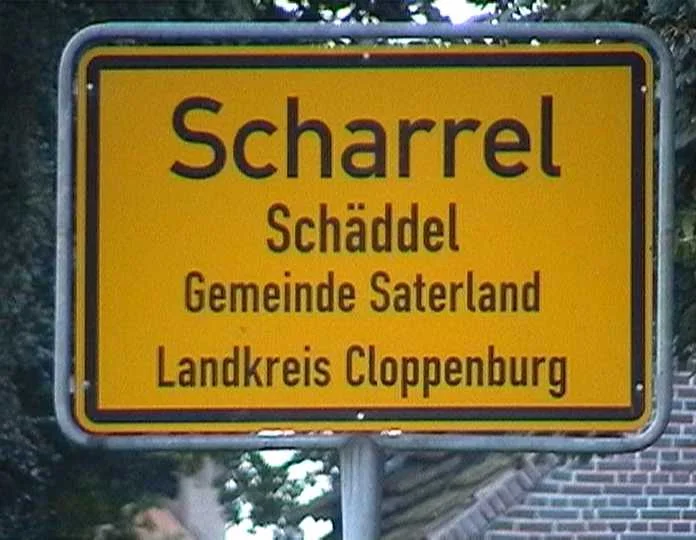
In 1998 Germany included Sater Frisian in Part III of the European Charter for Regional or Minority Languages - a legal recognition that the language has a right to exist, to be taught, to appear on road signs. Bilingual signs now mark the villages. The American linguist Marron Curtis Fort spent decades documenting Seeltersk and produced both a dictionary and a Saterlandic translation of the New Testament, published in 2000. Media reports often credit his work, and the attention it brought, with helping to revive the community's confidence in the language. Whether or not that is the whole story, the result is something rare in the long, mostly sad history of European minority languages. A language that should be gone is not gone. It is on a face mask, and on a town sign, and in the mouths of children who, two hundred years from now, may still have a word for knife that English forgot.
From the Air
The Saterland municipality lies near 53.03°N, 7.72°E in the Cloppenburg district of Lower Saxony, immediately east of the Hümmling ridge and south of East Frisia proper. From altitude the three Saterlandic villages - Ramsloh, Scharrel, Strücklingen - appear as a north-south line of settlements on sandy ridges, surrounded by drained moor and farmland. Recommended viewing altitude 3,000-5,000 feet. Nearest airports: Bremen (EDDW) about 75 km east, Münster Osnabrück (EDDG) about 100 km south, Groningen Eelde (EHGG) about 100 km west. The Sagter Ems river that long served as the only entry route runs along the northern edge of the language area.
Nearby Stories
- Stadskanaal 5 km away
- Warsingsfehn 7.6 km away
- Dinklage 8.4 km away
- Delfzijl 11 km away
- 1st Panzer Division (Bundeswehr) 14 km away
- Varel 15 km away
- Meppen 19 km away
- Coevorden 20 km away