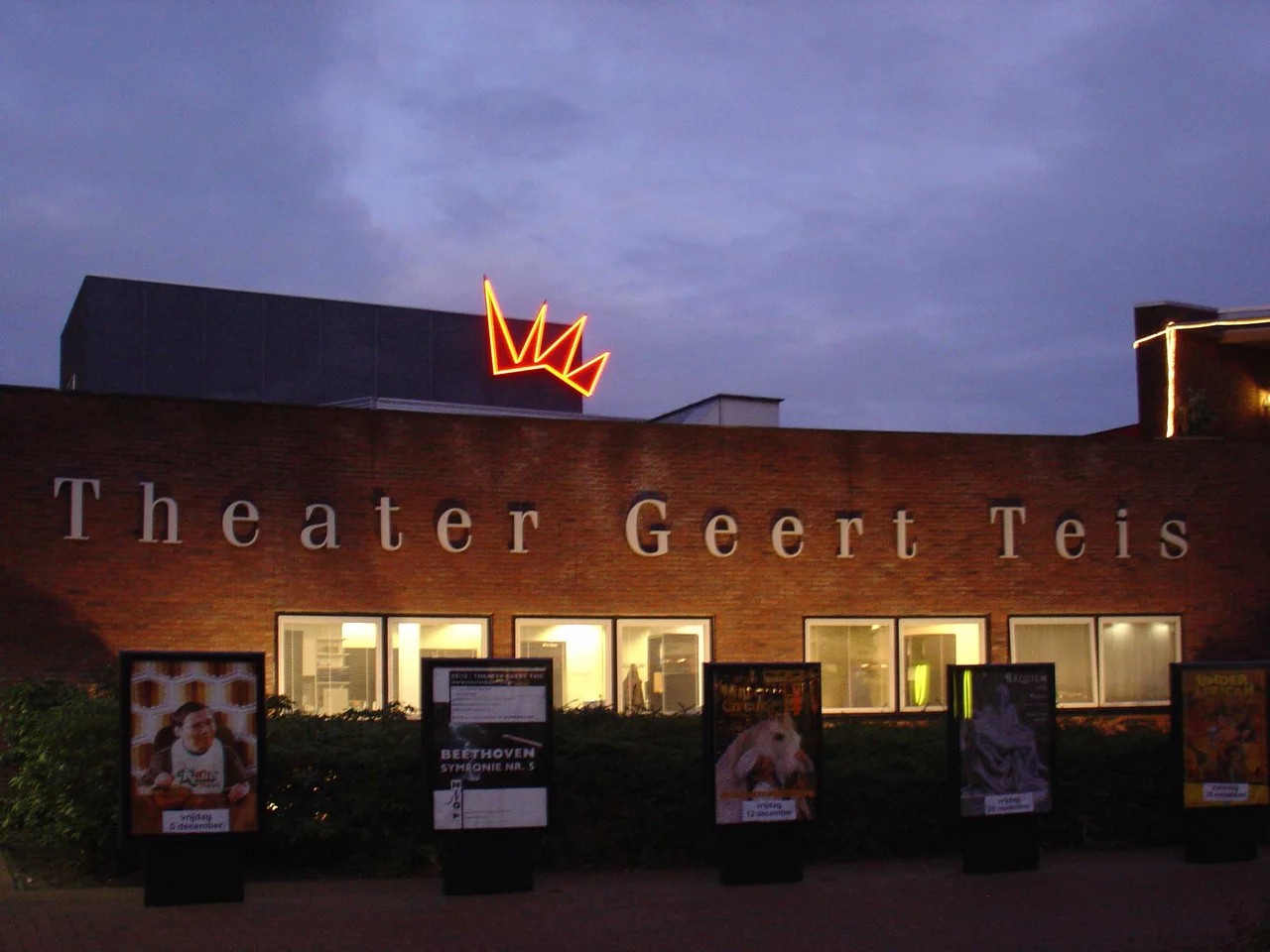

Stadskanaal
In 1762, the city council of Groningen made a quiet decision and did not write it down anywhere it might be found. They were going to extract peat from the bogs of Drenthe, the neighboring province, using Groningen city land as the entry point. The plan required digging a long, straight canal southeast from Wildervank toward the Drenthe border, and along that canal a town would eventually grow. Three years later, on February 11, 1765, the mayor and council formally approved the canal extension. Crews of about a hundred Groningen and German laborers picked up shovels and started cutting the Stadskanaal — the City's Canal — by hand. The town built along its banks took its name from the trench. Two and a half centuries later, the canal still runs ruler-straight through the middle of everything.
A Linear Village, Sixteen Kilometers Long
Most towns grow in clusters. Stadskanaal grew in a line. A nearly ten-kilometer stretch of its urban area sits as a linear settlement along the canal, and the broader village runs sixteen kilometers from Veendam in the north to Westerwolde in the south. Most of the houses are on the north side. That was not aesthetic. When the first twelve wooden houses went up in 1787, the city of Groningen wanted only Groningers as residents, not Drenthe people, and put them on the side closer to the city. The other bank was left thinner, and stayed that way. Today, walk along the canal and you can still read the policy in the housing density. The town's first wooden lock, the Springersverlaat, was sunk into the canal soon after, and the peat barges began to move.
The Potato and the Starch Factory
Peat cutting strips a landscape. After the bogs were cut out, what remained was poor sandy soil that early residents could not afford to fertilize with the expensive city compost on offer. The land sat unimproved for decades. Then, around 1850, two things changed everything: artificial fertilizer became available, and the potato moved into Dutch agriculture. Outside settlers bought up the worn-out plots, fertilized them, and planted. By 1866, Willem Albert Scholten had founded the Stadskanaal potato starch factory on the site of an old malt distillery. By 1871, five shipyards were operating along the canal. By 1910, sixteen shipyards stretched between Bareveld and the IJzeren Klap bridge, building peat barges, coastal vessels, and even seagoing ships in a town that had once been considered the poor end of the province.
Forty Thousand Ships a Year
By the late nineteenth century, the Stadskanaal canal was one of the busiest waterways in the Netherlands. Forty thousand ships a year passed through, carrying peat, potatoes, starch, and finished goods to Groningen and beyond. The railway followed in waves — a horse-drawn tram line in 1881, the Zwolle-Stadskanaal connection in 1905, the line to Zuidbroek in 1910, and the cross-border S.T.A.R. line in 1924. Stadskanaal Station, opened in 1903, briefly employed more than 400 railway workers and served as a major junction. Then road transport quietly killed all of it. The canal traffic dwindled to pleasure craft. Passenger trains were discontinued line by line, from 1935 onward, until by 1990 even freight stopped running. The S.T.A.R. line survived only because a foundation turned it into a museum railway in 1994 and put steam engines back on the tracks.
The Synagogue, the Factories, the Aftermath
Stadskanaal kept growing through the twentieth century — new neighborhoods through the 1960s and 1970s, a new shopping center in 1970 — until it became the second-largest municipality in Groningen province. Philips ran factories here for decades, employing thousands, until the company began winding down operations in 1978 and finally closed the last lines in 2006. The synagogue, built in 1860 after years of opposition, served the town's Jewish community until the Second World War, when most of the community was deported and murdered by the German occupation. Only a few people survived. The building stood empty afterward and was demolished in 1964. The town today is a working place of about 19,000 residents, with the canal that named it still cutting straight through, mostly carrying pleasure boats now where peat barges once queued.
From the Air
Located at 52.986 north, 6.959 east in the southeast of Groningen province. From cruise the most striking feature is the canal itself — the sixteen-kilometer ruler line of Stadskanaal, parallel to the older Semslinie that marks the Groningen-Drenthe border. Look for the linear strip of development running along the north side. Nearest airports: Groningen Airport Eelde (EHGG) about 25 nautical miles northwest, and Münster-Osnabrück (EDDG) across the German border to the south. Recommended viewing altitude 3,000 to 5,000 feet AGL for the canal geometry.
Nearby Stories
- Terborg, Germany 4.2 km away
- Lauwerzijl 5.8 km away
- Eems Canal 6.5 km away
- Papenburg 7.7 km away
- Meppel 9.8 km away
- Coevorden 10 km away
- Nuis, Netherlands 17 km away
- Quakenbrück 39 km away