.jpg)
Quakenbrück
In 1891, a twenty-year-old saddler named Friedrich Ebert wandered into Quakenbrück looking for work, found it briefly at a local workshop, and moved on. He was on the road in the way young craftsmen had been for centuries, taking jobs where he could, learning what he could. Twenty-eight years later he would be the first President of the new German Republic, sworn in during the chaos that followed the First World War. The saddlery is gone now. The town that took him in for a season has the kind of low-key density of remarkable history that turns up only when you start asking who actually came from here.
A Founding on the Hase
Quakenbrück was founded in 1234 by the Bishop of Osnabrück, although people had clearly been farming the river meadows around it long before any document existed to record them. The site was strategic: it sat at the northern edge of the bishopric, where Osnabrück's territory bumped up against rival lordships, and a town there meant a defensible point on the slow, dark River Hase. The name itself is older than the town - one popular etymology reads it as the Quaker Bridge, but the truer derivation likely refers to boggy, quaking ground at the river crossing. Quakenbrück joined the Hanseatic League in its heyday and became the unofficial centre of the surrounding Artland district, the deep, fertile farmland whose ancient half-timbered farmhouses still draw architecture students.
The Iron Knight of 1916
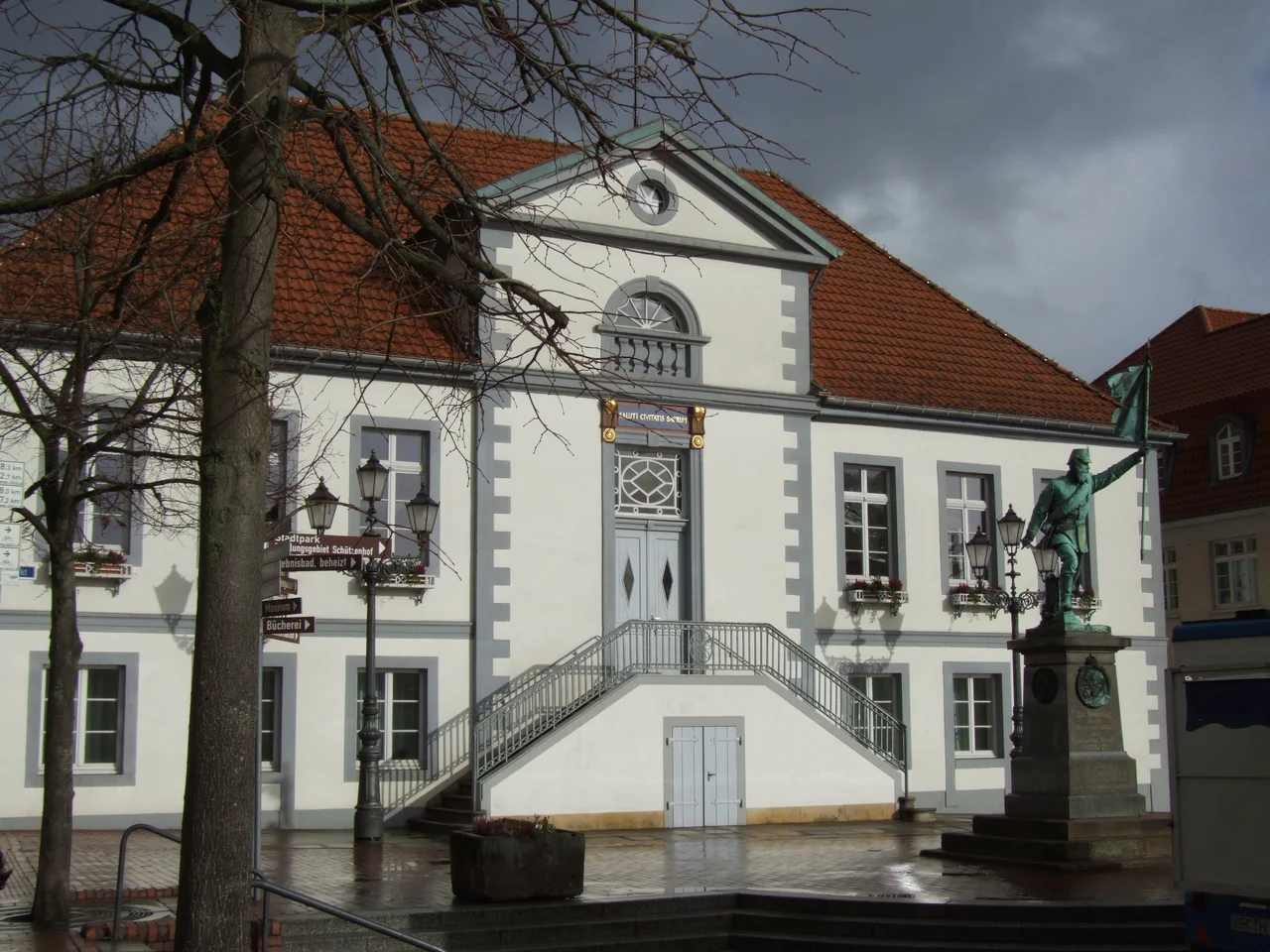
On 29 May 1916, in the middle of the First World War, the town received a strange gift. A wooden statue of a thirteenth- or fourteenth-century knight, carved from French poplar and built by two soldiers from the battalion of Clemens Freiherr von Schorlemer-Lieser, was installed in the town hall meeting room. It was a Nagelfigur - a nail-man - one of hundreds erected across Germany and Austria during the war. Civilians paid to drive an iron nail into the figure; the proceeds went to war charities and to the families of soldiers at the front. As the nails accumulated, the wooden knight gradually became armoured in iron - hence its name, the Quakenbrücker Eiserner Burgmann. It is one of the smaller and stranger artifacts of how a small town in Lower Saxony paid for a war it did not start and could not stop.
A Town That Sends People Out
The Artland-Gymnasium - the local secondary school - has a habit of producing graduates who go further than its modest size suggests. Klaus von Klitzing studied here before going on to win the 1985 Nobel Prize in Physics for the discovery of the quantised Hall effect. Hans-Gert Pöttering, born in nearby Bersenbrück in 1945, went from the same school to a long career in the European Parliament, which he eventually presided over. Holger Czukay, founding bassist of the experimental rock group Can, taught music at the school in the 1960s before going off to invent his own kind of sound. The town also raised the German-Dutch art historian Wilhelm Martin, the film critic Enno Patalas, and the actor Wilhelm Bendow, who became one of pre-war Berlin's most distinctive cabaret comedians.
Dragons in a Hayloft Town
The other thing Quakenbrück is known for is, improbably, basketball. The Artland Dragons play in a small arena in a town of fewer than fourteen thousand people, and for most of the 2000s they competed at the top of the Basketball Bundesliga. They finished runners-up in the 2007 season and won the German Cup in 2008 - results that meant fans from larger German cities had to drive into the flat agricultural country north of Osnabrück to see their teams play. The climate here is the gentle, damp, slightly cool type of the North German Plain: about 700 millimetres of annual rainfall, an average air temperature of 8.5 degrees Celsius, and maybe twenty-five summer days when the thermometer reaches 25. It is not weather that suggests championships. The Dragons won anyway.
From the Air
Quakenbrück sits at 52.68 degrees N, 7.96 degrees E on the River Hase in northern Lower Saxony, about 45 km north of Osnabrück. From altitude the town shows as a compact built-up area along the river, with the surrounding Artland farmland giving a distinctive patchwork of long, narrow field strips. Nearest airports are Münster Osnabrück International (EDDG) about 55 km south, and Bremen (EDDW) about 80 km north-northeast. Best viewing altitude 3,000-5,000 feet; the meandering Hase makes an easy navigation thread, and the Alfsee reservoir lies roughly 20 km south.
Nearby Stories
- Emsland Railway 5.1 km away
- British Occupation Zone in Germany 5.3 km away
- Friesoythe 13 km away
- Schüttorf 14 km away
- Nienhaus 15 km away
- Alexander von Humboldt 31 km away
- Minden 35 km away
- Minden Aqueduct 51 km away