
Schüttorf
In 1897, two German streets got electric lights for the first time. One was Unter den Linden, in Berlin - the most famous boulevard in the imperial capital. The other was the main street of Schuttorf, a small textile town in southwestern Lower Saxony with fewer than five thousand inhabitants. Schuttorf had built its own direct-current power station on Fabrikstrasse the year before. The Kaiser was electrifying his capital; Schuttorf was electrifying itself. For the next decade and a half, in this one specific respect, a county town on the Dutch border was as modern as Berlin.
Town Rights, 1295
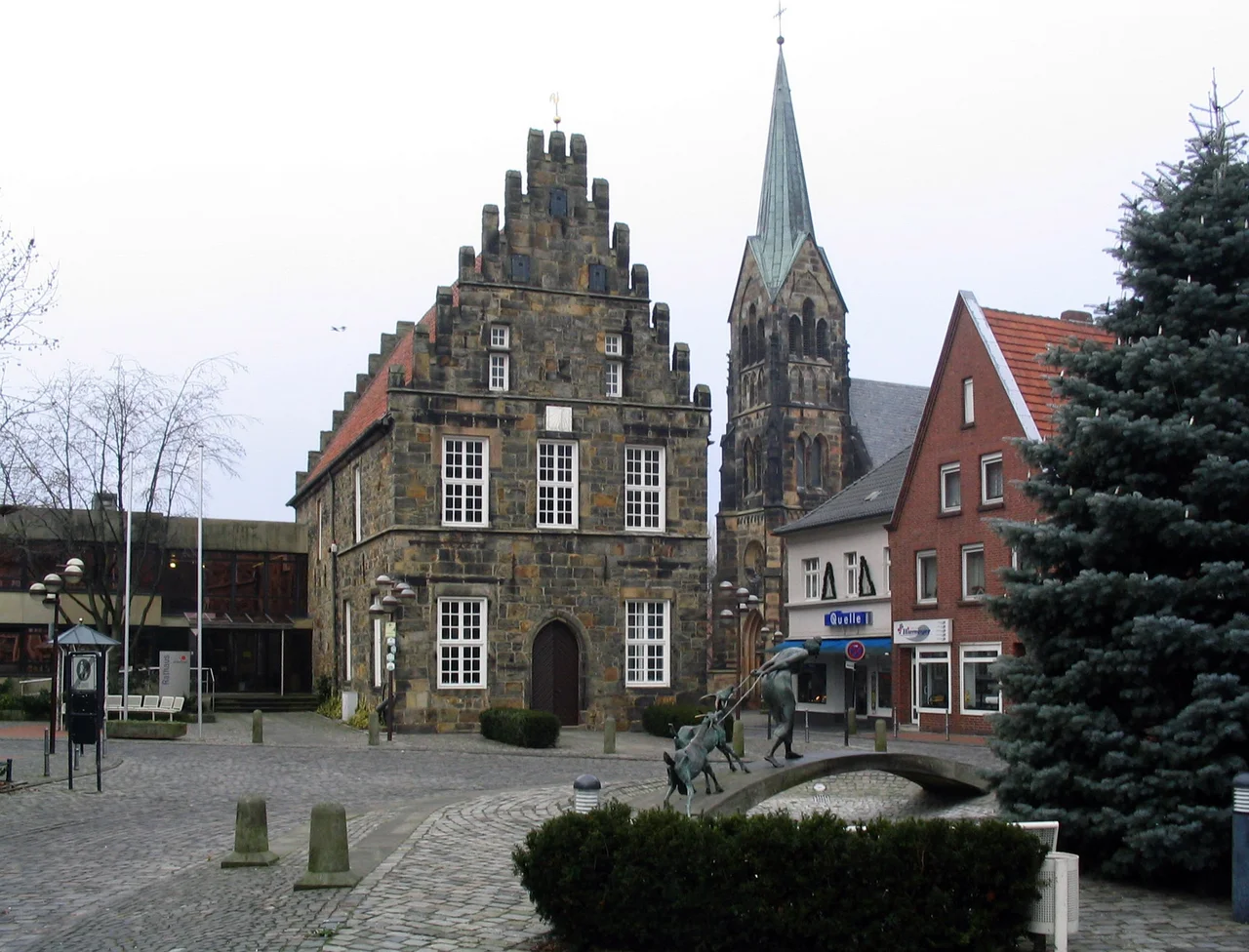
Schuttorf is the oldest town in the Grafschaft Bentheim - older than Bad Bentheim, older than Nordhorn. It received town rights in 1295 and proceeded to build itself a sturdy Town Hall from local Bentheim sandstone in the 15th century, crow-stepped gables stair-stepping up from the marketplace. Inside the Town Hall they kept the town's ellwand: a 68-centimeter calibration bar used to measure cloth. In a town that lived on textiles, getting the ell right was civic infrastructure. The Evangelical-Reformed Great Church of Saint Lawrence stands beside it, and beyond that the Catholic Church, both within view of the bronze statue of a woman leading two goats.
How Textile Wealth Built Three Villas
By 1871 Schuttorf had 1,692 inhabitants. By 1900 it had 4,110. The textile boom funded a generation of confident building: Villa Remy on Bentheimer Strasse, finished in 1906 in the style of the long-dead Baroque master Johann Conrad Schlaun, hipped mansard roof on top, classicist facades below. The Blue Villa - Villa Rost - on Lehmkuhle, finished in 1902. And the Villa Schlikker on Steinstrasse, a gift in 1903 from manufacturer Herman ten Wolde to his daughter Ida and his son-in-law, now a protected monument for its Art Nouveau interiors. Then the 1970s textile crisis hit, and most of the great firms folded. Only RoFa and G. Schumer survive from the original cluster.
Frank Zappa Versus Tornado Bull
From 1980 to 1994 the Vechte meadows hosted the Schuttorf Open Air, and the lineup is the kind of thing that gets retold in pubs forever. Midnight Oil. Whitesnake. Frank Zappa. Rod Stewart. Simple Minds. David Bowie. Die Toten Hosen. In 1982 the Münster band Törner Stier Crew opened for Frank Zappa in front of 50,000 people and, by general agreement, played the better set of the evening. In 1995, near Gildehaus, the Rolling Stones turned up. Eventually the festival was strangled by tightening building regulations, but the Komplex youth center keeps a smaller open-air going, and the memory of Bowie singing into the Vechte twilight has not faded much.
Hanseatic Echoes and Schumer's Trick
Schuttorf was once part of the Hanseatic League's trading reach - a small inland town living off the cloth trade between Westphalia and the North Sea. That commercial cunning still shows up in the stories. The distiller Schumer wanted his own mill, but the Count of Bentheim refused permission inside town - because the wind blowing over his land was, by feudal logic, the Count's wind. Schumer simply moved his mill a few meters past the community line and ran it with the Count's wind anyway. Schumers Korn is still distilled today, in nearby Salzbergen, still trading on the same name. The town also gave Lower Saxony three centuries of educators: the Kirchschule was founded in 1608 as a Latin grammar school, and is one of the oldest continuously-operating schools in the region.
Weggen on a Ladder
When a child is born in Schuttorf and the surrounding County, neighbors traditionally bring a Weggen - a loaf of raisin bread up to two meters long, carried on a ladder. The proper costume for delivering one is a Holtbeus: blue work jacket, black trousers, gray socks, wooden shoes, top hat, and a red neckerchief tied with a matchbox. The Weggen used to come with ham and cheese; nowadays it often comes with a Bobbycar or a child car seat. Other local specialties include Kaneelkokskes - crisp cinnamon-oil cookies baked in a waffle iron - and Bentheimer Moppen, hard caraway biscuits dipped in coffee at Christmas. The Schuttrupper Platt dialect, dense with Dutch loanwords, still gets airtime in the primary school. The town that electrified itself in 1897 still bakes by hand.
From the Air
Coordinates 52.317 N, 7.217 E. Schuttorf lies in the Vechte river valley about 5 km east of Bad Bentheim and 10 km from the Dutch border. The Schuttorfer Kreuz - a cloverleaf interchange where Autobahn A30 (east-west) meets A31 (north-south) - is the most prominent visual feature from the air, sitting just northeast of town. Recommended viewing altitude 2,500-4,500 ft AGL. Nearest airports: Munster/Osnabruck International (FMO/EDDG) about 50 km southeast; Enschede Airport Twente (EHTW) across the Dutch border to the west. The Bentheimer Berg sandstone ridge rises to about 80 m to the west.
Nearby Stories
- Hardenberg 4.5 km away
- COVID-19 protests in the Netherlands 6.9 km away
- St. Ludger Church, Billerbeck 8.3 km away
- Tecklenburg Castle 9.8 km away
- Stalag VI-C 12 km away
- Achterhoek 20 km away
- Warendorf 20 km away
- Quakenbrück 20 km away