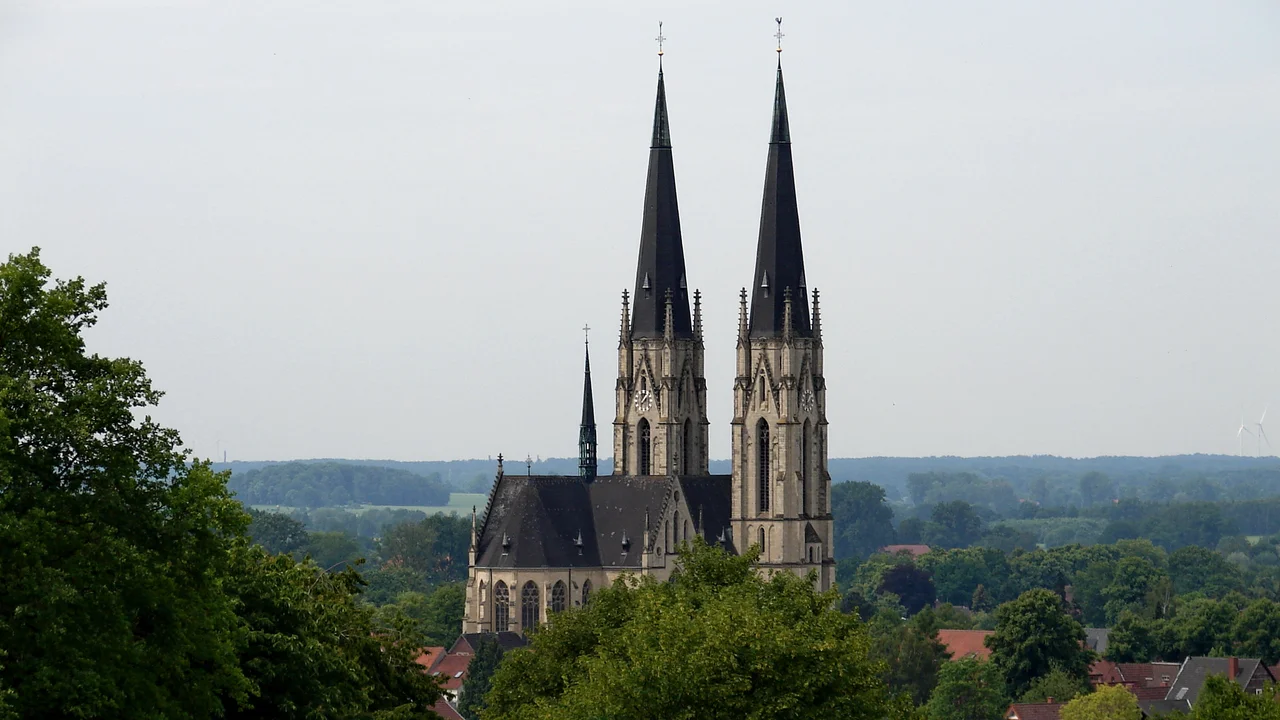

St. Ludger Church, Billerbeck
On 26 March 809, a missionary in his late sixties celebrated Mass in the morning at Coesfeld, rode a few hours northwest to Billerbeck, celebrated Mass again in the evening, and died before nightfall. His name was Liudger. He had been baptizing Saxons across Westphalia and Frisia for thirty years, and he had been the first bishop of Münster for four. The funeral chapel in the south tower of this neo-Gothic cathedral stands, by tradition, on the spot where he stopped breathing. Almost 1,200 years later, his right foot still rests in a monstrance under the altar there, and Billerbeck still calls itself one of the three high places of the diocese.
The Saint Who Came Here to Die
Liudger was a Frisian monk educated at York under Alcuin, the most influential Anglo-Saxon scholar of his generation. Charlemagne sent him to evangelize the Saxons of Westphalia, a campaign that was as much military occupation as missionary work. In 805 Charlemagne made him the first Bishop of Münster. Liudger founded the parish church of St John the Baptist at Billerbeck before the year 800, baptizing converts in the stream that still runs through the town. He died at Billerbeck on Passion Sunday 809. His brothers carried his body back to the abbey he had founded at Werden, near Essen, where his tomb in the Basilica of St Ludger has been a pilgrimage site ever since. But the people of Billerbeck kept the place where he had died, and a chapel was built there in the 11th century to mark it. That chapel is the seed of this cathedral.
The Cathedral That Isn't One
Strictly, this is a parish and pilgrimage church. It is not a cathedral, has no bishop's throne, and the diocese's seat is in Münster, fifteen miles east. But when the present building was inaugurated in 1898, Bishop Hermann Jakob Dingelstad said he had every right to call it the Ludger Cathedral, and the name stuck. Built between 1892 and 1898 on the foundations of the demolished Romanesque chapel and a 1735 funeral chapel, it was designed by Münster master builder Wilhelm Rincklake as a basilica with transept and twin 100-metre towers. The stone is Baumberger sandstone, quarried from the low Baumberge hills nearby, the same soft pale stone that built much of medieval Münsterland. Rincklake's towers can be seen from many kilometres away across the flat farmland, an improbably scaled marker for a town of fewer than 12,000 people.
Stone and Glass as Catechism
The interior is a careful catechism in stone and coloured light. The central nave rises 22.5 metres from floor to keystone, the side aisles ten, the roof ridge 34. The space holds 4,000 worshippers, more than half the population of the town. At the crossing, the vaulting opens into an octopartite pattern, eight ribs meeting where most Gothic vaults use four. The 15-metre east window, made by the Münster stained-glass workshop of Anton von der Forst from cartoons by Rafael Grünnes of Upper Austria, runs the work of salvation in parallel: Old Testament scenes below, New Testament scenes above, with a single non-biblical image at the centre. That image shows Liudger celebrating his last Mass at Billerbeck the day before he died. The transept and aisle windows depict saints connected to the Diocese of Münster: Paul the Apostle, Boniface, Willibrord, Ida of Herzfeld, and Gottfried of Cappenberg paired with Norbert of Xanten, the Premonstratensian founder who once took Gottfried's confession on a nearby hilltop.
The South Tower Chapel
Pilgrims who come to Billerbeck come for the south tower chapel. It is the quiet place where, by local tradition, the houses stood in which Liudger died. The altarpiece is carved from Carrara marble and shows the saint dying among his brothers. Under the altar slab, in a lit niche, is the monstrance that holds his right foot, presented to the Billerbeck pastor Hennewig in 1860 by Vicar-General Johann Bernhard Brinkmann, later confessor bishop, at St Ludger's Church in Münster. Two windows tell the legend of the saint's death: the transfer of his bones to Werden, and the moment when his nephew Gerfried and his sister Heriburg are said to have learned of his death through a column of light from heaven. Beside the altarpiece stand figures bearing the symbols of the virtues, the cross of faith, the anchor of hope, the heart of love, the blindfold and scales of justice.
The North Tower and What Came After
The north tower chapel holds a memorial of a different kind. More than 300 people from Billerbeck died in the Second World War; their names are carved on simple wooden crosses on the walls. A plaque at the entrance lists more than 100 still recorded as missing. Among the crosses stands a replica of the Pietà by Wilhelm Achtermann, which originally stood in Münster Cathedral and was destroyed by Allied bombing. A Billerbeck sculptor, Bernhard Meyer, carved the replica in 1937, donated by a local citizen, two years before the war began. Outside the south façade is a memorial stone added at the end of the cathedral's centennial in 1998, made of Baumberger sandstone and inset with stainless steel plates etched with sketches of the building's history. Twelve hundred years of Westphalian Christianity, beginning with a Frisian missionary who rode here to die, are recorded in this provincial town between Münster and the Dutch border.
From the Air
St. Ludger's Cathedral stands at 51.98°N, 7.29°E in the centre of Billerbeck, on the Münsterland plain about 25 km west of Münster. The 100-metre twin towers of Baumberger sandstone are visible from a long way off across flat farmland. Cruise at 2,500-3,500 ft AGL. Münster/Osnabrück (EDDG) is 18 nm east; Twente/Enschede (EHTW) in the Netherlands is 32 nm northwest. The wooded Baumberge hills rise immediately to the south.
Nearby Stories
- Wesel Station 4.7 km away
- Hamm (Westfalen) Hauptbahnhof 5.1 km away
- Tecklenburg Castle 5.3 km away
- Ohne, Germany 8.4 km away
- Henrichenburg Boat Lift 11 km away
- Siege of Groenlo (1627) 13 km away
- COVID-19 protests in the Netherlands 17 km away
- Warendorf 18 km away