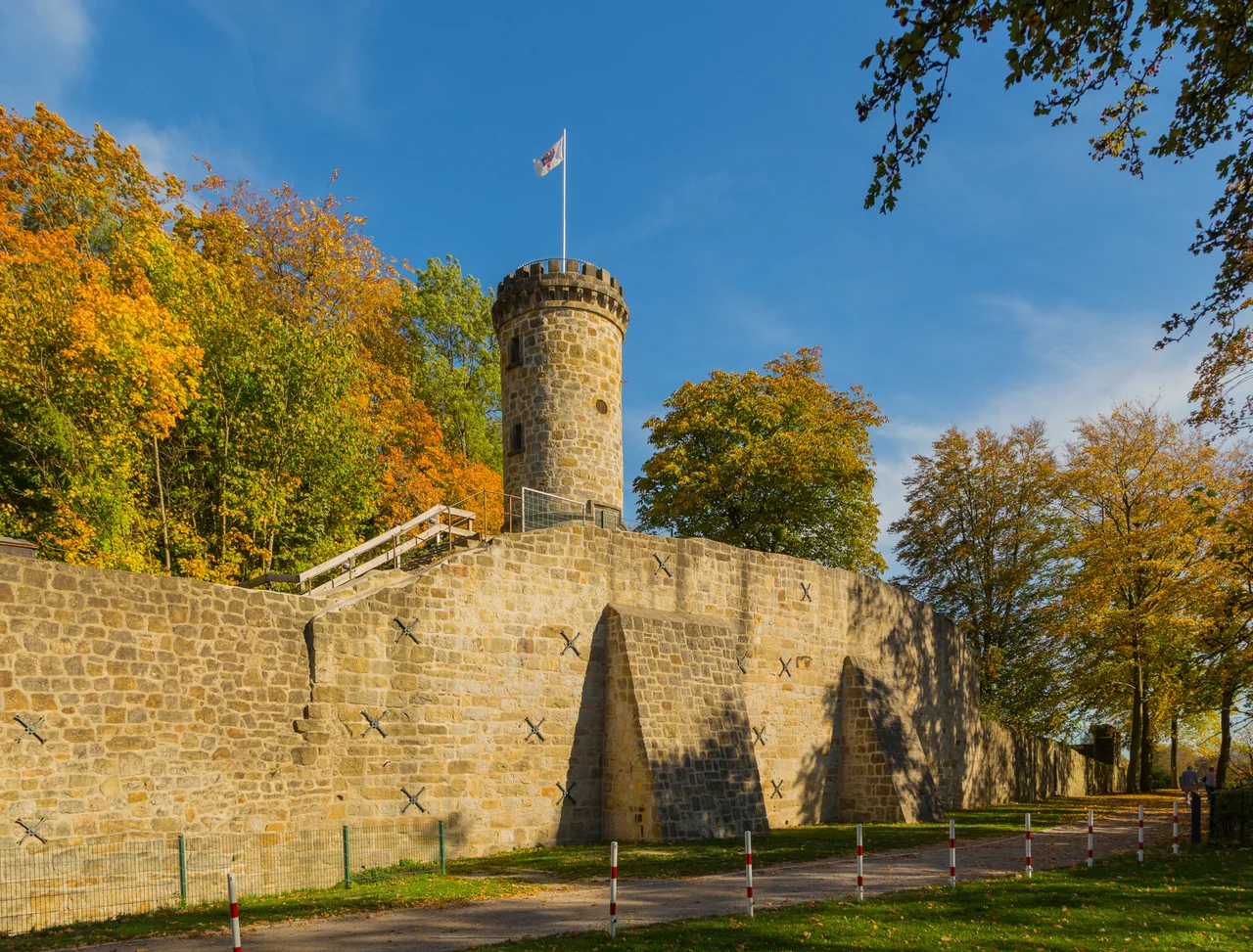

Tecklenburg Castle
By 1744, the Prussians had given up. Tecklenburg Castle - which an 1184 chronicler had called the largest and most powerful hilltop fortress in northern Germany - was simply too far gone to defend, too expensive to repair, and too useful as building stone. So they sold it for parts. Over the next century, the castle that had bankrolled Cologne archbishops and sheltered the alleged murderer of Archbishop Engelbert dissolved into the town below: into a hotel's renaissance fireplace, into the bridge piers of the Marcks house, into the walls of the local prison. The county whose name it bore had vanished decades earlier. The castle vanished one cart of stone at a time.
A Toll on the Northern Road
Around 1100, a Dutch Count of Zutphen looked at a narrow, easily defended hilltop in the Teutoburg Forest and saw a business model. The trade route from Lübeck through Bremen and Münster to Cologne had to thread this gap - which meant the man at the top could charge for the privilege. The castle that rose here became the seat of the County of Tecklenburg, a small but strategically rich territory whose lords could lean on neighboring Münster and Osnabrück. By 1184 the chroniclers were calling it the mightiest hilltop castle north of the Main. Within a few years, Archbishop Philip of Cologne paid the extraordinary sum of 3,300 marks to acquire the county - a transaction that gave the Archbishops of Cologne the geographical leverage to claim ducal authority over Westphalia itself.
The Murderer's Refuge
In November 1225, Archbishop Engelbert of Cologne was murdered in a wooded ravine - one of the most shocking political killings of the German Middle Ages, since Engelbert was also regent of the empire. The alleged killer, Frederick of Isenberg, fled to Tecklenburg Castle, where the count harbored him. The papal legate Conrad of Urach responded by laying both castle and town under interdict in 1226. By the following year, Cologne had taken possession of the castle outright. It was the moment Tecklenburg learned the lesson all medium-sized fortresses eventually learn: you can shelter a fugitive once, but the consequences last for centuries.
Countess Anna and the Doctor of Witches
The Reformation reached Tecklenburg in 1527 under Count Conrad, making the county the first region in Westphalia to convert. After Conrad's defeat at the Battle of Mühlberg in 1547, his daughter Countess Anna inherited a fortress that needed to become a home. She enlarged the windows, built a new entrance road - today's Schlossstrasse - and turned a defensive site into a residence. The bastion her father had thrown up was buried under the new embankment. Countess Anna also did something far more unusual for a 16th-century ruler: she protected those accused of witchcraft. Her court physician was Johann Weyer, the Rhenish doctor whose 1563 book De praestigiis daemonum argued that accused witches were mentally ill, not satanic. In 1884, when the town finally built a memorial tower on the buried bastion, they named it the Wierturm in Weyer's honor - the witches' defender remembered in stone four centuries after his death.
A Stage in the Ruins
By 1944, the buried bastion had been forgotten so thoroughly that workers digging an air raid shelter rediscovered it by accident, breaking through into a vault no one knew existed. After the war, Tecklenburg found a different use for its ruins. From 1927 onward, plays had been staged in the outer courtyard; in 1949, the Tecklenburg Open-Air Theatre took up permanent residence. Today, 2,300 seats fill the courtyard where Cologne's troops once mustered, and the Mauritz Gate of the 17th century frames a stage equipped for full musical theater. The Wierturm still stands on the inner rampart, brick and round and offering the view that drew the Count of Zutphen here nine centuries ago - a view that turns out to have been worth the cost of building, holding, losing, and finally repurposing an entire castle.
From the Air
52.22°N, 7.81°E. The castle ruins sit atop the Burgberg in the Teutoburg Forest ridge, with the small town of Tecklenburg clinging to the hillside below. Look for the round brick Wierturm and the open-air theatre's rake of seats below the Mauritz Gate. Nearest airport: Münster Osnabrück International (FMO/EDDG), about 15 km east. Best viewed in slanted morning or evening light when the Teutoburg ridge throws long shadows.
Nearby Stories
- Sparrenberg Castle 6.4 km away
- Ohne, Germany 7.5 km away
- St. Ludger Church, Billerbeck 8.6 km away
- Warendorf 10 km away
- Emsland Railway 12 km away
- Quakenbrück 14 km away
- Bielefeld conspiracy 31 km away
- Schnoor 62 km away