
Warendorf
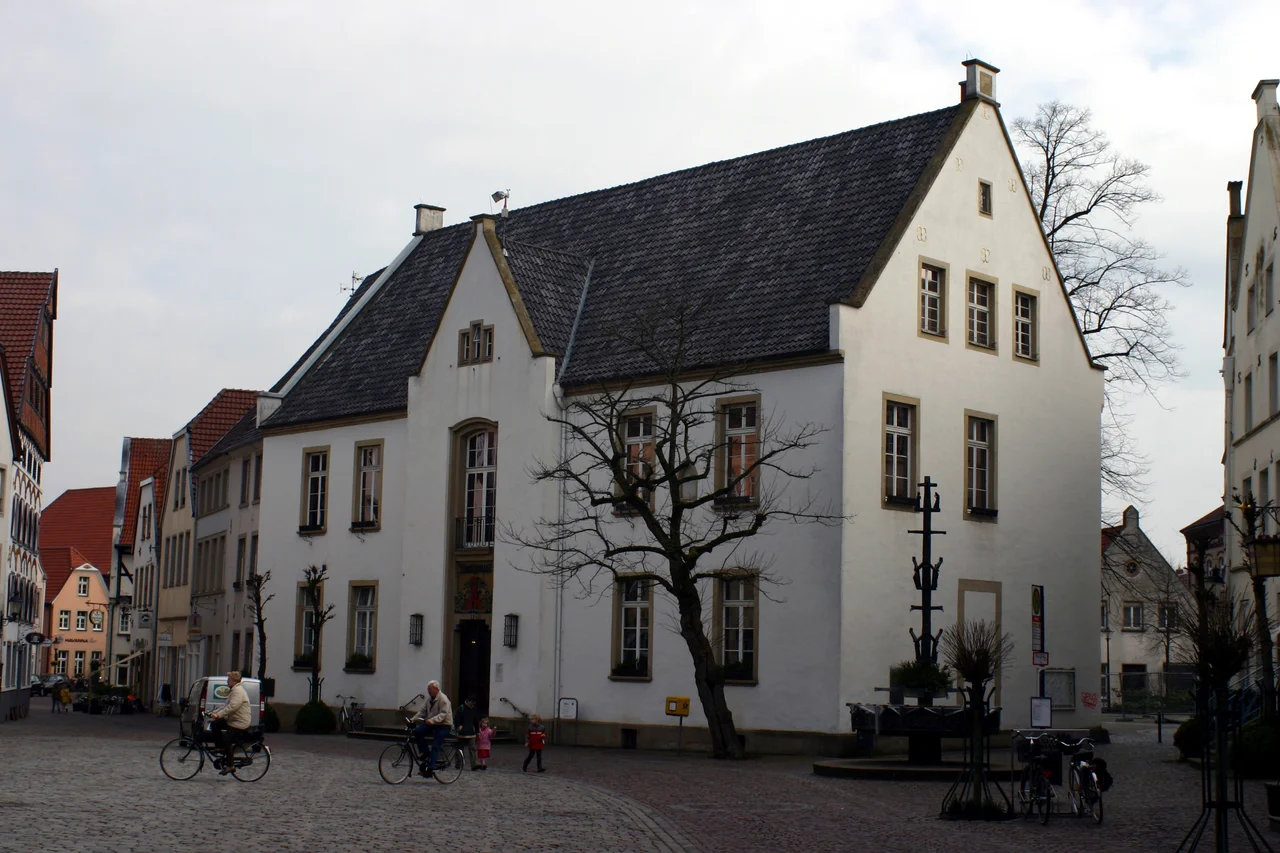
If German equestrian sport had a capital, it would be Warendorf. The North Rhine-Westphalian state stud farm is here. The German equestrian national federation's centre is here. The National Olympic Committee for horse sport is here. So is the Bundeswehr Sports School. Every German Olympic dressage rider, every show jumper aiming at a World Cup, every eventer chasing a Bundeschampionat - sooner or later, they all pass through this small town on the Ems. The streets smell of horses. The cobblestones know it. And the medieval market square at the centre of town has watched it all happen for eight hundred years.
The Village on the Embankment
The name comes down to us from old Saxon - Warintharpa, 'the village on the embankment' - and probably refers to a settlement that already existed by 700 BC. Between 1197 and 1201, Warendorf was formally chartered as a town, with a second parish church (the Marienkirche, the 'new church') established just west of the older St. Laurentius. By 1224 it was a civitas - a chartered civil community - and the linen trade had begun to make it rich. Wealthy merchants built up the Emsstrasse and Oststrasse and the market square; poorer townsfolk lived in dirt-floored houses where epidemics took whoever they wanted. In 1404 a great fire burned 600 houses, the old church, and the town hall with all its records inside it. Warendorf rebuilt.
One Week of Anabaptists
In 1534, while Münster was descending into its notorious Anabaptist millennium, the movement spread east to Warendorf. For one week in October, Anabaptist preachers ran the town. Then Franz von Waldeck, the prince-bishop of Münster, sent troops. Four of the Warendorf Anabaptist leaders were beheaded with swords on the market square; their bodies were strung up over the four town gates as warnings to anyone tempted to try the same thing again. The town lost its municipal charter and did not get it back until 1542. Free elections to the council waited until 1556. A century later, between 1627 and 1632, the Thirty Years' War took the charter away a second time, and in 1741 another great fire incinerated the Marienkirche and 332 more houses. The linen trade left with the tradesmen. Warendorf got poor.
Enter the Horses
Then in 1826 - fourteen years after the town came under Prussian rule - the Prussian stud administration took over what became the Westphalian Landgestüt, the state stallion depot in Warendorf. That single decision quietly redirected the town's destiny. Stallions stand at stud here; mares come from all over Westphalia and beyond to be bred; the foals fan back out to ride for amateurs, soldiers, and eventually for Olympic teams. By the twentieth century, when Westphalia and Hanover and Holstein had all become globally important sources of warmblood sport horses, Warendorf was at the operational heart of the Westphalian half of that pipeline. The barracks built just north of town in 1937 eventually became home to the Bundeswehr Sports School - the German military's elite training centre, where many of the country's Olympic athletes are still nominally serving soldiers, paid to train.
Hooves on Cobblestones
Warendorf is also one of the great cycling towns of the Münsterland. The Westphalian Lowland here is so flat and the cycle path network so dense that bicycles outnumber cars on certain village lanes. The Fettmarkt - first recorded in 1657 - is still held every year, part fair, part flea market, part livestock auction. On 15 August, the Feast of the Assumption, the town processes through narrow streets behind the Marienkirche's banners. The world skydiving championships have come here. The national swimming championships have come here. And the great equestrian championships - the Bundeschampionat for young horses, the international jumping shows - return year after year to the stud's grass arenas, where the founding stallions of half of Germany's competition pedigrees still stand in their boxes.
Notable Sons and Daughters
Warendorf has produced people who matter beyond the horse world. Bernhard Sprengel, born here in 1899, made his fortune in chocolate and put his collection of modern art into the Sprengel Museum in Hannover - one of the most important modern art collections in Germany. The soprano Elisabeth Grümmer, who sang at Bayreuth and the Vienna State Opera in the postwar decades, died here in 1986. Paul Spiegel, born in Warendorf in 1937, survived the Holocaust in hiding in occupied Belgium as a child and went on to become president of the Central Council of Jews in Germany from 2000 until his death in 2006 - a small-town Westphalian boy who became one of the most consequential voices of German Jewish life of his generation.
From the Air
Warendorf sits at 51.954°N, 7.993°E on the Ems river, in the eastern Münsterland 30 km east of Münster. Recommended viewing altitude 2,000-3,500 feet AGL to take in the compact medieval town centre with its market square, the Ems curving past it, the green expanses of the state stud farm and Bundeswehr Sports School complex on the northern edge of town, and the patchwork of pastures around it - some of which are paddocks for the stud's broodmares and young horses. Nearest airport: Münster Osnabrück (EDDG/FMO) 18 miles west-northwest. Paderborn Lippstadt (EDLP) is 26 miles south-southeast. The terrain is flat - this is the Westphalian Lowland - with no significant relief for tens of kilometres.
Nearby Stories
- Battle of Villinghausen 6.2 km away
- Tecklenburg Castle 7 km away
- St. Ludger Church, Billerbeck 7.3 km away
- Henrichenburg Boat Lift 8 km away
- Ohne, Germany 9.5 km away
- Sparrenberg Castle 10 km away
- Wewelsburg 17 km away
- Minden 35 km away