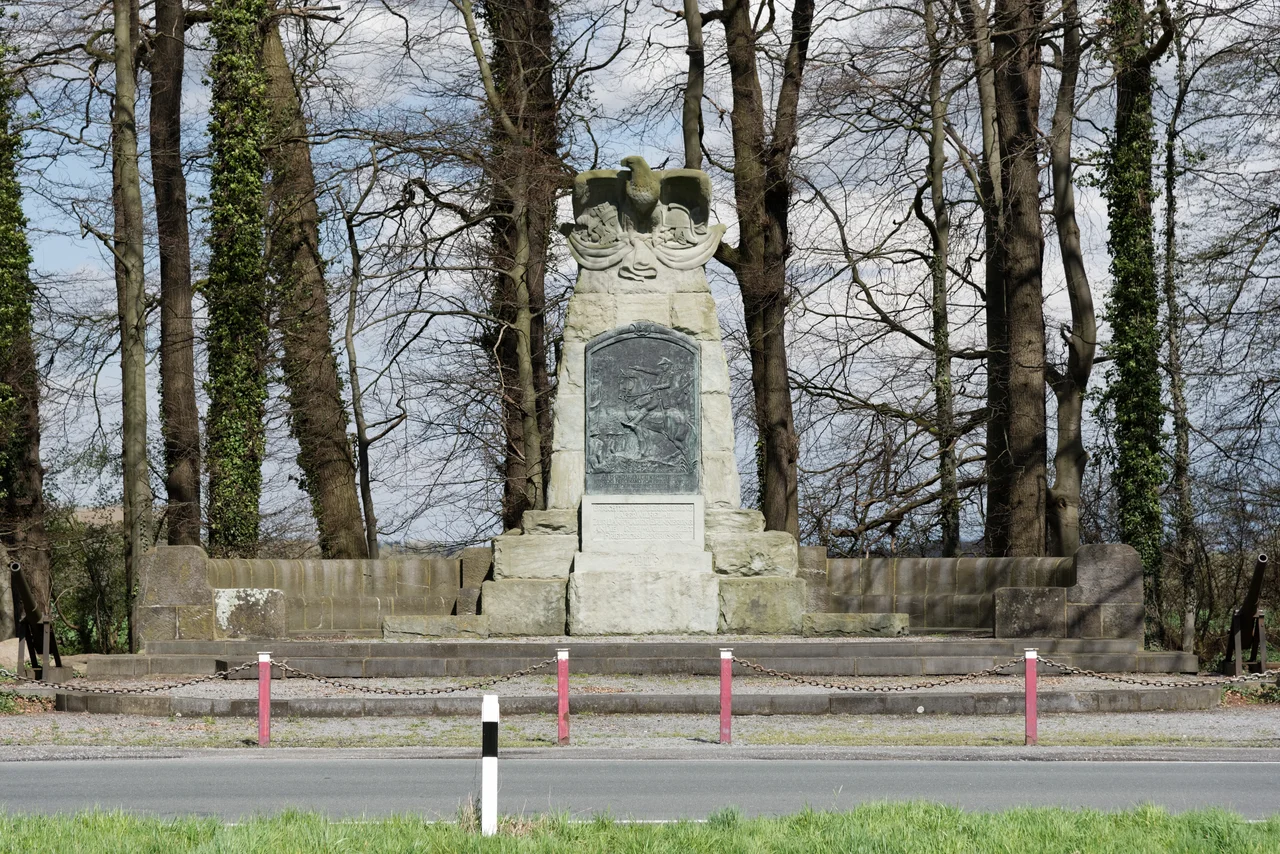

Battle of Villinghausen
Two French marshals brought ninety thousand men to a stretch of low Westphalian hills in July 1761. They outnumbered Prince Ferdinand of Brunswick's Anglo-German army by a comfortable margin. They also outranked each other identically, and that turned out to matter more than anything else. Neither the Duc de Broglie nor the Prince de Soubise was willing to take orders from the other, so when Broglie attacked Ferdinand's left flank on the morning of 16 July expecting his colleague to hit the weakened right at the same time, Soubise sent only token forces forward. The Allied right held. The Allied left was reinforced. Broglie's assault broke. By noon the French were in retreat and a battle that should mathematically have gone the other way had become, for the rest of Europe, the news of the summer.
The Long Westphalian War
The Seven Years' War in western Germany had by 1761 settled into a kind of geographical grind. France was the senior partner in the great anti-Prussian coalition, and a French army was permanently in Westphalia, trying to push Frederick the Great's flank in by way of Hanover. Standing in their way was Prince Ferdinand of Brunswick, brother-in-law to Frederick and one of the more capable Allied commanders of the war, leading a force of Hanoverian, Hessian, Brunswick and British troops paid for largely by London. In July 1761 the French commanders Victor-François, duc de Broglie, and Charles de Rohan, prince de Soubise, brought their two armies together with the goal of forcing Ferdinand out of the fortified town of Lippstadt on the Lippe River. Reinforcements under General Friedrich von Spörcken had just brought Ferdinand's strength up to about 65,000 men. The combined French armies still came to roughly 90,000.
The Lippe and the Ahse
Ferdinand lined up along a series of low hills, anchored on his left by the Lippe River in the north and on his center by the Ahse. It was a position chosen with care. On 15 July, the first day of the battle, Broglie attacked the Allied left in the north. His troops made progress against German units under Wutginau, but immediately to the south, John Manners, Marquess of Granby, held his ground with his British troops and the French assault stalled. Reinforcements came up for both sides during the night. Ferdinand made a calculated bet and shifted strength from his right to thicken his left, where the day's fighting had been heaviest. He was gambling that the French would not press his right hard enough to make him regret it. He guessed correctly.
The Marshals Who Would Not Speak
On the morning of the sixteenth, Broglie resumed his attack on Ferdinand's left, expecting Soubise to launch a coordinated assault on the now-weakened Allied right. Soubise instead ordered only a few small actions. The structural reason was straightforward and faintly absurd: the two French commanders held the same rank, were not subordinate to one another, and neither was prepared to follow the other's direction. While Broglie pressed forward alone, fresh Allied reinforcements under Wolff arrived along the Lippe River and struck the French flank. Broglie's attack lost its forward momentum, then its position, then its order. By around noon the French were in full retreat across the front. The battle was over before the second afternoon's sun was high.
The Cost
Battles of this scale in the eighteenth century killed and wounded in the thousands. Among the named French dead at Villinghausen was Pierre-François, Marquess of Rougé, a lieutenant general, killed in action alongside his cousin Louis-Ferdinand-Joseph de Croÿ, the 6th Duke of Croÿ-Havré. The Allied list of officers present reads like a roll of figures whose later careers would shape British history: Granby, the dragoon general whose generosity to his veterans turned his name into a chain of pub signs; Charles Cornwallis, then a brevet lieutenant-colonel of the 12th Regiment of Foot and twenty years away from his surrender at Yorktown; George Townshend, future Marquess Townshend, possibly with the 24th Regiment of Foot. The rank-and-file dead in the German hills are mostly anonymous now, but the line between Villinghausen and the wider story of empire runs through a surprising number of them.
The News, and the Treaty
Villinghausen was not a strategic catastrophe for France - the French armies still outnumbered Ferdinand and were able to continue offensive operations afterwards, though the two armies split and operated independently again. But it was a decisive piece of news. London heard the report with euphoria, and William Pitt the Elder used it to harden his line in the ongoing negotiations with Versailles. The French westward drive against Ferdinand never really recovered. By 1762, France had lost the strategic town of Cassel, and the Treaty of Paris in 1763 required the evacuation of the German territory it had occupied. A battle won by two French commanders' unwillingness to cooperate had quietly become one of the hinges of the wider war.
From the Air
Coordinates 51.6622°N, 7.9953°E, in the flat Lippe River valley north of the Sauerland uplands. The battlefield lay across low hills between the Lippe to the north and the Ahse to the center, near the modern villages of Kirchdenkern and Vellinghausen in the Welver municipality, east of Hamm and west of Lippstadt. From the air at 2,500-4,000 ft AGL, the terrain is gently rolling farmland with hedgerows and small wooded patches, and the two rivers are easy line-of-sight reference points. Nearest airfields: Hamm-Lippewiesen (EDLH) about 12 km west, Arnsberg-Menden (EDKA) about 25 km south, Paderborn-Lippstadt (EDLP) about 20 km east.
Nearby Stories
- Henrichenburg Boat Lift 4.8 km away
- Kemna Concentration Camp 12 km away
- Warendorf 12 km away
- Gerleve Abbey 14 km away
- Wewelsburg 15 km away
- Altena Castle 17 km away
- Sparrenberg Castle 19 km away
- Edersee Dam 46 km away