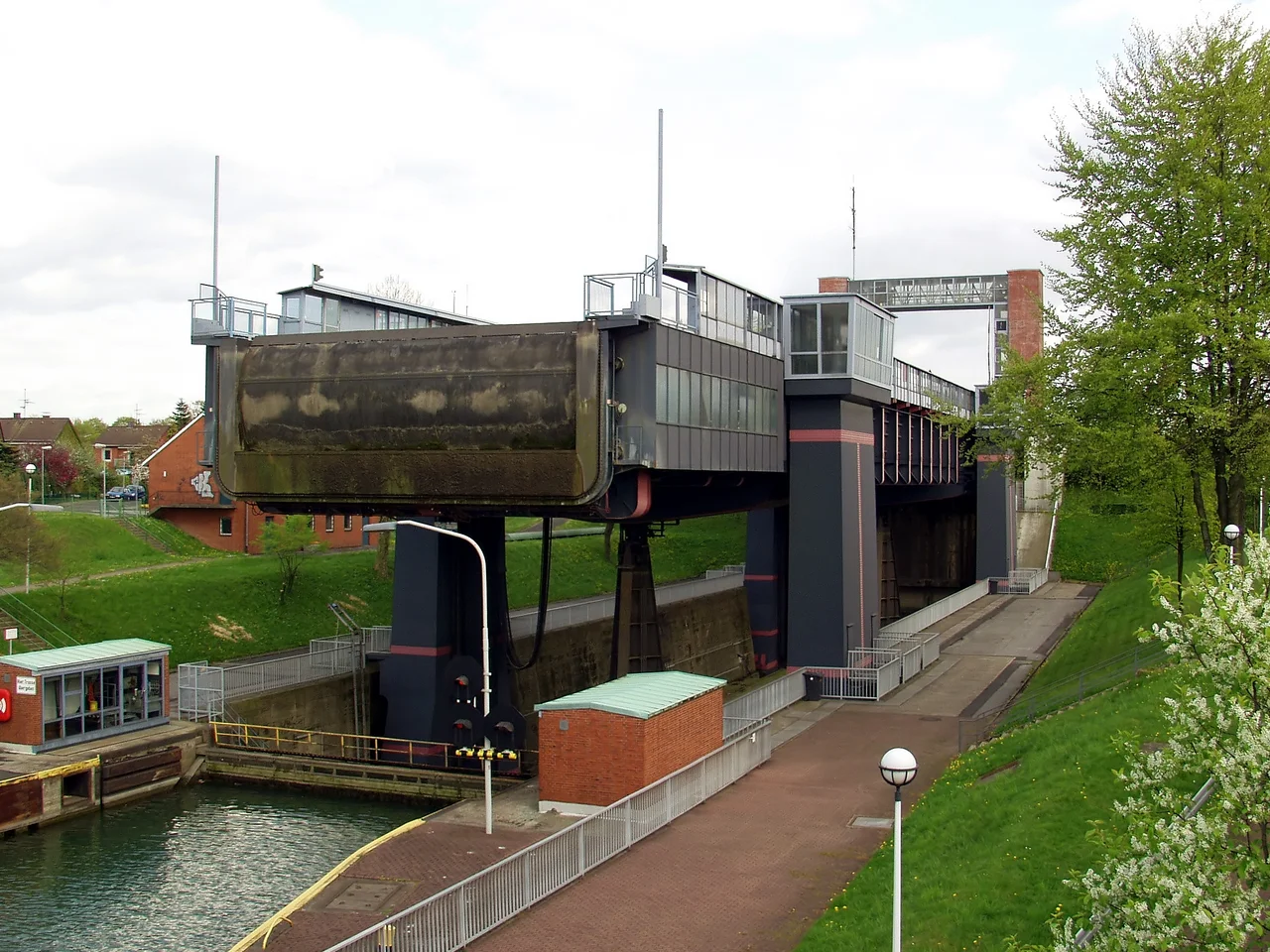

Henrichenburg Boat Lift
On 11 August 1899, Kaiser Wilhelm II stood at the head of a brand-new canal in Westphalia and inaugurated something Germany had never built before. A boat lift. A bridge for water. The Dortmund-Ems Canal needed to climb fourteen meters at this point in Waltrop-Oberwiese to reach the harbor at Dortmund, and a chain of locks would have wasted a small lake of water for every barge passage - water that had to be pumped up the hill in the first place. So the engineers built a vertical elevator instead. They were the first to attempt it in Germany. The lift itself was the largest and most spectacular structure on the whole canal, an iron-framed cathedral straddling the waterway, and once you saw it move you understood what the Kaiser had come to look at.
Floating an Ironclad
The trick was Archimedes, scaled up to industrial size. The trough that held the barge - sixty-seven meters long, eight wide, filled with two meters of water - weighed roughly a thousand tonnes loaded. Underneath it sat five enormous cylindrical floats, each one immersed in its own water-filled well sunk forty meters down. The upward push of the floats exactly balanced the downward weight of the loaded trough. The whole assembly was effectively weightless. A small electric motor - enough to overcome friction and viscosity, not enough to lift a barge - turned four steel worm gears, each twenty meters tall and 280 millimeters in diameter, that guided the trough up or down its tracks. The lifting itself took two and a half minutes. A full cycle, including the barges entering and exiting, took forty-five. That was much faster than a chain of locks, and it used essentially no water - the same water rode up and down inside the trough each time.
The Coal Highway
Without Henrichenburg, Dortmund's harbor would not have been reachable. The lift was the corridor through which Ruhr coal flowed north to the North Sea, riding 350-tonne barges built specifically for the Dortmund-Ems gauge. Generations of bargees brought their boats into the lower trough, watched the upper gates seal, felt the floor rise smoothly under their feet, and exited into the canal that ran on to the harbor. The structure was built like a bridge that swallows ships. The iron framework, painted in industrial green, hosted two control towers - one above, one below - and the boiler and machine houses sat in cottages alongside, full of fragrant grease and slowly turning shafts. As barge sizes grew through the twentieth century, the lift's 350-tonne capacity became too small. A new lift opened next door in 1962, designed for vessels up to 1,350 tonnes, using the same float-and-counterweight principle but with only two floats instead of five.
The Year the Trough Stuck
The old lift was retired in 1962. In 1963, a year after closure, somebody made the attempt to start it up again. The trough refused to come fully home in either direction. It had tilted in retirement, settled a millimeter or two off its track, and whatever pride the engineers of 1899 had built into the system, the moving parts had stopped agreeing about which way was up. The decision was made not to repair it. The trough sits frozen mid-stroke today, somewhere between the upper and lower docks, exactly where it stopped. In 1979, the lift was designated a centerpiece of the Westphalian Industrial Museum. The iron frame was restored. The control towers became visitable. The boiler and machine house turned into a gallery of models and old photographs. In the lower dock - now used as a marina - sit the police-and-fireboat Cerberus of 1930 and the motor cargo vessel Franz-Christian of 1929, both with their cargo holds laid out as an exhibition of bargee life. A four-hundred-meter stretch of the upper canal holds a fleet of historical vessels.
The New Lift That Already Stopped
The 1962 lift had its own short career. By 1989, even its 1,350-tonne capacity was being outgrown, and a modern ship lock was built alongside, sized for vessels 190 meters long with a four-meter draft. The 1962 lift kept running as a backup. Then, in December 2005, technical problems took it out of service. The cost of repair - against the slow decline of cargo traffic into Dortmund Port - did not pencil out. The lift may never run again. The result is that the whole port now depends on a single lock, and when that lock needs maintenance, as happened in the summer of 2021 when its gates were dismantled and laid out in the chamber for repair, the entire harbor closed for six weeks. Three lifts, three eras, one canal: the 1899 original frozen as a museum, the 1962 successor mothballed, the 1989 lock the only one still working.
A Cathedral You Can Cycle Past
The Henrichenburg complex - now called the Waltrop Lock Park, Schleusenpark Waltrop - is one of the most heavily visited stops on the Ruhr's Industrial Heritage Trail. Cyclists riding the Dortmund-Ems-Kanal route and the Emscher Way pull up at the upper dock, prop their bikes against the iron railings, and walk through the green-painted trusses of a lift that was supposed to be obsolete by 1962 and has outlived its successor instead. The Anderton boat lift in England, the Strepy-Thieu in Belgium, the Peterborough in Ontario, the Falkirk Wheel in Scotland - Henrichenburg sits in a small global family of these mechanisms. But it was the first in Germany, the one Wilhelm II came to inaugurate, and it is the one you can still climb into the control tower of, look down at the trough, and trace with your finger the spot where, in 1963, the whole thing decided it had done enough work for one century.
From the Air
The boat lift complex sits at the northern end of the Rhine-Herne Canal where it joins the Dortmund-Ems-Kanal, at 51.6166 degrees North, 7.3259 degrees East, in Waltrop-Oberwiese. From the air, the giveaway is the contrast between the four parallel water channels of the Schleusenpark Waltrop - old lift, disused shaft lock, new lift, modern ship lock - all running roughly north-south and stepping fourteen meters up to the upper canal. The 1899 lift is the oldest, southernmost iron-framework structure with five distinctive float wells visible as a row of round caps. The nearest airport is Dortmund (EDLW / DTM), about 15 km southeast. Munster Osnabruck (EDDG / FMO) is 60 km north.
Nearby Stories
- Engels-Haus 6.9 km away
- Hochschule Niederrhein 7.7 km away
- Wesel Station 8.6 km away
- Gerleve Abbey 10 km away
- Hamm (Westfalen) Hauptbahnhof 11 km away
- Oude IJsselstreek 20 km away
- Warendorf 21 km away
- Atta Cave 26 km away