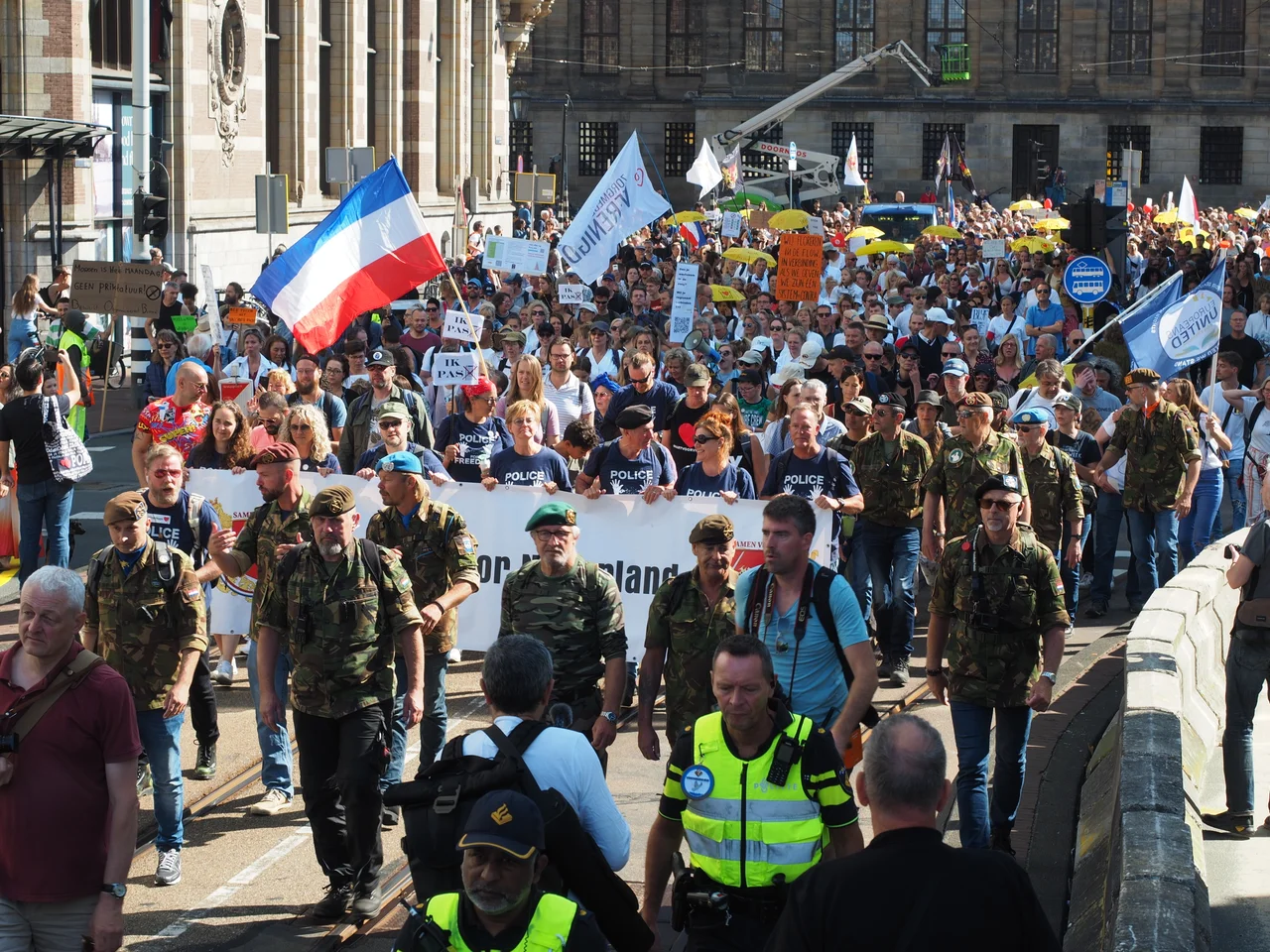

COVID-19 protests in the Netherlands
When the Dutch parliament first debated a nationwide curfew in September 2020, the proposal failed for a reason that had nothing to do with epidemiology. The last time the Netherlands had lived under one, the orders had come from a German occupier. Four months later, with infections still rising and the B.1.1.7 variant spreading fast, the same parliament approved one. The curfew took effect on 23 January 2021. By the next night, the first cars were burning.
The Measure With a Memory
Mark Rutte's caretaker government announced the curfew at a press conference on 20 January 2021. The House of Representatives backed it the following day, after a motion pushed the start time from 20:30 to 21:00. It would run from 21:00 to 04:30, beginning Saturday 23 January, and remain in place for the next three months. The Outbreak Management Team had pressed for it since September, but the Netherlands had been under a full lockdown since 14 December and infections were not falling fast enough. The decision was contested on every front - in parliament, in the courts, on the streets - but the framing that mattered most was historical. For many older Dutch citizens, a national curfew was a Second World War artifact. It had not returned in seventy-five years.
Three Nights of Fire
On the first night, police issued 3,600 fines for being outside without a valid reason. By Sunday evening 24 January, that was no longer the main story. On Urk - a former island in Flevoland with a tight, conservative community - youths set fire to a GGD COVID-19 testing site. In Eindhoven, rioters who had gathered to protest the lockdown threw stones, golf balls, fireworks, and knives at police, set vehicles alight, and looted a supermarket inside the central railway station. By that night the disorder had spread to Enschede, Helmond, Roermond, The Hague, Tilburg, and Venlo. In Enschede, rioters tried to break the windows of the Medisch Spectrum Twente hospital. More than 300 people were arrested. On the second night, 150 more were detained in Amsterdam and Rotterdam, and trouble flared in Den Bosch, Zwolle, Amersfoort, Alkmaar, Hoorn, Gouda, Haarlem, and Veenendaal. The third night was lighter. Within roughly an hour, the situation in the remaining hotspot cities was back under control.
Who Came Out for the City
The rioters were a small minority, and the response from neighbors and businesses was sharp. In Maastricht, after rumors of incoming trouble, several hundred supporters of the local football club's hardcore section marched through the city center to deliver a single message - we will not tolerate destruction and looting - then went home in time for the 21:00 curfew. The mayor of Rotterdam, Ahmed Aboutaleb, addressed rioters directly in a video, asking whether they were proud to have wrecked their own city and contrasting them with the generation that had rebuilt Rotterdam after the German bombing of 1940. Prime Minister Rutte said the events 'have nothing to do with protests, this is criminal violence and we will treat it as such.' The mayor of Eindhoven, John Jorritsma, was bleaker: 'If we continue down this way, we will head to civil war.'
The 2G Rule and a Second Wave of Unrest
Disorder returned in November 2021 when the government floated the 2G rule - access to hotels, restaurants, cafes, cultural venues, and non-essential services only for those who were gevaccineerd (vaccinated) or genezen (recovered). A protest in Rotterdam on 19 November turned into a riot. Police opened fire on rioters, injuring seven people. Fifty-one people were arrested in Rotterdam alone. Riots also struck Stein, Roermond, Urk, The Hague, Enschede, Leeuwarden, and Tilburg. Water cannons, mounted units, and police dogs were deployed. Early in January 2022, several thousand people gathered in Amsterdam in defiance of the rules. Images of a police dog biting a protester by the left arm while an officer tried to restrain it spread worldwide, drawing strong criticism of police force used against crowds.
After the Curfew
The curfew ended on 28 April 2021. From 23 March 2022, EU citizens could enter the Netherlands without restrictions. Masks became optional. On 17 September 2022, the remaining COVID-19 measures were lifted. Many of the people who had marched against the lockdown did not stop marching - they shifted their attention to the concurrent Dutch farmers' protests against legislation aimed at reducing agricultural nitrogen pollution by cutting livestock numbers. The slogan signs changed, the underlying grievance about a distant government imposing rules on local life did not. The riots of January 2021 had been described in Dutch media as the worst civil unrest in forty years. Whether they were really a protest against the pandemic or something older finding a moment of opportunity is a question Dutch politics is still arguing about.
From the Air
The protests touched dozens of Dutch cities; the article's coordinates point to the Twente region in eastern Overijssel near 52.36 N, 6.67 E, where Enschede was a major flashpoint. Nearest airports: Twente Airport (EHTW) just north of Enschede, Münster-Osnabrück (EDDG) about 40 km east, Groningen Airport Eelde (EHGG) to the north. Eindhoven (EHEH), Rotterdam-The Hague (EHRD), and Amsterdam Schiphol (EHAM) cover the western hotspots. The Netherlands is small enough that from cruising altitude in clear weather, a single view often takes in several of the cities that rioted on the same night.
Nearby Stories
- Veluwezoom National Park 2.4 km away
- Stalag VI-C 3.8 km away
- Nieuwe Toren, Kampen 4.1 km away
- 2009-10 Eerste Divisie 6.1 km away
- Achterhoek 7.9 km away
- Hardenberg 8 km away
- Bad Bentheim 8.8 km away
- Gerleve Abbey 17 km away