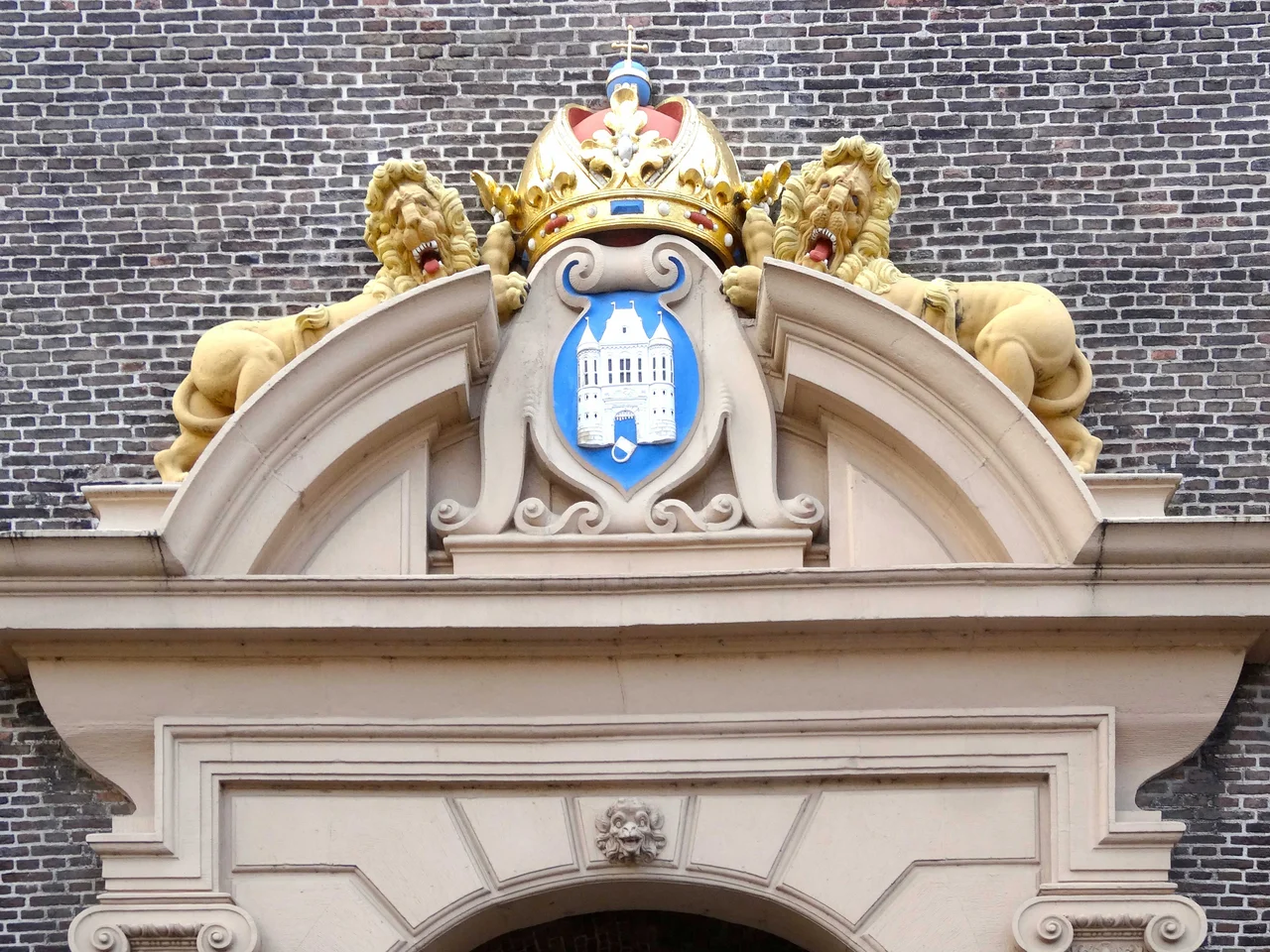

Nieuwe Toren, Kampen
The drawing was supposed to crown the Town Hall of Amsterdam, the building that would later become the Royal Palace on the Dam. Instead, Philips Vingboons's elegant octagonal lantern ended up here, in Kampen, perched on a brick stump along the Oudestraat. From the cobbles below, you cannot tell that you are looking at a piece of Amsterdam's unbuilt grandeur. You can only hear the consequence: every seven and a half minutes, daytime, the bells inside it speak.
A Tower Out of Place
Kampen began the Nieuwe Toren in 1649. The lower courses of brick rose under the hand of Dirck Janzn, a master carpenter and mill-maker from Edam, but the design that would give the tower its silhouette came from somewhere unexpected. Vingboons, one of the Dutch Golden Age's leading architects, had drawn the lantern with another commission in mind, possibly the new town hall going up on the Dam in Amsterdam. That commission slipped away. The drawing did not. By 1664 it stood completed above the Oudestraat, an architectural transplant from a city of canals to a city of warehouses, and Kampen had a tower that looked like nothing else in town.
The Voice of François Hemony
The bells came before the tower could hold them. Between 1659 and 1662, François Hemony, the bell-founder whose name became almost synonymous with the Dutch carillon, cast thirty bells for Kampen. With nowhere finished to put them, they hung temporarily in the tower of the town hall. The town hall tower, however, was not big enough to take the heaviest of them. Only when the Nieuwe Toren was ready, in 1663, did the great bass bells arrive: three more from Hemony, four older ones cast by Geert van Wou around 1481-1483, and one by Kiliaen Wegewaert from 1627. The combination made for an unusually deep, heavy-voiced instrument, a carillon that did not sing so much as it tolled.
The Brass Drum
Inside the tower sits a brass drum, cast by François Hemony in 1661, that does not stop working. It is the mechanical heart of an automatic playing mechanism driven by the tower clock, and it triggers the bells every seven and a half minutes during the day. Carillonneurs once changed the drum's melodies every two months, pausing only in the deepest cold of winter when the linkages stiffened. The historical record of those drums is its own quiet archive: nineteenth-century carillonneurs pegged Rossini opera melodies into the brass, so that for stretches of the year, an Italian aria drifted out across the Overijssel rooftops at quarter-hour intervals. Today the city carillonneur still resets the drum's tunes twice a year.
Beetles and Restoration
In 2008, the carillon had to come down. The death-watch beetle, that small wood-boring insect with a name that sounds like a Gothic novel, had been at work for years in the oak frame of the upper tower. Every original beam needed replacing. The bells were lowered, the timber was stripped back to nothing, and the whole upper structure was rebuilt. When the restoration finished at the end of 2011, the bells went back up rearranged according to the original pre-1939 plan: heaviest at the top of the lantern, a configuration the twentieth century had quietly altered. The Royal Eijsbouts foundry cast a new set of treble bells for the occasion, modern interpretations of an old shape. The carillon now counts 48 bells.
The Cow and the Joke
Every summer, during the Kamper Ui(t)-dagen festival, a wooden cow appears in the Nieuwe Toren, hoisted into view. It is a wink at the Kamper uien, the centuries-old cycle of self-deprecating jokes the people of Kampen tell about themselves and which other Dutch towns have happily adopted. The tower's role in the festival turns architecture into punchline: a national monument enlisted, briefly, as the straight man in a joke that the city has been telling, more or less, since the seventeenth century. The carillonneur Frans Haagen still plays the bells live twice a week, Monday at 11 in the morning during market, Saturday at 4 in the afternoon.
From the Air
Coordinates 52.5592 N, 5.9164 E, on the eastern bank of the IJssel at the heart of Kampen's old town. The lantern of the Nieuwe Toren stands roughly 65 meters and reads clearly against the river from a slow circle at 2,000 feet AGL. Lelystad Airport (EHLE) lies about 25 km to the west across the IJsselmeer; Teuge (EHTE) sits 35 km south. Kampen sits low; haze off the IJsselmeer can soften silhouettes at midday but morning light from the east picks out the tower against the dark river.
Nearby Stories
- Round House (Nunspeet, Netherlands) 2.6 km away
- Almere 3.3 km away
- Pinksterlanddagen 4.7 km away
- Joure 6.1 km away
- Bovenkarspel 6.2 km away
- Sallandse Heuvelrug National Park 8.2 km away
- Hoogeveen 12 km away
- Afsluitdijk 12 km away