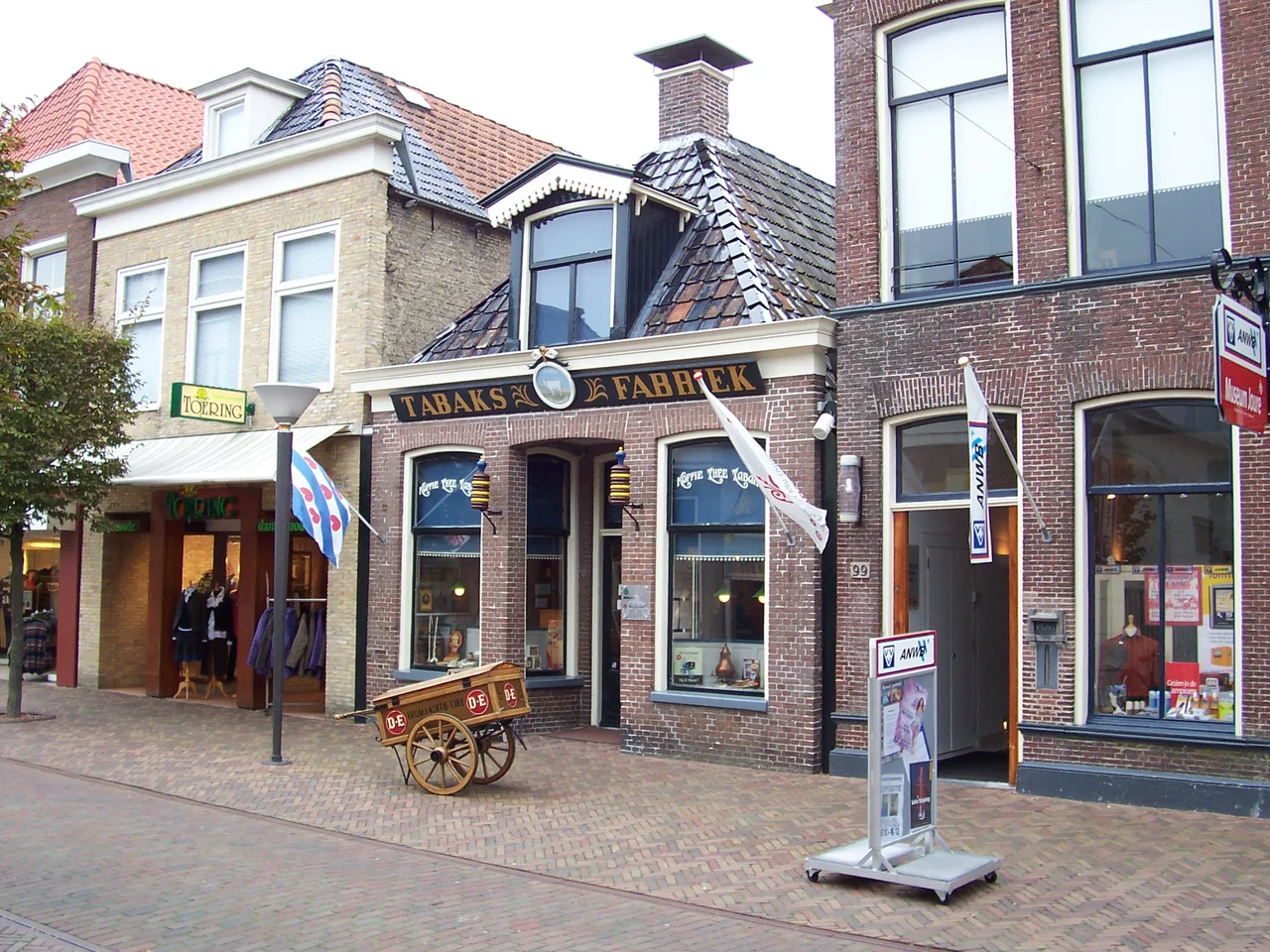

Joure
The people of Joure are nicknamed Jouster Keallepoaten, the Calf's Legs of Joure. The name comes from a pastry, two long elongated pieces of rye-flour dough baked side by side with honey and herbs so they end up looking like the hind legs of a calf. According to local memory the early Jousters baked these as an offering to a water spirit, thanking it for giving their lands so much water. The water came whether they baked or not, of course. But the practice stuck, and now the pastry is the town's emblem and its people's nickname, which is both odder and more charming than most place-name epithets you will encounter in the Low Countries.
Building on a Sand Ridge
Joure grew along a gaast, the Frisian word for a sand ridge that rises just slightly above the surrounding peat and bog. A late-medieval dike ran from the local toll house to Haskerhorne, and the village's main street, the Midstraat, was built right on top of the embankment. In the early fifteenth century, Hanseatic League merchants dug a network of canals reaching the area precisely because canals offered an escape route from the feared Northerners, the raiders associated with the Kalmar Union. A defensive geography that was also a commercial one. The Kolk, a small water basin, was excavated, and from it the De Overspitting waterway was cut to neighboring Heerenveen. Joure ended up on a crossing of waterways next to the old village of Westermeer.
Egbert Douwes Opens a Shop
In 1753, a Frisian named Egbert Douwes opened a colonial goods business on the Midstraat. His son was named Douwe Egberts. The shop sold what colonial Dutch trade made available: coffee, tea, tobacco, spices. The little store survived its founder by centuries. It began to evolve into something industrial in the 1930s and 1940s. The heirs adopted Douwe Egberts as the company name, and during the postwar decades the firm grew into a world brand, one of the great names of European coffee. The Joure store stayed open for years as a kind of mother church, even after corporate headquarters moved to Utrecht. It finally closed on October 24, 2014. The original premises now belong to Museum Joure, which preserves the building where the whole thing began.
Skûtsjes and Stoelklokken
Two crafts defined Joure's economy beyond coffee. The first was shipbuilding. Yards along the canals built skûtsjes, the flat-bottomed Frisian sailing barges that hauled peat from the bogs to the markets, and the smaller prams used for shorter runs. Street names today, the Eeltsjebaes and Aukebaes and Hettebaes, preserve the memory of the shipwrights who worked there. The second was clockmaking. From the eighteenth century onward, Joure was renowned for traditional Frisian wall clocks, the stoelklokken and staartklokken with their painted scenes and brass weights. The work was pure home industry, aided by a local copper-melting facility that supplied the metalwork. A handful of skilled tradesmen still make these clocks today, an unbroken thread of small-shop craftsmanship running for three centuries.
Not Quite a City, Not Quite a Village
Joure has always sat awkwardly in Dutch municipal taxonomy. It was never granted city rights, but with more than 13,000 inhabitants it long ago outgrew anything a village could plausibly claim to be. Old Frisian tradition has a word for exactly this in-between status: a vlecke, a market town that is neither one thing nor the other. Until 1984 it was the seat of the municipality of Haskerland. From 1984 to 2014 it served as the administrative center of Skarsterlân. Then, on January 1, 2014, the municipal map was redrawn one more time, and Joure became the administrative center of the new municipality of De Fryske Marren, the Frisian Lakes. Two windmills still stand restored, De Groene Molen and Penninga's Molen, and the base of a third, Wielinga-stam, survives. Like the calf's-leg pastry, they continue.
From the Air
Joure sits at 52.97N, 5.80E, just south of the Sneekermeer in central Friesland. From 2,500 to 4,000 feet the historic town center reveals itself: the Hobbe van Baerdt church tower (the Jouster Tour) is the most prominent vertical feature, with the water tower nearby. The town occupies a junction of the A6 and A7 motorways, which makes it easy to spot from the air. Drachten (EHDR) is the closest aerodrome to the northeast; Lelystad (EHLE) lies south across the IJsselmeer. The Frisian Lakes spread west and south.
Nearby Stories
- De Steenhuistermolen, Stiens 1.5 km away
- Bovenkarspel 4.1 km away
- Pinksterlanddagen 5.1 km away
- Afsluitdijk 7.1 km away
- Hoogeveen 9.5 km away
- De Marne 10 km away
- Holmes's Bonfire 12 km away
- Urk 16 km away