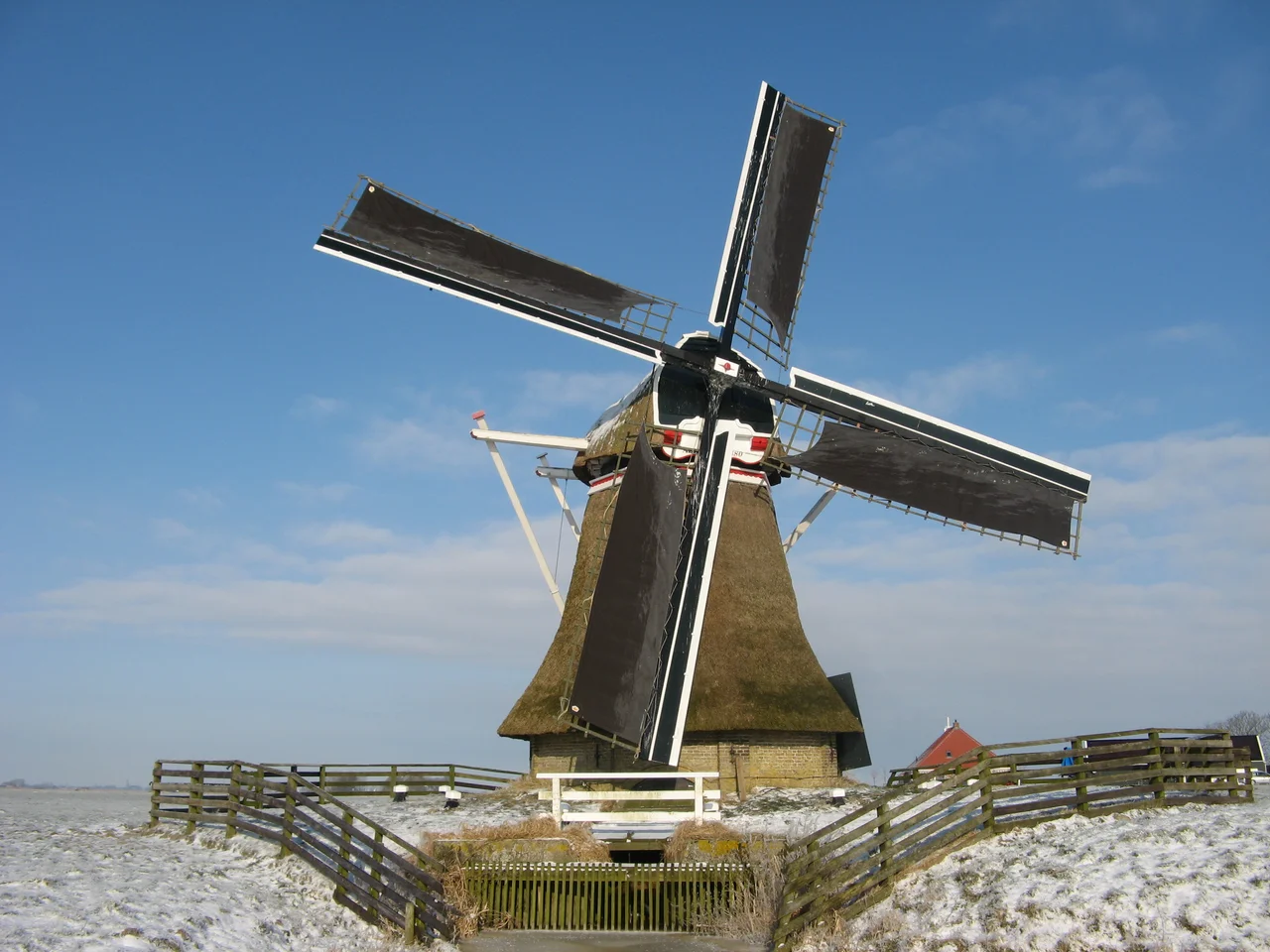

De Steenhuistermolen, Stiens
There is a phrase the Dutch use for windmills that no longer have to work but are kept ready in case they do: in reserve. De Steenhuistermolen, on the polders just outside Stiens in Friesland, was officially given that status in 2006. The sails still turn. The Archimedes' screw at its base can still lift water out of the polder, 278 litres per revolution, if the back-up pumps ever fail. A working mill held in waiting is a quietly Dutch idea - a country that has spent eight hundred years pumping water uphill is reluctant to throw away anything that ever did it well.
A Mill That Sits Low
What you notice first about De Steenhuistermolen is that it crouches. There is no stage, no gallery, no platform to walk around: the sails sweep almost down to ground level. That puts it firmly in the category the Dutch call a grondzeiler, a ground-sailer, the smallest class of working smock mill. The two-storey octagonal smock sits on a single-storey base, both thatched, with the cap winded - turned to face the wind - by a tailpole and winch reaching down to the earth. The sails span 15.04 metres, modest by Dutch standards. Common sails, cloth on wooden frames, the older design that requires the miller to climb out and reef them in changing wind. Everything about the mill is sized for one job: drainage of a small Frisian polder.
The Year the Storm Won
Built in 1880, De Steenhuistermolen worked its polder for seventy years before the weather caught up with it. In 1952 a storm did enough damage that the local water board lost confidence in the mill and erected a windpump - a metal-frame wind-driven pump of the kind that dotted farms across the world in the early twentieth century - to take over the drainage duty. The smock mill was repaired and restored by 1955, knocked again by some unspecified damage in 1966, and restored once more in 1967. In 1969 the water board hedged its bets a third time: an electric motor was installed to drive the Archimedes' screw, so the mill could keep working even when there was no wind. Each intervention extended the mill's life a little further into a future it had not been designed for.
Bought by a Foundation
On 4 September 1985 the mill changed hands. Its buyer was Stichting De Fryske Mole, a foundation set up specifically to keep Frisian windmills alive, and De Steenhuistermolen became the thirty-fourth mill in its portfolio. The foundation now holds dozens of Frisian mills under collective care, a quietly remarkable cultural rescue. Another full restoration followed in 2000. By 2006 the mill was no longer needed to drain the polder on a routine basis - modern electric pumps had taken over that duty - and the status of in reserve became official. It is Rijksmonument number 24547, one of the long list of nationally protected monuments that braid through the Frisian landscape.
Iron, Cogs, and Lifted Water
The mechanism inside De Steenhuistermolen is the kind of compact gear-train that early Dutch engineers refined over centuries. The four sails turn a cast-iron windshaft, cast in 1986 by the Hardinxveld-Giessendam foundry that supplied many of the country's restoration projects. The windshaft carries the brake wheel with its 45 cogs, which meshes with a wallower of 23 cogs at the top of an upright shaft running down through the mill's spine. At the bottom of that shaft, two crown wheels share the load. One drives the Archimedes' screw through a small geartrain; the other is carried directly on the screw's axle. The screw itself is 97 centimetres in diameter, set at a 22-degree incline, and each revolution lifts 278 litres of water from polder to canal. The numbers feel small until you remember that the mill ran for decades without stopping.
Open by Appointment
De Steenhuistermolen does not keep regular visitor hours. To see inside, you write or call ahead, and someone meets you. That is in keeping with its current status: not a museum, not a daily working mill, but a piece of working heritage looked after by people who care about it. The flat polders around Stiens stretch out in every direction, sliced by drainage ditches that the mill once kept emptied. The wind that turns the sails on demonstration days is the same wind that used to do the pumping in earnest. Stand close enough and you can hear the wooden cogs engage, a slow regular tock that has not changed since the year the mill was built.
From the Air
Located at 53.269°N, 5.821°E in flat polder country just south of Stiens. From 1,500-2,500 ft AGL the mill reads as a short thatched cone with low-sweeping sails set among rectilinear drainage ditches. Look for the geometric grid of polder fields - the mill sits at one of the ditch junctions. Best low-angle light is early morning from the east. Nearest airports: Leeuwarden Air Base (EHLW) about 5 km south, Drachten Airfield (EHDR) about 30 km southeast. Open North Sea air rolls in unimpeded from the Wadden Sea 8 km north - sustained winds keep the polders dry but make for bumpy approaches.
Nearby Stories
- Prinses Margriet Canal 1.7 km away
- De Marne 2.6 km away
- Maritime Institute Willem Barentsz 3.3 km away
- Northern Netherlands 5.1 km away
- Afsluitdijk 12 km away
- Schule am Meer 42 km away
- Gemini Wind Farm 48 km away
- West Sole Gas Field 272 km away