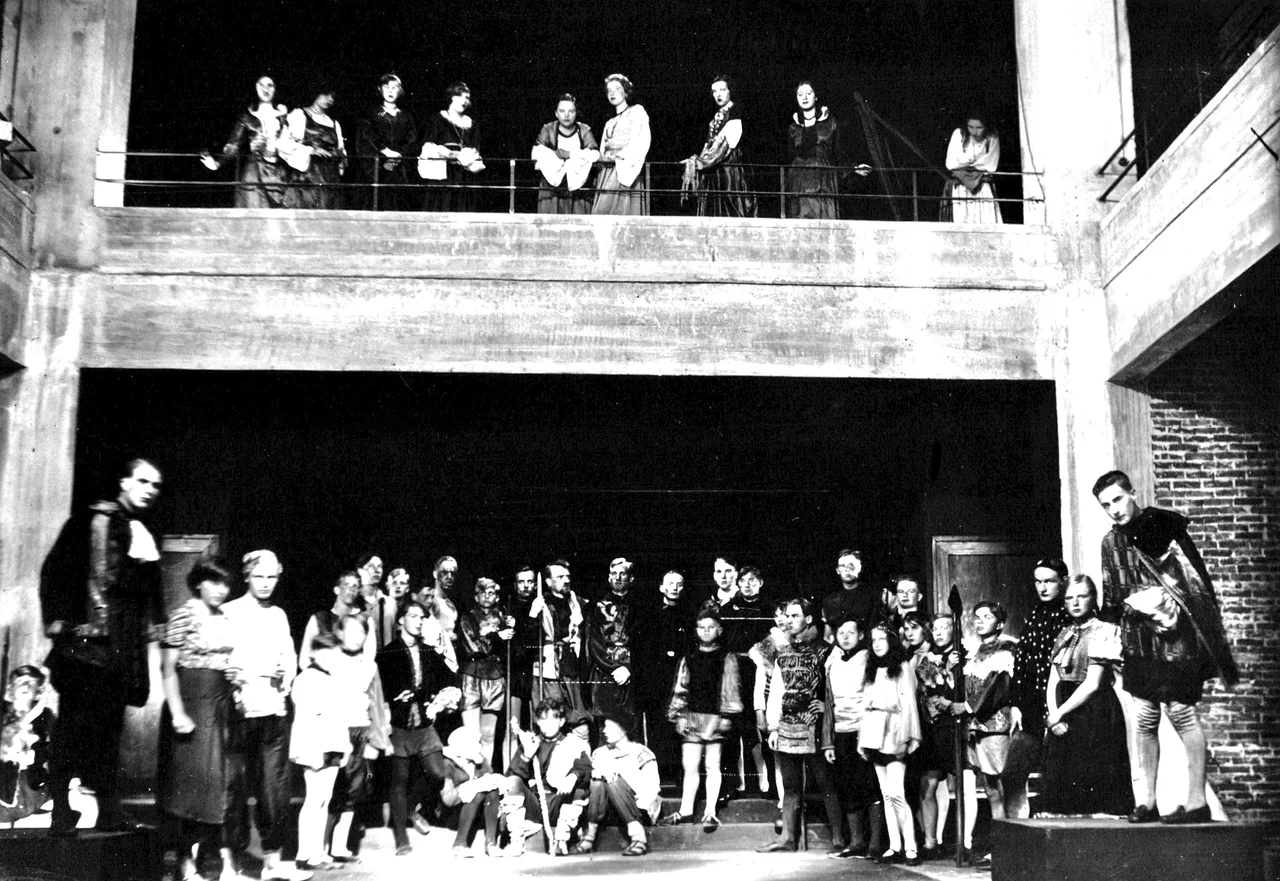

Schule am Meer
In May 1925, on the windswept East Frisian island of Juist, a German educator named Martin Luserke opened a school with ideas that would have raised eyebrows in any major capital - and certainly did on the staid German mainland. Boys and girls would learn together. Teachers would be addressed by nicknames and considered first among equals. Students would help shape the lessons. Plays would be performed in three languages. Comradeships called Bears, Bulls, Dolphins, Foals, Seals, Penguins, Pinnipeds, Vultures, and Wolves would mix ages and sexes across the entire student body. The school would be called Schule am Meer - School by the Sea - and for nine extraordinary years, it would be one of the most ambitious experiments in progressive education the Weimar Republic produced.
How to Build a School on a Sandbank
Luserke had been thinking about this school for years before he opened it. In 1924 he set up the Stiftung Schule am Meer, a private foundation whose board of trustees collected progressive thinkers across half of Europe. The Swiss educator Rudolf Aeschlimann. The Austrian painter Fritz Hafner. The Erfurt industrialist and art collector Alfred Hess. The sociologist Elisabeth Jaffé, née von Richthofen. The Nuremberg chemist Paul Reiner. Four of them - Aeschlimann, Hafner, Luserke himself, and Reiner - taught classes alongside running the institution. The Prussian state contributed some funding. The rest came from tuition, donations in kind, and the personal networks of the trustees. Robert Wichard Pohl, the Göttingen physicist, donated most of the school's musical instruments. Paul Reiner's wife arranged for a Steinway grand piano. The first students arrived in May 1925 to a campus built between the Wadden Sea on one side and the North Sea on the other - the first progressive school in Germany ever sited on an island.
The Theatre Hall That Should Not Have Existed
What set Schule am Meer apart from the other progressive German schools of the era - and there were several, including the Salem and Odenwaldschule of Kurt Hahn's circle - was the theatre. Luserke believed stage play was a fundamental educational tool, equal in weight to mathematics or biology. Plays were performed in German, English, and French, often with senior guest students brought in from England, France, and the United States specifically to deepen the languages. In 1930 and 1931, at the absolute bottom of the Great Depression, the school somehow raised the money to build a free-standing theatre hall on the island - the only German school in history to do so. The Berlin architect Bruno Ahrends, an S.a.M. parent, designed it. The hall was intended not just for performances but as a training facility for amateur play teachers throughout the German Reich. The school's orchestra and choir, both founded and conducted by the brilliant concert pianist and composer Eduard Zuckmayer, gained national reputation. Eduard's younger brother, the playwright Carl Zuckmayer, visited and collaborated. The stage hall and the dormitory building Arche - the Ark - are still standing on Juist, currently slated for demolition.
Equal Rights and Duties
The democratic structure of the school was the most radical thing about it. Students and teachers were considered equal in rights and duties. All members of the Schulgemeinde - the school community - participated in shared decision-making, treating the community itself as a kind of legislative council. The animal-named comradeships, each of about ten students of different ages and sexes, cut across class lines entirely. Each comradeship was led by a teacher addressed as primus inter pares, often by first name or a cheerful corruption of their surname. From grade 5 through grade 13, students worked toward the German Abitur graduation. Because the school was technically an open-air institution, parents of children with respiratory illnesses sent their sons and daughters there for the sea air. The Austrian mountaineer Ulrich Sild, from Vienna, was one of them; chronic asthma had defined his childhood, and he graduated at S.a.M. in March 1931. Six years later he died at twenty-six. The school placed equal value on science, art, and athletics. Its curriculum included visual and performing arts, sports, crafts, and gardening alongside the academic core.
Closed in March 1934
The school existed for nine years, from the beginning of May 1925 to the end of March 1934. The Nazis closed it - or rather, made its continued existence impossible. Several members of the Schule am Meer community were Jewish; many of the trustees, parents, and students were political progressives whose views were now criminalized. Students, parents, and teachers scattered to North America, South America, South Africa, Mandatory Palestine, Spain, France, England, and Switzerland. The board of trustees member Alfred Hess had already died in 1931. His son Hans, an S.a.M. student, would later become a museum curator in England. The student Beate Köstlin would later be known as Beate Uhse, the pioneering postwar entrepreneur. The graduate Felicitas Kestner became the composer Felicitas Kukuck. The graduate Walter Georg Kühne became a paleontologist. Eduard Zuckmayer, the school's beloved musician, eventually emigrated to Turkey and became one of the founders of music education in the Turkish Republic. Each of them carried the memory of an island school out into the world. Almost a century later, those memories are still cited as evidence of what German education could have been before it was made to be something else.
From the Air
Coordinates 53.68°N, 6.96°E, near the western end of the island of Juist in the German East Frisian chain. The two surviving Schule am Meer buildings - the Arche dormitory and the theatre hall - are situated near the village of Loog, west of the main Juist settlement. Recommended viewing altitude 1,000-2,500 ft. Juist itself is car-free, and the historic school grounds sit between dunes facing the North Sea and the polders facing the Wadden Sea. Nearest airports: Juist's own grass strip (EDWJ), with FLN Frisia Luftverkehr flying in from Norden-Norddeich (EDWY). The light along the Frisian coast is famously soft and watery; cold winter afternoons give the cleanest visibility.
Nearby Stories
- East Frisian Islands 4.2 km away
- HVDC DolWin2 4.7 km away
- Sandwater 8 km away
- Zoutkamp 11 km away
- Delfzijl 12 km away
- Tiefwasserreede 13 km away
- Schiermonnikoog National Park 24 km away
- Gemini Wind Farm 25 km away