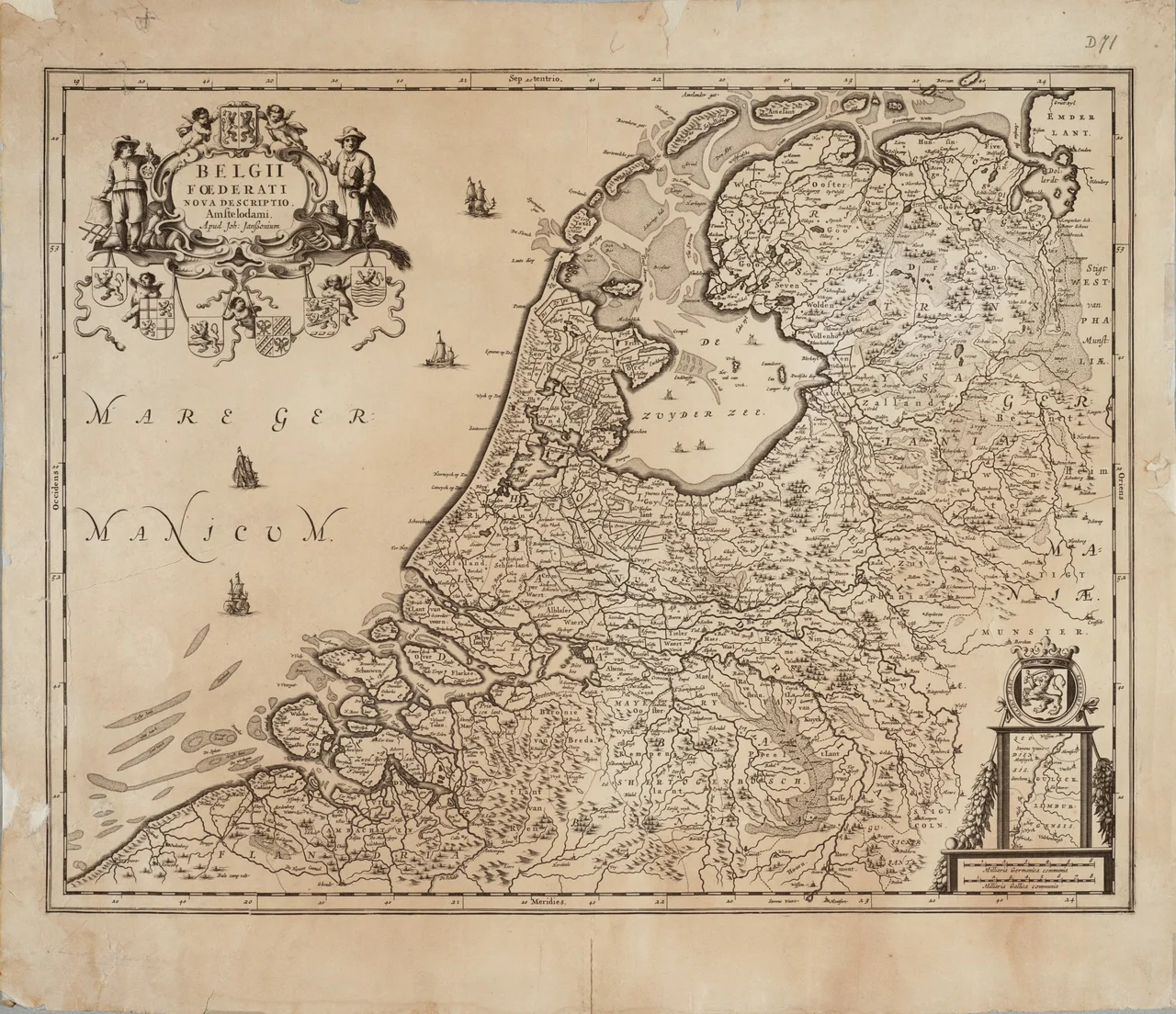

Northern Netherlands
Every winter, as the first real cold settles over Europe, the entire country starts watching the ice. The question on everyone's mind is whether the Elfstedentocht - the eleven-city tour - can finally be held again. It is a single ice-skating route, just under 200 kilometers long, that links eleven historic Frisian towns by frozen canal. It was last skated in 1997. If the natural ice ever holds again, the resulting event would be, by some estimates, the largest single gathering in the history of the Netherlands. The Northern Netherlands - Friesland, Groningen and Drenthe - is the corner of the country that this anticipation belongs to. It is a region the rest of the Dutch consider remote and that visiting foreigners barely consider at all. That is partly why it stays so interesting.
Three Provinces, Three Characters
The north is not one place. Friesland is wide meadow and water, with twenty-four interconnected lakes ideal for sailing and a language - Frisian - that sits somewhere between Dutch, English and the Scandinavian tongues. Groningen has the region's only true city, a lively university town of about 230,000 with a famous modern art museum and the soaring Martini tower at its center. Drenthe is the odd one out. Where most of the Northern Netherlands is flat polder, Drenthe lies on a low plateau of heath and forest, dotted with prehistoric dolmens called hunebedden. Outside the cities, life moves at a different speed. Retirees from the crowded west move here for the quiet; young people often move the other way, looking for work. The result is a population that ages thoughtfully and a landscape that stays uncrowded.
The Wadden and the Islands
The northern coast of the Netherlands is not really a coast. It is the southern shore of the Wadden Sea, a shallow tidal expanse stretching east into Germany and Denmark. At low tide, large stretches of seabed surface. A peculiar local sport called wadlopen - mudflat hiking - has grown up around this fact: under a licensed guide, walkers cross the exposed mudflats from the mainland near Pieterburen or Holwerd to one of the West Frisian Islands. It is wet, slow, occasionally dangerous and unlike anything else in Europe. The islands themselves - Texel, Vlieland, Terschelling, Ameland, Schiermonnikoog - have been Dutch holiday country for generations. Texel is famous for its mutton; Pieterburen, on the mainland, runs a rescue center for seals that wash up sick or orphaned. The Wadden Sea is a UNESCO World Heritage site for good reason.
Bourtange and the Fortified Past
Inland, the Northern Netherlands carries an unusual concentration of fortified towns. Bourtange, in southeast Groningen near the German border, is the most spectacular: a star-shaped fortress built in 1593 to defend against Spanish armies, abandoned in the nineteenth century, then meticulously restored to its eighteenth-century appearance. From above it looks like a geometric diagram laid into the polders. The Fraeylemaborg near Slochteren survives as a manor-house museum. Appingedam, a small town in northeast Groningen, is famous for its hanging kitchens - timber-framed rooms cantilevered out over the canal that runs through town. Franeker, in Friesland, owns a working eighteenth-century orrery built into the ceiling of a wool-comber's living room. These are the kind of sights that travel guides discover slowly and that locals tend to assume the rest of the world already knows about.
What People Drink
Beer is everywhere in the Netherlands, but the north has a quieter specialty. The province of Groningen is home to Hooghoudt, one of the country's largest distillers, founded in 1888 and still producing a wide range of jenever, bitters and gins. The regional drink of choice is berenburg, a herbal liqueur built on Dutch gin and a recipe that originated in Amsterdam but found its devoted audience here. Sonnema Berenburg, in Friesland, and Weduwe Joustra each have their followers. A Dokkumer coffee is the local answer to an Irish coffee: hot coffee, berenburg and whipped cream, served on a cold afternoon when the wind is doing what the wind does on the polders. The West Frisian Islands keep their own bitters - Juttertje on Texel, Schylger Jutters-Bitter on Terschelling. Fladderak, a less common liqueur flavored with lemon and cinnamon, hides on the back shelves of older bars.
Slow Travel by Design
The Northern Netherlands has more than sixty train stations, most of them small, several unstaffed. Trains run via Zwolle to and from the rest of the country, with two intercity services an hour north to Leeuwarden and Groningen. Buses fill in everywhere else. But the real way to see the region is by bicycle. Flat terrain, an unmatched network of dedicated bike paths, ready-made themed routes in every tourist office, and roads that are typically far less crowded than those in the western Randstad - all of it conspires to slow visitors down to the speed the landscape rewards. You ride past meadows of black-and-white cows and past windmills that are still functioning, not props. You stop in villages for coffee and cake. By the second day you stop checking the clock. That is the design feature, not the bug.
From the Air
The Northern Netherlands occupies the country's top right, from roughly 52.7 degrees north up to the Wadden Islands at 53.5 degrees, between about 4.7 degrees east on the Frisian coast and 7.2 degrees east at the German border. From cruising altitude the region reads as a green-and-blue grid of polder and canal, broken in the southeast by the darker forest and heath plateau of Drenthe. The string of West Frisian Islands traces the northern edge above the broad mudflats of the Wadden Sea. The A7 motorway crosses the Afsluitdijk causeway from North Holland into Friesland; the A28 runs north from Utrecht to Groningen. Nearest airport: Groningen Airport Eelde (EHGG) sits just south of Groningen city, with international scheduled service to Copenhagen, London and Gdansk. Bremen Airport (EDDW) lies about an hour east across the border. Recommended viewing altitude 5,000 to 10,000 feet to take in the contrast between the flat northern polders and the wooded Drenthe plateau.
Nearby Stories
- Hoogeveen 3.2 km away
- Onstwedde 4.2 km away
- Wetsinge 4.7 km away
- Abe Lenstra Stadion 5.2 km away
- De Zwaluw, Burdaard 7.4 km away
- Dollart 8.7 km away
- Twist, Germany 11 km away
- IJssel 19 km away