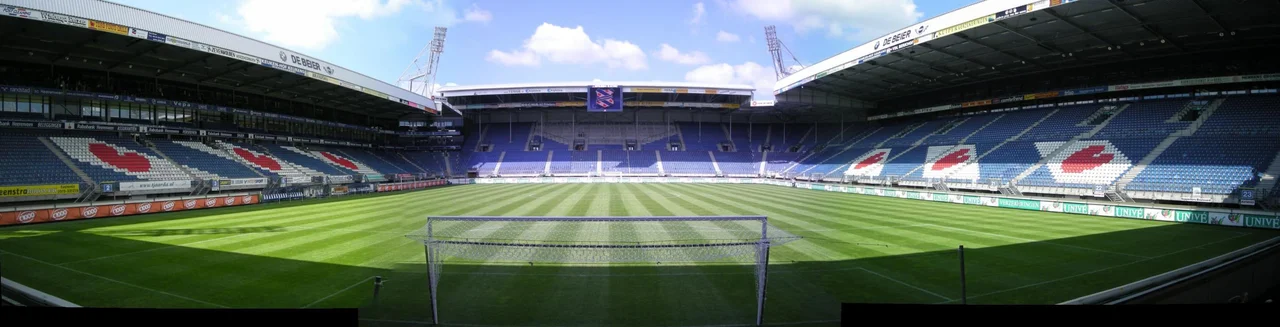

Abe Lenstra Stadion
Abe Lenstra died on September 2, 1985, at sixty-four years old. The next day, on the community sports park named for him in Heerenveen, an international football match was played. It was the only international that ground would ever host. The man who joined the local club at fifteen and scored 700 goals across roughly 730 matches over a career that spanned almost three decades did not live to see his name on a kick-off. Nine years later, on the same ground, the modern Abe Lenstra Stadion would open, and the symbolic first kick would be made by a future king of the Netherlands.
The Boy Who Stayed
Abe was born in Heerenveen on November 27, 1920, and he stayed. He joined SC Heerenveen at fifteen and played there for nearly seventeen years before finally leaving for SC Enschede in 1954. In 1960 he made a transfer the locals must have found delicious, jumping to SC Enschede's archrival, Enschedese Boys, where he played until he was forty-two. Most footballers retire long before that age. Most footballers do not score 700 goals. In a country whose elite club football was still semi-professional through much of his career, Lenstra was a phenomenon, and in Friesland he was something more: the local boy who became great without ever quite leaving.
Building a Stadium in the Polders
Construction began in 1993. The original plan called for a stadium with open corners, the classic European arrangement that lets wind move through the bowl, but partway through the build the club changed its mind and closed the gaps. When the doors opened on August 20, 1994, capacity was about 14,500 seats. The opening ceremony brought Prince Willem-Alexander, the future king, who took the symbolic first kick. The first real match was Heerenveen against PSV Eindhoven, and PSV brought a young Brazilian striker who had never played a competitive match in Europe before. His name was Ronaldo. He scored, of course.
Growing With the Club
As SC Heerenveen climbed the Eredivisie table through the late 1990s and 2000s, the stadium grew with them. The 2002 expansion nearly doubled capacity to 26,100. Empty corners were progressively filled in. By the early 2010s, the waiting list for season tickets had pushed the club to plan a jump to 32,000 seats, ready for the 2012-13 season. That expansion was judged too risky and was shelved. A smaller 29,000-seat plan for the summer of 2012 fell to the economic downturn. The capacity today sits at 27,224, which makes it one of the larger venues in the Dutch top flight but still small enough that the supporters in their orange and blue feel close to the pitch.
A Bid That Went East
The stadium was named one of five Dutch venues in the joint Belgium-Netherlands bid for the 2018 FIFA World Cup. Had the bid succeeded, the Abe Lenstra would have been expanded to FIFA's minimum 44,000-seat requirement. In December 2010, FIFA awarded the tournament to Russia instead. The club, anticipating the announcement, had already postponed its next expansion. The other Dutch host cities in the bid spread across the football map: Amsterdam, Rotterdam, Eindhoven, Enschede. In 2024, the stadium got a different kind of major tournament when it was selected to host a match in the UEFA Women's Nations League Finals, a smaller stage than the World Cup but a real one, and one Abe himself, the small-town striker who outscored everyone, would surely have approved.
From the Air
The Abe Lenstra Stadion sits at 52.96N, 5.94E on the southern edge of Heerenveen in Friesland. From 3,000 to 5,000 feet the white-roofed bowl is clearly visible against the green polderland, with the A32 motorway running close by. Drachten Airport (EHDR) is roughly 25 kilometers northeast for general aviation; Groningen Airport Eelde (EHGG) and Lelystad (EHLE) sit further out. The flat Frisian landscape and the patchwork of canals around the city make this an easy place to find from altitude.
Nearby Stories
- De Steenhuistermolen, Stiens 1.5 km away
- Bovenkarspel 4.1 km away
- Pinksterlanddagen 5.1 km away
- Afsluitdijk 7.1 km away
- Hoogeveen 9.5 km away
- De Marne 10 km away
- Holmes's Bonfire 12 km away
- Urk 16 km away