.jpg)
De Marne
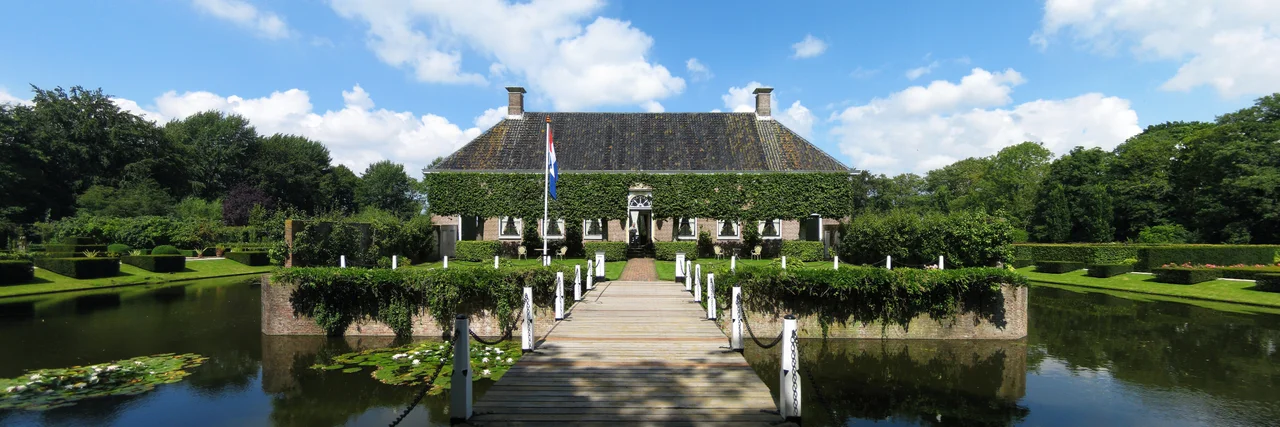
Spanish tradition gives the statue of the Virgin Mary a white handkerchief in her hand to catch her tears. At the hermitage in Warfhuizen, in what used to be the municipality of De Marne, the practice has been adapted into a strange and lovely transaction. Pilgrims bring a new white handkerchief. They give it to the hermit, who swaps it with the one the Virgin has been holding. The used handkerchief - now touched by the statue's hand - is given to someone who is sick or lonely, or carried by a student to a difficult exam. The hermitage sits in a village of a few hundred people, in farmland that used to be tidal flats, in a former municipality that no longer exists.
A Municipality Lasted 29 Years
De Marne was created in 1990 by merging four smaller municipalities - Eenrum, Kloosterburen, Leens, and Ulrum - into a single administrative unit with about 10,000 inhabitants spread across 21 villages and 240 square kilometres of the northwestern Groningen coast. The local government employed around 115 people. On 1 January 2019 it was dissolved again, folded into a much larger municipality called Het Hogeland along with Bedum, Eemsmond, and Winsum. The map keeps the villages. The signs on the council buildings have all been replaced. The name De Marne survives as a regional identity - it appears on the spelt-bread labels and the tourism brochures - and as a habit of speech for anyone who lived there before the merger.
Salt Water Turned to Pasture
The most dramatic change to the De Marne landscape in living memory happened in 1969, when the Lauwerszee - a large salt-water inlet of the Wadden Sea - was sealed off from the open sea by a dike. The result is the Lauwersmeer, a 90 square kilometre body of water that began as a coastal estuary and is now a freshwater nature reserve. Salt retreated slowly from the soil over decades. Wetlands emerged where mudflats had been. The area is now a destination for fishing, birdwatching, walking, and cycling, with the village of Lauwersoog at the seaward end serving as a small harbour. Stand on the dike that closed the Lauwerszee and you are looking at one of the rare cases in Dutch hydraulic history where an act of engineering created a landscape almost overnight.
The Wierde Villages
Before dikes, the only way to live in this country was to build upward. The Frisians who settled the Groningen coast piled clay into artificial dwelling mounds called terps (or wierden in the local dialect), and built their houses and churches on top. When the North Sea storms came, the mound stayed dry. Drive through De Marne today and you can still read the geography of fear: villages like Hornhuizen and Westernieland sit visibly higher than the fields around them, with church towers crowning the rise. Eenrum, Pieterburen, Wehe-den Hoorn, Kloosterburen - 21 villages in all, many of them with listed heritage farmhouses and protected village centres. The Borg Verhildersum in Leens is a small fortified manor house with surrounding farmland. The seal creche in Pieterburen takes in injured Wadden Sea seals. Abraham's Mustard Museum in Eenrum is exactly what it sounds like.
Maren and Church Organs
De Marne is laced with maren - narrow waterways that twist through the countryside, originally cut for drainage and now used for recreational sailing and canoeing. The municipality marketed itself as a network of footpaths, cyclepaths, and water routes connecting all the villages. The area also has an unusual concentration of important historical church organs. Builders including Arp Schnitger - whose surviving Groningen instruments are central to the European baroque organ tradition - left work in churches across De Marne, alongside organs by the Lohman family and by Hinsz. For a region whose population never exceeded 10,000, that level of musical patronage is striking. A 'Spelt Project' coordinates local farmers, millers, bakers, upholsterers, and distillers to produce spelt grain, flour, bread, gin, and cushions stuffed with spelt husks - one of those small-scale rural economies that thrives quietly on the edge of nowhere.
People Who Came From Here
Sicco Mansholt was born in Ulrum in 1908. As Dutch minister of agriculture after the war, then as European commissioner for agriculture from 1958 onward, he designed the Common Agricultural Policy that still shapes European farming subsidies six decades later. He served briefly as president of the European Commission. Hendrik Nicolaas Werkman, born in Leens in 1882, became an experimental Dutch artist, typographer, and printer; he was killed by the SS in 1945, just before the liberation. Cornelis Simon Meijer, born in Pieterburen in 1904, became a mathematician whose Meijer G-function is taught in graduate analysis courses worldwide. Freek de Jonge, born in Westernieland in 1944, became one of the most prominent Dutch cabaret performers and writers of the late twentieth century. Four large lives from four small villages, on a coastal strip that the rest of the Netherlands rarely thinks about.
From the Air
De Marne sits in the northwestern corner of Groningen province at 53.35 N, 6.37 E, on the south shore of the Wadden Sea. Groningen Airport Eelde (EHGG) is about 35 km southeast. From low altitude on a clear day, the area is recognizable by the long Lauwersmeer body of water on its western edge, the dike line of the Wadden Sea coast to the north, and a scatter of villages on visible wierde mounds above flat farmland. The Pieterburen seal creche and the Borg Verhildersum manor in Leens are local landmarks. The Marian hermitage stands in Warfhuizen, near the centre of the former municipality.
Nearby Stories
- Spinnenkop Wedderveer 2.5 km away
- Rysum Organ 3.3 km away
- Miedenmolen, Holwerd 3.9 km away
- Tynaarlo 6.4 km away
- Prinses Margriet Canal 10 km away
- Norderney 13 km away
- Schule am Meer 31 km away
- Gemini Wind Farm 47 km away