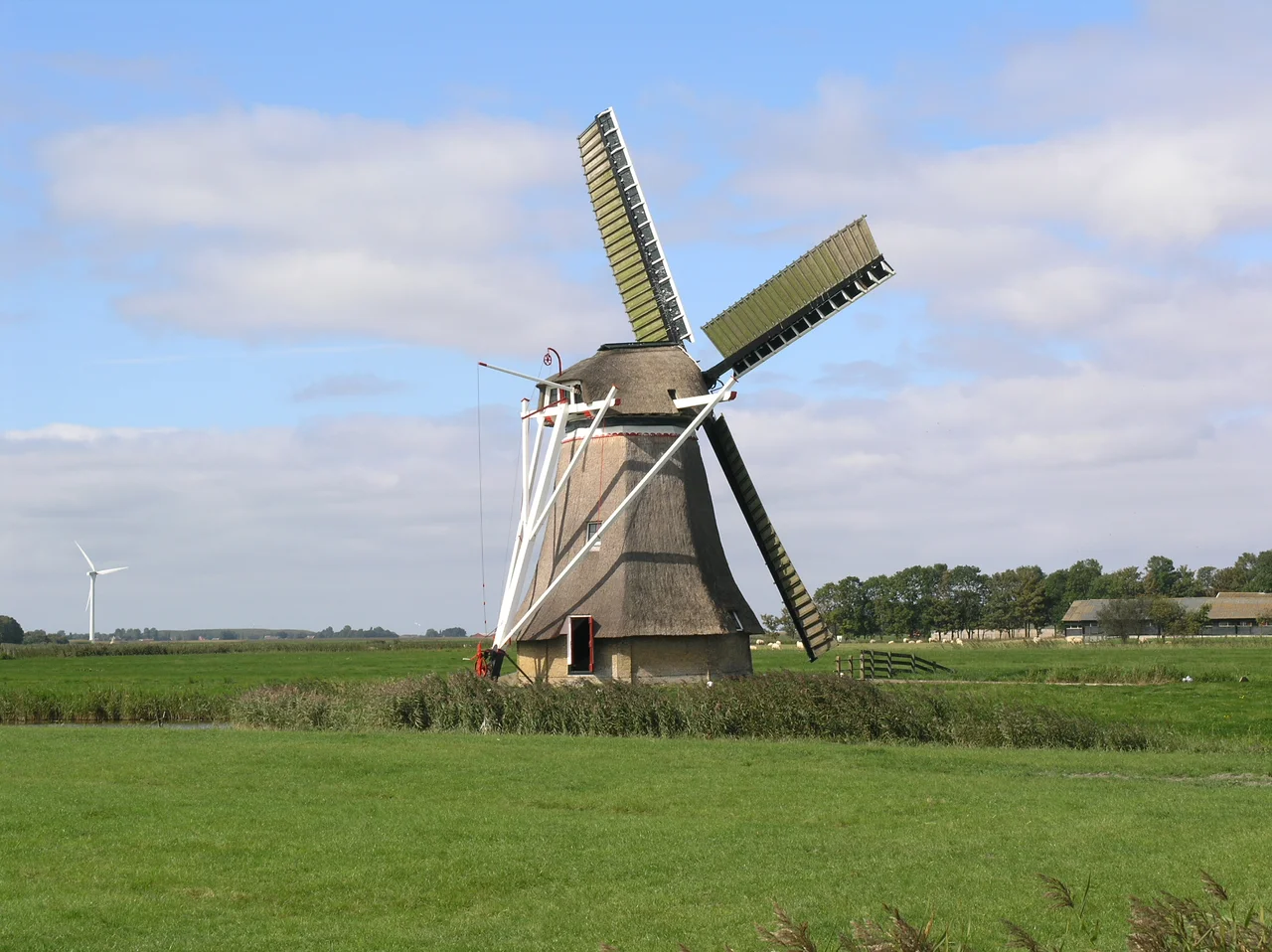

Miedenmolen, Holwerd
Most polder mills move a modest amount of water. The Miedenmolen, on the salt-marsh edge of Holwerd just inland of the Wadden Sea, moves a lot. Each revolution of its Archimedes' screw lifts 1,667 litres - roughly six times what its smaller cousin De Steenhuistermolen down the coast can manage, and almost an order of magnitude more than the smallest grondzeilers in the region. The screw is 1.70 metres across and nearly six metres long. The mill that drives it has been doing the job, off and on, since 1855.
Made for the Dwergsmear
The Dwergsmear Polder sits behind the sea dikes of the northern Frisian coast, in country so low and so wet that without active pumping it would simply revert to marsh. The mill was built in 1855 to drain it. Like De Steenhuistermolen, the Miedenmolen is a grondzeiler - sails reaching almost to the ground, no working stage, no gallery - but its three storeys make it noticeably taller than its smaller relations, and the longer sail-span gives it more torque. The smock and cap are thatched, the cap rotated to face the wind by a tailpole and winch reaching down to the polder grass. The mill type is built for one purpose: lift water continuously, in whatever weather offers itself.
Patent Sails and a Foundry in Groningen
What separates the Miedenmolen mechanically from the older polder mills is its sail system. The four Patent sails, span 20.80 metres, use hinged shutters that the miller can adjust without climbing out into the wind - a technology that dramatically extended the usable hours of any mill so equipped. The cast-iron windshaft carrying the sails was poured in 1904 by De Munck Kiezer, the foundry at Martenshoek in Groningen province, and the date is visible in the casting. The shaft drives a brake wheel with 57 cogs, then a wallower with 29, then down a vertical shaft to a crown wheel of 44 cogs meshing with a 43-cog gearwheel on the Archimedes' screw axle. The numbers do not quite reduce; the gearing is set for steady, slow torque rather than speed.
A Polder Mill in the Electric Age
By 1953 the regional water board had decided the mill should be fully mechanised - electric pumps were doing most polder drainage by then, and a wind-driven mill was hard to justify on pure economic terms. Meetings on 27 December 1961 and 13 March 1962 worked out a compromise: an electric motor was installed to assist the mill, but full mechanisation was set aside. The wooden gears and the iron windshaft kept turning. The mill was restored in 1966 to bring it back to good condition. In 1976 the water board sold the mill to the Stichting De Fryske Mole, the foundation that has rescued so many Frisian mills, and it has remained in the foundation's care ever since.
Thijs Jellema and a New Screw
Two further restorations followed: one in 1978 and another in 1994. The 1994 work was carried out by the millwright Thijs Jellema of Birdaard - the neighbouring village known today as Burdaard - a name that reaches across more than a century of Frisian mill craft. In 2004, the original wooden Archimedes' screw was replaced with a steel one, sized to match the original at 1.70 metres in diameter and 5.82 metres long, inclined at 19.7 degrees. The steel screw lifts the same 1,667 litres per turn that the wooden one did, but should not rot. In 2006 the mill was officially placed in reserve - retained for emergency drainage if the electric pumps fail. The polder is dry today because of pumps. The mill is a backup older than the pumps it backs up.
On the Edge of the Wadden
Holwerd lies on the very edge of the Wadden Sea, the tidal flats that stretch from the Netherlands into Germany and Denmark. The ferry to the island of Ameland leaves from here. The land behind the dike is so flat that the Miedenmolen stands as the tallest object for kilometres in every direction, its silhouette visible from the sea wall when the weather is clear. Three centuries of polder engineering laid down the patchwork of fields around it - drained, redrained, gridded with ditches. The mill is one knot in that long quiet pattern, the kind of structure built by people who knew they were borrowing land from the sea and wanted to be sure the sea did not ask for it back.
From the Air
Located at 53.341°N, 5.919°E on the coastal polder of Holwerd, less than 2 km inland of the Wadden Sea dike. From 1,500-3,000 ft AGL the mill is unmistakable - the tallest vertical in flat reclaimed land, with the Ameland ferry pier on the coast just north. Look for the geometric grid of the Dwergsmear Polder ditches converging on the mill site. Nearest airports: Leeuwarden Air Base (EHLW) about 20 km southwest, with general aviation at Drachten Airfield (EHDR) 35 km south. Strong sustained northwesterlies off the Wadden Sea - this is wind country, and the reason the mill was built where it was.
Nearby Stories
- Prinses Margriet Canal 1.7 km away
- De Marne 2.6 km away
- Maritime Institute Willem Barentsz 3.3 km away
- Northern Netherlands 5.1 km away
- Afsluitdijk 12 km away
- Schule am Meer 42 km away
- Gemini Wind Farm 48 km away
- West Sole Gas Field 272 km away